

When Israel destroyed Gaza’s courts, legal protections for women vanished
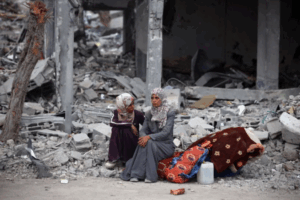
Palestinian women in Gaza City, 12 October 2025
Shojaa Al-Safadi reports in Mondoweiss on 14 April 2026:
When S.Y. returned to where her home once stood, she could not find a single wall to recognize it by. The street had caved into dust and gray cement. What caught her attention first was the silence, no voices, nothing moving around. Smoke and dust from broken concrete filled the air. Homes had fallen into each other, as if the neighborhood had collapsed inward.
She began searching for something familiar, any trace that this had once been her home: a doorway, a wall, a piece of furniture. There was nothing intact, only fragments buried under rubble.
“When I went back, my house was finished,” she said. “I lost my husband, I lost my kids, I lost my house. I came back and there was nothing. Not even the walls. And I was not even left with the slightest personal belonging or a government document to prove my rights.”
More than 16,000 women in Gaza have lost their husbands since October 2023, leaving 1 in 7 families now led by a woman. On December 4, 2023, the Israeli army released a video showing the demolition of Gaza’s main courthouse, one of several judicial institutions destroyed across the territory as part of Israel’s broader campaign of targeting judicial and law enforcement institutions and personnel, with the objective of facilitating social collapse.
For women like S.Y., the consequences of this social collapse has stripped her of any means of asserting her rights through legal recourse, given the decimation of the legal system’s ability to adjudicate family affairs. The legal vacuum has left hundreds of thousands of women unable to claim inheritance, formalize a divorce, retain custody of their children, or obtain documented protections under Palestinian personal status law. For these women, the killing was not the end of what Israel took from them.
‘There is nothing I can do to get my rights’
S.Y., 33, agreed to speak to Mondoweiss on the condition of anonymity for fear of repercussions from relatives. She comes from east of al-Bureij refugee camp but is currently sheltering in her sister’s home in al-Nuseirat. Before the war, she described her life with her children as “ideal, happy, full.” Her daughter was the one she felt closest to.