

What the Joint List’s revival signifies for Palestinian politics in Israel
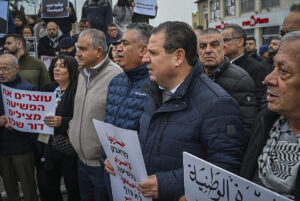
Palestinian citizens of Israel, including Hadash party head Ayman Odeh, hold a mass demonstration against the epidemic of criminal violence and state neglect, Sakhnin, northern Israel, 22 January 2026
Abed Abou Shhadeh writes in +972 on 28 January 2026:
For Palestinians inside Israel, last week proved to be a collective breaking point. It began when Ali Zbeedat, the owner of a grocery store chain in the northern city of Sakhnin, shut down his businesses last Monday to protest an extortion attempt by criminal gangs. Over the following days, Zbeedat’s defiant act sparked coordinated strikes across dozens of Arab localities, where residents are similarly fed up with their abandonment by the state in the face of an epidemic of organized crime.
The escalation culminated in a mass demonstration in Sakhnin last Thursday [22 January], with an estimated 50,000 people taking to the streets in what was the largest mobilization of Palestinian citizens in years.
This sequence of events generated exceptional political momentum. Just hours after the demonstration, amid sustained public pressure, the leaders of Israel’s four major Arab-led parties — Hadash, Balad, Ta’al, and Ra’am — met with the heads of local authorities and signed a brief, symbolic document bearing the logo of the Sakhnin Municipality. In it, they expressed their intention to revive the Joint List ahead of this year’s election, the historic electoral alliance formed 10 years ago that aimed to overcome the ideological divides and interpersonal rivalries among the community’s fragmented leadership, but broke down in 2022.
This is a historic event in a volatile political moment. Even before the publication of polls gauging the Joint List’s electoral strength — predicting that it could secure 15-16 of the Knesset’s 120 seats, making it the third largest force in Israeli politics — the popular demand for unity suggests the possibility for unprecedented voter turnout in Arab society.