

What it’s like to survive in Gaza when your children are killed
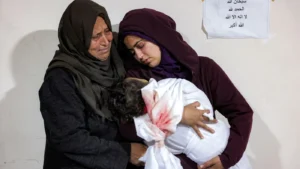
A Palestinian mother cradles the body of her daughter Ibtissam Elyan, who was killed when an Israeli air strike hit the family home in Beit Lahia in the northern Gaza Strip on 25 March 2025
Ahmed Abu Artema writes in Middle East Eye on 24 December 2025:
The human tragedies caused by Israel’s ongoing genocide in Gaza are countless. Nearly two million Palestinians are living through pain and grief, and every family carries its own story of devastation, amid horrific massacres and the destruction of homes.
For a mother, the death of a child is a heartbreak that lasts a lifetime. In Gaza, it has reached an unprecedented and unimaginable scale. Death has not come one by one, but in batches. On 24 May, Dr Alaa al-Najjar, a paediatrician, lost nine of her children in a single Israeli air strike. Her home was bombed while she was at work in Nasser Hospital in Khan Younis, trying to save the wounded.
No words are sufficient to capture what these mothers have endured. Yet some, whose children were killed by Israel, have chosen to share their stories. I bring together the accounts of four mothers, drawn from direct conversations and words they shared publicly on Facebook.
Their experiences offer only a glimpse of the overwhelming catastrophe families across Gaza have faced since October 2023.
Buried alive
The poet Alaa al-Qattrawi lost all four of her children at once, under horrifying circumstances. On 13 December 2023, Alaa was at her family’s home in central Gaza, while her children were staying with their father in Khan Younis. When the Israeli army invaded the city and arrested their father, the children were left trapped with their grandmother.
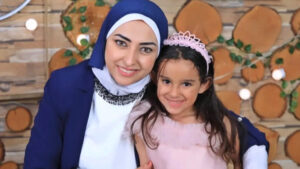 Alaa’s daughter, Orkida, managed to call her mother, pleading for help. She said they could not leave the house because Israeli snipers were surrounding it. Soon afterwards, Israeli soldiers confiscated the mobile phones in the house, cutting off all contact between Alaa and her children for four months. Later, news arrived that Israel had destroyed the house where the children had been sheltering.
Alaa writes, addressing her daughter Orkida: “I can’t imagine that your soft body and your beautiful hair are under the rubble of a three-storey concrete house. I don’t want to imagine that. But I still remember your voice before the connection was cut off, telling me that you would wait for me to get you out of there, and that you were taking care of your little sister, Carmel.”
In April 2024, after the Israeli army withdrew from Khan Younis, the truth was confirmed. The four children had been killed: Yamen, eight; the twins Kinan and Orkida, six; and Carmel, three. Their bodies remained under the rubble for four months, with no one able to reach them.
Reflecting on giving birth to her children, Alaa describes the fine surgical stitch left by her caesarean sections. For years, she said, she hardly noticed it. But after losing her children, it became a constant source of pain.
She writes: “I would often forget about it. I hardly ever noticed that fine cosmetic thread at all. But now, I feel it and see it often. I can truly look at it, and it has begun to affect me. It hurts my heart, my liver, my soul, and even aches with every breath I take, between inhaling and exhaling. No one ever told me that this fine thread in my body would remind me every minute that you gave birth to a boy, a girl and twins, beautiful children, and then you were left alone.”
Alaa later addresses her children directly:
Before you had notebooks and school bags, a special hairstyle and particular perfumes you loved, coloured pencils and rough drafts, a notebook for notes and a secret diary; before you had your own tastes in food – dishes you loved and later refused, and dishes you once refused and later came to love; certificates and photographs to hang on the wall, a corner you preferred, and a special cup for your favourite drink; novels and books of poetry and bookmarks; prescription glasses and sunglasses; private thoughts and spiritual inclinations, experiences of consciousness and the unconscious; letters, beloveds, friends, and music whose melodies you would keep whenever the heart grew tender; and a Qur’anic surah with its own special resonance in your moments of reflection – Israel took all of this from you and gave you four graves instead.
After a ceasefire was announced in October 2025, Alaa observes: “I cannot believe that the war has stopped, but I can believe that the occupation is a monster, and that humanity is its favourite prey.”