

‘We’re engaged with the cultural boycott of Israel and not with the question of why there is a boycott’
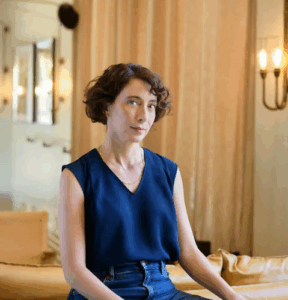
Ayelet Gundar-Goshen
Gili Izikovich writes in Haaretz on 10 December 2025:
A few years ago, a young Palestinian construction worker was doing renovations in author Ayelet Gundar-Goshen’s Tel Aviv home, including when Gundar-Goshen was nursing her then-infant son. It put her on edge that a strange man with a hammer was moving around the house; this made her feel embarrassed.
To hide both of these emotions, Gundar-Goshen put on a hospitality act. She made coffee and arranged cookies on a pretty platter and turned on the radio to soften silences in the conversation, but then a report came on the television about an Arab worker stabbing his Jewish employer. Until that moment, she recalls, she was not sure how good the worker’s Hebrew was, but she gathered that he understood the report based on his reaction. The atmosphere in the house, which until that moment had been polite, suddenly became loaded. A sense of fear arose. Neither touched the coffee or cookies.
“I was scared, and there was a moment when I realized that he too was afraid of me,” says Gundar-Goshen. “That man in my living room glanced a lot at me to figure out what I was going to do. Would I call the contractor who brought him to come and pick him up? Would I call the police and tell them I suspect that there is an illegal resident here in my house and to come check his ID papers?
“… This was a fraught situation, and in the middle of it was my son, a plump and smiling baby, happy. As far as the baby was concerned, there was someone else in the house to admire. There were three of us in the room: two of them completely fleeing from each other and one of them unaware.”
Gundar-Goshen adapts this situation in the gruesome opening chapter of “Guests,” her recently released novel (Achuzat Bayit Books, edited by Shira Hadad). It takes place in a new apartment with a mother, a nursing baby and an Arab worker who is using his tools to install a balcony railing. The mother’s tense alertness and the discomfort she is trying to blur through performative kindness reverse like a horror film.
One moment of inattentiveness leads to a rolling disaster, a violent event in which everyone understands who to blame. The mother’s decision not to tell the whole truth immediately leads to a shift in fate, relationships of vengeance and escape, and to guilt that is hard to shake off again and again. Throughout the book, in each relationship’s dynamic, it is not clear who the attacker is and who the victim is, who should be afraid of whom and who is actually dangerous.
“The horror of the opening is almost a thriller, but the real horror is not the external fear. It’s the easiest thing to say there is a monster here outside, and it’s the most complicated to say that the horror is not the encounter with the other, but: Who I am in this encounter, who do I become when I am afraid?” the author explains. “For all the characters in the book, the question arises, ‘am I the victim here?’ because we are accustomed to always seeing ourselves as the victim.”
Cycle of destruction
At the core of her fifth novel are a range of topics that manifest in Gundar-Goshen’s work as an author and in her main professional field – clinical psychology. Her interest in grey areas and morally ambiguous situations has led her to become one of the most internationally successful voices in contemporary Israeli literature.
“Guests” is an example of this success. It was published in early October in Israel after being released in Germany, Switzerland and Austria; it will soon be released in France and Italy. This success has characterized Gundar-Goshen’s writing since the very beginning of her career. Her first book, “One Night, Markovitch,” winner of the 2013 Sapir Prize for debut fiction in 2012, was based on historical cases in which people from Jewish settlements in pre-state Palestine were sent to Europe on an organized mission to marry Jewish women and bring them to the Yishuv.

Covers of English editions of three of Ayelet Gundar-Goshen’s novels
However, protagonist Yaakov Markovitch refuses to release his beautiful wife by issuing her the divorce bill required by traditional Jewish law. The book was translated into nine languages and nominated for many international prizes.
Her second book, “Waking Lions” (2014), followed a doctor who ran over an Eritrean refugee in hit-and-run accident and was subsequently blackmailed in a unique way by a Sudanese refugee who witnessed the accident. The bestseller was translated into 14 languages and NBC purchased the screen rights; The New York Times named it one of the 100 best books of 2017.
Blurring and ethical unclarity are also central to her 2018 novel “The Liar,” which was published during the heyday of the #MeToo movement. An unpopular girl encounters an aging reality show star whose glory days are behind him. An ugly incident between them is misunderstood as an attack, a conclusion the girl does not hasten to refute. The book has been translated into 11 languages and was adapted into a film in Russia.
In her fourth book, “Relocation” (2022), an Israeli family that has moved to California goes into a tailspin after the son is suspected of murdering a Black boy. The story combines a comfortable life, parental anxieties, Israeli militarism and social volatility, and ironically, thanks to the book’s success in the United States, Gundar-Goshen herself and her family were invited to spend a year teaching at Stanford University. She returned to Israel in early 2025.
In no situation and in no relationship in “Guests” is there certainty about who the sheep is here and who the wolf is. At the beginning of the book I suspected that it was going to go in the direction of leftist breast-beating.
“I consulted writer Dror Mishani about this book and he gave me good literary advice: ‘You have to be completely egalitarian with all your characters, to hate them and love them to the same extent. Anyone who feels differently concerning Israeli or Arab characters isn’t writing a book, but rather a manifesto.’ That stuck with me.
“… Reality doesn’t work like a Marvel movie. In reality, everyone is both a sheep and a wolf, and we love to tell a story in which we are the sheep – or, alternatively, ‘a nation like a lion.’ A lion is an animal we love to identify with, but in reality, we are the whole jungle, and you have to explore all the animals there.
“At university I knew someone who didn’t think at all about when he went to Africa to work at a security job as a story related to morality. He thought what fun it is for him – to pay for university, but also to fly to an exotic country and to do something he loves doing, to be a kind of ‘Tactical Rescue Unit 699 for hire.’
“…Only with time and between the lines did he understand: Why is Unit 699 [sent to African countries]? Because there were Israeli pilots who were training there. Whom were they training? The local air force. Why? Because the military there is bombing the rebels from the air. And then he discovers that they are taking down everyone who opposes the president there.
“…This is an Israeli community that we hardly talk about – young people who travel after they finish their military service to train in Africa: Border Police in Rwanda, Sayeret Matkal special ops people in Ethiopia, intelligence veterans in Canada. Some of the time they train in the midst of a civil war. … The community that develops in places like that interests me.”
‘We don’t have the right not to know’
The 43-year-old author and mother-of-three also engages with these questions in her personal life. She has always been politically active, but after October 7 – and a long stint of volunteering to aid Israelis displaced to an Eilat hotel from Gaza border communities – she became a permanent figure at protests to bring back the hostages, against the war and against Israel’s policy in the Gaza Strip.
Though “Guests” is ostensibly detached from the current events, it is impossible not to connect it to what is happening in Israel now. This is especially evident in the context of the psychological issues it deals with, mainly with regard to guilt and responsibility.
“I started to write this novel way before the war, and I have two contradictory thoughts about that,” says Gundar-Goshen. “On the one hand, literature is not a pack animal. It’s not a donkey for hauling your ideological load. On the other hand, this question pursues me at the personal level. I see a political dimension in this book. Since October 7, my thinking about writing has changed. I used to think about writing as an expression of passion for a story – there’s a kind of libido of a question that you have to dive into.

Protesters holding the letters for Boycott, Divestment and Sanctions outside Downing Street during a pro-Palestinian march in June 2025
“Today I think about literature also as an ethical activity. The fascist is afraid of words – look at the film ‘No Other Land’ and the reactions to it. The fascist will go to war to the death over a book, over a television series – like the war against the series ‘Our Boys.’ I understand that if fascists are so afraid of words, apparently words change something. They’re so afraid of works of art that look the truth straight in the eye, so it could be that this is what has to be done – writing works that do exactly that.”
On the other hand, again and again I found myself thinking about something that happens in the book and is connected, I think, to your identity as a therapist. Every character has circumstances. Even if you judge them, there is justification for every behavior. It’s a bit like how in therapy you improve the way a patient feels. But what if he should be feeling bad? Sometimes not judging someone is in itself moral crookedness.
“I think about that question a lot surrounding the phrase ‘moral injury.’ Many people suffer from PTSD symptoms in the context of moral injury – a situation in which you have done something contrary to your values. There is a lot of attention to treating moral injury, and many therapists who treat soldiers who are deeply troubled by things they have done. The discussion of therapy is a discussion that is impossible to separate from the ethical discussion. It’s clear that at the clinical and ethical level, we have responsibility: You’ve taken an 18-year-old kid, you’ve conscripted him, you’ve taught him to be a combat soldier and you have taught him that he must do what he’s told, so you as a state have responsibility for what happens to this kid after he has killed someone.
“The term ‘moral injury’ reduces us only to the therapeutic dimension, but if we talk about this only as a problem that the therapy has to solve, we are liable to ignore the big question: Why are so many people suffering from a disorder that stems from a person doing something that goes against their conscience, their moral values, and is now suffering because of that? Because after all nightmares, tremors and flashbacks – it’s possible to call this moral injury, and it’s also possible, in some cases, to call this pangs of conscience.”
Is it the job of psychologists in Israel to exempt people from their pangs of conscience? What is it like to help a person, a country, in a situation like this?
“There is moral injury in every war. It can happen even in the most moral war in the world, but it is obvious that there will be more injuries of this kind when you send more people, for long periods of time, to carry out missions in which there are more immoral and illegal orders.”
“… There is tremendous importance to mental fortitude at a time like this, but there are things you don’t have the moral right not to know. I understand this at the human level, people who can’t bear to see any more. And I too don’t always want to see, but there is ethical significance in not seeing, in cutting disengaging entirely. If the significance of fortitude is cutting disengaging from human responsibility, it’s impossible to accept that. More than that, something can be bad for an individual and a society in the short term, and in the long term will push for change. Relating to psychology as a means to feeling better is mistaken. There are things in our lives about which we shouldn’t feel better.
“Relating to guilt as a symptom that it’s necessary to release people from is something problematic. Because guilt is also a motor for change. Excessive guilt has lethal power, it suffocates – but we are a culture that is allergic to guilt. We just want to feel better about ourselves, and there is something unhealthy in that.”
Illegitimate cancelling
Gundar-Goshen learned extensively about the inability to observe reality and feel empathy beyond that given to the affinity group during the time she spent teaching at Stanford. Gundar-Goshen taught a course in the psychology department about narratives of trauma and recovery in art and therapy, and in that context she brought testimonies of survivors of the Nova festival on October 7. She relates how after the class, Jewish and Israeli students came up to her and thanked her for recognizing Israeli suffering – but a week later, she brought voices of Palestinians from Gaza. The picture was reversed.
“You see how the students who a week earlier came to say thank you looking at you in shock. And pro-Palestinian students who a week earlier had wriggled in discomfort were now prepared to listen. I said to them: ‘Pay attention to what is happening to us. We aren’t able to hear authenticated testimonies if they don’t match what we have already decided. The inability to hold on to both this and to that is as though someone has gone over our dictionary and erased all the conjunctions.
“There were people who warned us about coming to Stanford and being there as Israelis, but my experience was very good. On the other hand, ‘Guests’ is the only one of my books that doesn’t have a publication date in the United States. My publisher there said it’s economic suicide to publish a book by an Israeli writer when the American cultural world is boycotting anything Israeli, except nonfiction books about the occupation.”
This boycott is also being implemented by many writers, a lot of them Americans, who chose not to publish their books in Israel.
“Throughout history, dictators have been preventing the distribution of books so that the populace would not be exposed to ideas. Today it’s the writers themselves who are doing this voluntarily. Anyone who refuses to publish a book in Hebrew is preventing the citizens of Israel from being exposed to their ideas. There’s a big difference between opposing the government in Israel and refusing to see your book printed in Hebrew. … This cancellation is illegitimate in my view. The other side of this is that I feel that the discourse in Israel is very engaged with the boycott and not with the question of why there is a cultural boycott.
There are people who will tell you that boycotts are antisemitic.
“There are parts of the boycott movement that are antisemitic. That’s something you see in the United States, and of course this is not legitimate. But there are extensive parts of the cultural world where they didn’t boycott us during the war and previous operations – for example, festivals and places that were in contact with Israel throughout the years, despite the situation in the West Bank and Gaza. There is room to stop and ask what is happening now that people are saying they can’t.
“We are also not having a real discussion about this among ourselves. I’ve heard a lot of people who are saying: ‘We don’t want to boycott Israel, and the moment it goes back to being Israel and not the state of crazy messianism it is now, we won’t boycott.’
“I feel that for me, it’s very clear when the criticism is legitimate and is demanding an end to the war, and when the question is about the fact of the legitimacy of this country. It is impossible to accept the statement that because of the government or the occupation, Israel has no right to exist, and that you and I have no right to live here as Israelis. I’ve encountered people who tell me I have to go back to Europe, and this is upsetting. But to come and say yes to a Palestinian state, to stop the occupation, to return the hostages and to end the war, and to say yes to the State of Israel – that’s a position that can be discussed.”
“Are all of us Bibi? Because I am coming out against the argument that all Gazans are Hamas, and to me every sentence in which there is ‘all of them’ looks suspect. On the literary scene in the United States at the moment, there is no distinction being made between the people and the government, and this is not happening to any other country – not to Russian writers and not to Chinese writers. Ironically, this is collaboration with the other side.”
‘Our generation has to do something’
A few months ago, Gundar-Goshen shared her frustration in an article she published in the British Sunday Times dealing with the double boycott of the Oscar-winning film “No Other Land.”
On the right, the film was boycotted because of its depiction of Israeli violence against Palestinians in the West Bank. On the left, it was boycotted because the film was created with two Israelis. Gundar-Goshen blew her stack and now too, in a long conversation at a café, her frustration was evident.
“Isn’t it ironic that [Israeli actors] Hagai Levi and Ari Folman are being boycotted by [right-wing ministers] Miki Zohar and Miri Regev, and by the BDS people?” she asks rhetorically.
There are Israelis who will relate to this as a hasbara attack.
“It’s not an attack, it’s the reality. You said: ‘Not a crumb will go into Gaza,’ and look, now there is starvation in Gaza. This is the reality. You are simply not prepared to look at it straight in the eye, and anyone who does look at it straight in the eye, you deem a traitor.
“There are very many people for whom it is currently very difficult to cooperate with Israel and some of them are Israel’s best friends. It’s like a drunk driver whose friend says to him: ‘You can’t drive like that.’ It’s possible to complain ‘What kind of friend is that?’ – but you can understand that he’s the friend who is going to save your life, otherwise you will crash into a pole. We are already crashing.”
You could have been part of the emigration wave and experienced a real relocation.
“I have an 8-year-old son, and I’m not prepared for him to be conscripted to defend a Jewish settlement in Gaza. It is not going to happen. If I don’t want it to happen, our generation has to do something. Our grandparents’ generation established this state, my grandmother was wounded in 1948. Our tired and battered generation, it’s our battle. The question is what state is going to be here. Either you do something or you aren’t doing something – those are the two positions, either against or standing off to the side.
“Instead of despairing, we have to be angry. Despair will keep us at home, anger won’t. As I see it, [far-right minister] Itamar Ben-Gvir is laying his hands on my children’s future. I need anger in order to shout: ‘This is not yours, it is ours.’ I can’t say: ‘I am not able to do more.”
This article is reproduced in its entirety