

UN adopts resolution calling on Israeli withdrawal of West Bank, Golan Heights
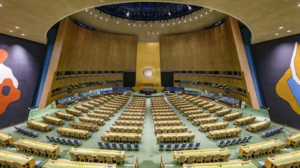
United Nations General Assembly
Ben Kroll reports in Haaretz on 3 December 2025:
The United Nations General Assembly approved on Tuesday resolutions calling on Israel to withdraw from the Golan Heights and West Bank, both territories it has been occupying since the Six-Day War in 1967.
The resolution regarding the Golan Heights, with 123 voting in favor, 7 against and 41 abstentions, led to criticism from Israel’s UN envoy, who called it “detached from reality.”
Sponsored by Egypt and titled The Syrian Golan, the resolution reissues a demand for an Israeli withdrawal from the territory, calling its continued presence “a stumbling block in the way of achieving a just, comprehensive and lasting peace in the region.”
The resolution decries Israel’s 1981 Golan Heights Law, which applied Israeli sovereignty over the territory that was captured from Syria. The resolution adds that Israel must withdraw to the line it held on the eve of the Six-Day War.
The resolution on the West Bank and East Jerusalem passed overwhelmingly, with 151 countries in favor, 11 against and 11 abstaining. Backed by Qatar, Jordan, Djibouti, Mauritania and Palestine, it urges Israel to follow international law, quickly end its presence in the occupied territories and remove all settlers from the West Bank.
Israel’s ambassador to the United Nations, Danny Danon, wrote on social media that the vote “proves how disconnected [the United Nations General Assembly] is from reality.” In a post on X, Danon vowed that “Israel will not return to the 1967 lines and will not abandon the Golan. Not now, not ever.”
The votes come amid rising tensions between Israel and its two neighbors to the north, Lebanon and Syria. Earlier this week, President Trump reiterated that he would like to see Israel and Syria agree on a peace deal. “The United States is very satisfied with the results displayed, through hard work and determination, in the Country of Syria,” Trump wrote on Truth Social. “It is very important that Israel maintain a strong and true dialogue with Syria, and that nothing takes place that will interfere with Syria’s evolution into a prosperous state.”
According to Trump, Syrian President Ahmad al-Sharaa “is working diligently to make sure good things happen, and that both Syria and Israel will have a long and prosperous relationship together.”
Syrian President Ahmed al-Sharaa told Fox News in early November that his country will not enter into direct negotiations to join the Abraham Accords at the current time, but added that “perhaps the Trump administration will help us reach that kind of negotiation.”
Additionally, The New York Times reported on Tuesday that representatives of all 15 members of the UN Security Council are set to begin a four-day visit to Syria and Lebanon on Wednesday. Along with visiting Damascus and Beirut, the delegation will also visit the Lebanon-Israel border and travel to the headquarters of the UN peace force known as UNIFIL. Among other things, the diplomats will meet with the Lebanese army commander responsible for disarming Hezbollah.
According to The Times, trips of this sort are rare since the itinerary must be approved by all 15 members of the Security Council, even more so in the Middle East, where security concerns are paramount. The last such UNSC trip to the Middle East was six years ago, when officials visited Iraq and Kuwait.
Ben Samuels contributed to this report.
This article is reproduced in its entirety