

UK court says Palestine Action ban ‘unlawful’: What does the verdict mean?
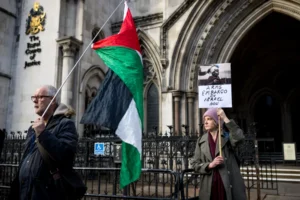
Protesters holding a placard and a Palestinian flag gather outside the Royal Courts of Justice in London
Priyanka Shankar and Anealla Safdar report in Al Jazeera on 13 February 2026:
In a landmark ruling celebrated by human rights groups, the High Court in London has called the United Kingdom government’s ban on the pro-Palestinian campaign group, Palestine Action, “unlawful”.
In July last year, the UK government had banned the group, which had protested against Israel’s genocidal war on Gaza and the UK’s support for Israel. The Labour government led by Prime Minister Keir Starmer designated it as a “terrorist” organisation and a national security threat, putting it on par with armed groups like al-Qaeda and ISIL (ISIS).
Here’s a timeline of when and why Palestine Action was banned and what members of the group have had to endure so far: [video]
What does Friday’s ruling mean?
On Friday morning, judges at the Royal Courts of Justice struck down the British government’s proscription against Palestine Action, ruling that they were “satisfied that the decision to proscribe Palestine Action was disproportionate”.
Sean Summerfield, a UK-based barrister specialising in international criminal law and human rights at Doughty Street Chambers, told Al Jazeera that Friday’s ruling mainly vindicates those who stood in solidarity with Palestine Action and will not have an effect on those directly engaged with the group.
Since the ban, the UK police have arrested 2,787 people for holding signs like “I oppose genocide”, “I support Palestine Action” in silent vigils across the UK, according to a statement by the campaign group, Defend Our Juries.
After Friday’s court ruling, holding such placards will no longer be considered unlawful. Defend Our Juries said that after Friday’s ruling, seven people charged with Section 12 (Terrorism Act 2000) offences for addressing Zoom calls as part of the Lift the Ban campaign against Palestine Action will also have their arrests deemed unlawful.
Summerfield said the UK’s Director of Public Prosecutions will now have a decision to make about what to do with those already arrested.
“Do they respect the decision of the High Court and discontinue those prosecutions, or do they continue to prosecute pending appeal? The Metropolitan police have already indicated they will now stop arresting people for holding placards, but that does not preclude further arrests if the appeal succeeds,” he said.