

Too much attention? Why coverage of Israel and Palestine dominates global media

Media workers and activist protesting the targeting of journalists in Gaza, outside the Union for Journalists in Israel HQ in Tel Aviv, July 2025
Dahlia Scheindlin writes in Haaretz on 18 February 2026:
The United Nations Special Rapporteur for the Occupied Palestinian Territories, Francesca Albanese, provokes extreme reactions. They range from thoughtfully critical to berserk. “You are a miserable liar, an antisemite and a menace to freedom living [sic] people everywhere,” and “Thank you Francesca Albanese! She is saving human rights international law for all of us she saves humanity! [sic]”
The Italian lawyer (a title some dispute) makes news on a regular basis, most recently for calling Israel (or, in her telling, its impunity) the world’s “common enemy” last week.
Other statements of hers can be baffling if viewed through the prism of truth: the October 7 attack was merely a response to oppression, no antisemitism was involved, 680,000 Palestinians have been killed in the war; she liberally compares the war on Gaza to the Holocaust (not just any genocide), yet literally opposed the cease-fire deal – problematic as it is – last fall.
Even the UN Secretary-General’s spokesperson last week conveyed his “disagreement,” and a number of European countries have distanced themselves from Albanese. The French foreign minister called for her to resign, as did his German and Czech counterparts.
Whether one thinks she is the savior of humanity or a menace to “freedom living people,” what’s certain is that she generates plenty of headlines about Israel and Palestine. As if there weren’t enough already.
Whole lotta love
Team Israel will never agree with Team Palestine on bias in the UN, human rights groups, international courts or the media regarding the conflict.
But there is one undisputed empirical point: the disproportionate attention to Israel and Palestine relative to other conflicts where people are suffering and dying. Even the former director of the global humanitarian organization Oxfam restated this accusation in an interview with the UK’s Channel 4 on Friday.
Israel captured the global imagination from the moment it was born – and not always in a negative way. In 1948, a draft constitution for the new state was published in full in The New York Times. At present, there are certainly more United Nations resolutions on this issue than on other conflicts. The global media tend to report every conflict-related death and often just injuries; a tragic contrast to the dearth of attention to the bloodbath in Sudan. If you look closely, you might find closer reporting about Ukraine. On Tigray, Cambodia-Thailand, Rwanda and Congo, far less so.
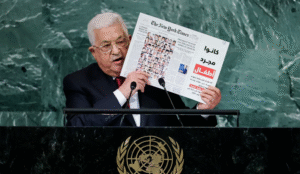
Palestinian President Mahmoud Abbas holding up a New York Times front page, featuring photos of children killed in Israeli airstrikes, at the 2022 UN General Assembly in New Yor
The post-October 7 Israeli maxim “No Jews, no news,” is frightfully ignorant and demagogic, but the volume of Israel and Palestine news does indeed dwarf the others.
The real question is why. Right-wingers in Israel, the U.S. and more broadly believe that this disproportionate attention equals an anti-Israel obsession fueled by antisemitism. The left argues that Israel’s abuse of Palestinians warrants the hyper-focus and accuses right-wingers of attempting to deflect from Israel’s actions.
The antisemitism charge as a driver of global attention is hard to prove; after all, the attention has always been there, and the most recent surge of antisemitism is fairly new. But either way, the argument that anti-Zionism or antisemitism alone explains the issue ignores a long list of other and equally pertinent reasons.
Every possible reason
Haaretz English editor-in-chief Esther Solomon gave an apposite explanation in a podcast for the paper in early 2024. When she thought about it, “I really became quite overwhelmed by how many reasons from religious, historical, political, diplomatic, cultural, ideological, even practical reasons, why this part of the world punches so far above its weight.” The entire conversation is worth hearing, but here are some additions and corollaries to her basic arguments that seem even more prominent post-October 7 than in the past.
Some of the long, original list can be grouped together: Religion, history and culture all combine in the small land of Israel and Palestine to capture attention for huge swaths of the world’s population: Christians, Muslims and Jews see Jerusalem as their axis mundi, something neither Congo nor Kyiv can claim. Solomon argues that these faiths alone account for about 60 percent of the world’s population.
The historical dimension is therefore ancient, but this conflict also encapsulates a huge story of modern global history. Zionism is cut from the cloth of late 19th-century European nationalism. The final international momentum towards accepting the establishment of the state was driven by the crimes and atrocities of Europe against the Jews.
That put Israel forever in the crosshairs of the “West vs. the rest” notions of history. Backed by Europe due to conscience, adopted by America for both Cold War strategy and western Christian (later evangelical) sentimentalism – Israel has always been seen as the outpost of the postwar Western empires, imposed on a colonized Middle East fighting centuries of foreign meddling. Overwhelming U.S. foreign aid and iron-clad political cover is the financial and policy manifestation of this far deeper symbolism.
People wearing masks depicting U.S. President Donald Trump and Israeli Prime Minister Benjamin Netanyahu, at a regime anniversary celebration in Tehran last week. Credit: Majid Asgaripour/WANA via Reuters
How can Sudan compete with all of this? The war raging there now is part of the collapse of a civilian transition that began in 2019, from longtime dictatorship to hopeful democracy. The current phase that began in 2023 essentially involves two warlords from the same country fighting each other. There are few religio-identity, ideological or historical themes that resonate with the rest of the world.
But additionally, one can’t discount the possibility of a certain type of Western racism – in which Black-on-Black violence in Sudan, Rwanda and Congo, or Ethiopia in Tigray – is somehow normal, if anyone notices it at all.
More than a hint of this can be heard from Albanese herself, explaining to New York Times columnist M. Gessen last October why she was so horrified by her earlier experiences in the West Bank in 2010. “What Albanese saw there shocked her,” Gessen wrote, but it was Albanese’s comment that shocked me: “In part, she [Albanese] admits, because Israeli settlers ‘look like me. I’m sorry, I have my biases as well. I couldn’t make sense that people who are Western-educated could be so barbaric toward other human beings. So violent and so casual about it.'”
If Western audiences seek integrity, they must do some serious soul-searching about reinforcing racist, orientalist thinking they claim to despise by omission; by failing to demand more for Black and brown people suffering at the hands of Black and brown abusers, and of holding the latter to lesser standard.
The point is not to diminish the attention poured on the plight of the Palestinians; I’m all for it, and everyone suffering deserves it. But at the very same time, going deeper into anger at Israel in Western democratic countries, and it’s not just about white Western hypocrisy or the anti-colonialism fads on campus. That accusation in itself is faddish and shallow.
The democracy trap
The fact remains that Israel has marketed itself from its earliest moments as the shining light unto even the enlightened nations, a model democracy, the villa in the Middle East jungle. In hindsight, I wonder how that gorgeous draft constitution with its beautiful articles of democracy, equality and human rights got into The New York Times in 1948 at all.
In some ways, Israel comes through – for example, with a mostly free and independent press (increasingly under threat). Most journalists would agree that for much of its history, Israel and Palestine have always been far more accessible to cover than, for example, Myanmar or Iran at present (the ban on foreign journalists entering Gaza is an exception).
It’s that very access that feeds disproportionate coverage relative to other conflicts, and that contributes to the looming sense that Israel and Palestine is ubiquitous – possibly even boosting tropes about the global prominence (or global control) of Jews.
This very same Israeli assertion of democracy, while robbing Palestinians of self-determination in perpetuity and smothering them under an authoritarian military regime, drives people crazy.
Both 59 years of occupation and nearly 80 years of Palestinian statelessness since 1948 is far longer than some of the most notoriously unjust regimes. South Africa’s apartheid, for example, began in 1948, never claimed to be democratic, and ended, arguably, with the 1994 elections (46 years). Nobody likes to be treated as if they’re dumb.
What’s even more quixotic, then, is the right-wing whataboutism in response to accusations of Israeli war crimes: “What about those other horrible regimes?” Syria under Assad was a favorite example. But you can’t code switch for convenience after decades of insisting on democratic purity.
The list of reasons for disproportionate attention is long; but the solution to it is short. Stop making Israel comparable to the world’s worst offenders. Stop the war, end the occupation, accept Palestinian self-determination once and for all. Maybe then, Israelis can complain they don’t get enough coverage.
This article is reproduced in its entirety