

This Palestinian already lost a leg to settler gunfire. And they keep coming for him
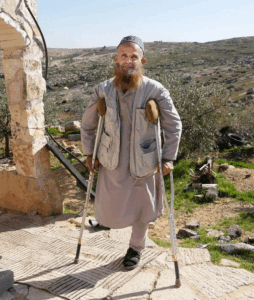
Sheikh al-Amour, January 2026
Gideon Levy writes in Haaretz 10 January 2026:
The Israel Defense Forces never loses its grim sense of humor. After a video posted on social media showed an armed soldier roughly knocking down an older Palestinian man who was leaning on crutches, the army stated that the amputee “acted violently toward a security vehicle” owned by a resident of the nearby settlement of Avigayil, as Matan Golan reported in Haaretz last month.
A 60-year-old man, one leg amputated above the knee, “acted violently” toward an armored settlement security vehicle – how much harm could such a man possibly do to a car? Apparently enough to justify pushing him to the ground, injuring and humiliating him.
But the clip, which went viral, showed only a tiny fraction of the unbelievable maltreatment to which the settlers and the army subjected Sheikh Saeed al-Amour, a farmer and laborer from the community of Al Rakeez, whose homes are scattered on the slopes of Masafer Yatta in the South Hebron Hills.
The man who lost his leg after being shot last April by the security chief of Avigayil – who had encroached on his land – and was shackled in detention following the surgery to amputate his leg, was arrested twice since then by the army following incidents involving the same trespassing settler, and yet again detained and abused in custody, according to his testimony.
This week, after visiting Sheikh al-Amour’s home, a little girl, one of his grandchildren, ran into the room and told him that settlers had once again invaded his property. She showed him photos she had taken on her cellphone. We hurried outside. On the lovely, verdant slope opposite the sheikh’s home, on which olive trees and wheat and barley grow, a settler was grazing his flock, as though the land belonged to him and his sheep. In the eyes of the lawless hill dwellers here, everything belongs to them and everything is permitted – by divine right. Roughing up a disabled man is also allowed, by God’s command and with the aid of the IDF.
A stone structure with a tin ceiling covered in canvas – the al-Amour family’s home is perched on the slopes of a hill, under the threat of a demolition order. Al-Amour is married to three women, two of whom live with him here, the third in the nearby city of Yatta; he has 14 children and 17 grandchildren. He sleeps on a single bed in a bare, empty room.
For most of his adult life he worked in construction in Israel, and subsequently in Yatta, before being disabled. He and his family own 7.5 dunams (almost 2 acres) of land around the house, on which he grows his crops. He skips around on his crutches across the rocky terrain on which he built his house, taking a childlike delight in relating every detail of what has happened to him in the past few years.
Nasser Nawaj’ah, a field researcher for B’Tselem – The Israeli Information Center for Human Rights in the Occupied Territories, who lives in the nearby village of Susiya, says he has never met anyone more determined to fight for his land than the sheikh, who told us this week: “I will give up my children, but not my land.”
To a settler who once offered to buy his property, al-Amour tell us, he replied that he would never sell it – not even for a hill of gold as large as the one beside his house.
Like everywhere in the West Bank, his family’s life was also turned upside down after October 7. Before that day “there was a trickle of incidents” involving invading settlers, but since then “the trickle has become a flood.” He’s referring to the multitude of illegal outposts that have sprung up in the area, the harassment by residents of Avigayil, and in general, the violence, perpetrated by settlers in uniform (usually members of the rapid-response units in the settlements) and by the army, in an attempt to expel him from his own land.
Last April 17 the assaults reached a peak. Toward evening, al-Amour relates, he was summoned by his son Elias, 16, who declared: “There is a settler on our land who is drilling holes in order to fence it off.” The sheikh rushed out and shouted at the settler, who turned out to be the very security chief of nearby Avigayil: “What are you doing? This is my land!” al-Amour shouted, whereupon the man tried to grab the cellphone from Elias, who was filming the confrontation.
In the eyes of the lawless hill dwellers here, everything belongs to them and everything is permitted – by divine right. Roughing up a disabled man is also allowed, by God’s command and with the aid of the IDF.
The settler then started to strangle the youth as the father yelled that he suffers from asthma. The man released the boy but grabbed al-Amour’s left arm, forcing him roughly to the ground, and then firing one bullet into his right leg. Al-Amour lay there bleeding for 40 minutes, he tells us; a Palestinian ambulance that had been summoned by the family was not allowed to approach. Finally an Israeli ambulance arrived and took him to Soroka Medical Center in Be’er Sheva, guarded by soldiers. Al-Amour – whose leg had to be amputated the next day above the knee – was held in custody in the hospital on suspicion of attacking the settler who had stolen onto his land.
When he woke up after the surgery, al-Amour found himself not only without his right leg, but also with his remaining leg and arms shackled to the bed. He relates that food was brought to him, but only after shouting for help for a while was one arm released so he could eat it, albeit clumsily. Meanwhile, two soldiers guarded the dangerous, amputee terrorist, and did not offer help when the food scattered on him and fell on the floor.
“Dirty Arab,” they called him. For his part, he asked, “Is this a prison or a hospital?”
The sheikh was held in custody in Soroka for four days, until his lawyer obtained video footage showing the security officer encroaching on his land and attacking him – contrary to the allegation that al-Amour and his son intended to perpetrate a terror attack on the nearby settlement. Al-Amour and Elias, who was also arrested after his father was wounded, were released on a bond of 10,000 shekels (about $3,100).
Settlers steal Saeed al-Amour’s crutches.
After his release from Soroka, al-Amour asked for an ambulance to take him to the Meitarim checkpoint where a Red Crescent ambulance was waiting. Instead, he says, he was thrown onto the floor of an army jeep, blindfolded, and with hands painfully bound behind his back, taken to Meitarim. “The settler wanted to murder me and now you want to kill me slowly,” he told the soldiers in the jeep. From the checkpoint he was taken to Ahli Hospital, in Hebron, for further treatment.
A few days later the sheikh was discharged, on crutches. He was forced to get along without any proper rehabilitation, but is scheduled to receive a prosthetic leg soon, thanks to a Palestinian charity that offered to underwrite it.
So Al-Amour returned home – but the harassment by settlers was far from over. On the morning of December 15, the same security official who had shot him in the spring once again invaded his land and tried to fence it off. Al-Amour phoned the police, and soldiers arrived to dismantle the improvised barrier.
How did that incident end? With the arrest of al-Amour – whom soldiers grabbed and thrust into their vehicle, after blindfolding and handcuffing him. During the ride to an army base abutting the settlement of Susya, he tells us, he was beaten by the soldiers, who threw him to the ground when they arrived. He remained at the base from about 8 A.M. until 6 P.M. and was roughed up several times. At one point a soldier tried to loosen his handcuffs after he complained about them, but then another soldier intervened, saying, “Forget it, let him die.”
After being released that evening, an army jeep dumped him in the middle of nowhere, a few hundred meters from the base, and left him there. The soldiers gave him his crutches and cursed him: “You son of a bitch, there are no video cameras here.” His reply: “But there’s a video that God has.” Fortunately, a Palestinian passerby took him to the hospital in Yatta where he was checked and discharged.
The next attack was not long in coming, however: Midday on December 26, Elias told the sheikh that he had again spotted a settler on their land trying to erect a fence – the very same shooter. One of his sisters ran outside and shouted at the invader, while al-Amour came out spryly on his crutches, yelling, “Thief! Thief!”
The family one again called the police and a few officers arrived with some soldiers. Meanwhile, the settler sat in his car, watching the goings-on. Al-Amour protested – but was knocked down by a soldier. After struggling to get up, he was once again taken into custody. More handcuffs, another blindfold. “Let him suffer,” the attacker told the soldiers, who took him to the Susya base. He again suffered abuse from the soldiers and was released in the evening together with another Palestinian, who had nothing to do with the incident. This time the soldiers didn’t take him anywhere, only opened the gate and sent him on his way, with his crutches, far from home, before a member of his family came to pick him up.
For our part, this week, when we went outside with al-Amour we saw a settler with long earlocks, in a parka, grazing his sheep on seeded and tilled land that is not his.
The IDF spokesperson said in response: “On April 17, 2025, several Palestinians attacked a number of Israeli civilians near Avigayil in the Judea Division. During the attack, shots were fired at a Palestinian acting violently. An IDF force that arrived on the scene provided initial medical treatment and evacuated him to a hospital for further treatment. In two additional incidents, the Palestinian was detained due to involvement in illegal security activity: first after placing a barbed-wire fence near Mitzpe Avigayil, and again after damaging a security vehicle in the settlement. In both cases, the suspect was later released by security forces.” It was also stated that a complaint Al-Amour filed regarding IDF soldiers’ conduct in December “is under review.”
This article is reproduced in its entirety