

This is how Israeli settlers, backed by the military, erased a Palestinian village from existence last week
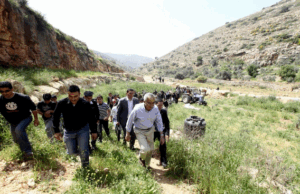
Palestinian Prime Minister Salam Fayyad arrives to pay a visit to support Palestinian farmers in the village Yanoun, 5 April 2012
Majd Jawad reports in Mondoweiss on 4 January 2026:
My last visit to the village of Yanoun was about two years ago, when I reported on the only school that remained in the beleaguered hamlet in the northern occupied West Bank. Israeli settlers and the army had been continuously harassing the residents of the Palestinian village in an attempt to force them to leave.
“Look closely at the village and examine it carefully,” a local representative, Rashid Murrar, told me at the time. “You may not see it next time.” He was right. Khirbet Yanoun, a small rural Hamlet southeast of Nablus known for its agricultural production, no longer exists.
On the morning of Sunday, December 28, 2025, Israeli military authorities issued a sudden warning: all residents of Yanoun had to evacuate by 4 p.m.
Murrar packed all his belongings by evening, leaving Khirbet Yanoun with his family. Once home to dozens of families, the village stood completely empty of its residents for the first time in decades.
Murrar’s family had been the last to stand their ground in the village in the face of relentless settlement expansion. Since the late 1990s, when Israeli settlements and their associated outposts began encircling Yanoun, there have been hundreds of attempts to empty it of its inhabitants.
Yet no image of that slow process of displacement has rivalled the scene that unfolded in Yanoun last week, with roads, homes, and fields left silent.
This is the story of how yet another rural Palestinian community has been ethnically cleansed by Israeli settlers and the Israeli army, joining the growing list of Palestinian communities in the West Bank countryside that have been erased from existence.

Yanoun school, 15 September 2015
A life like hell
Yanoun’s ordeal began between 1996 and 1999, with the establishment of the Israeli settlement of Itamar and a series of surrounding outposts, including Giv’ot Olam and Givat Arnon (also known as Hill 777). Over time, these settlements tightened their grip around the hamlet, restricting movement, access to land, and daily life.
Nearly twenty families were displaced from Yanoun in the years that followed, many after repeated settler attacks. By 2002, the remaining families were forced to leave the hamlet entirely for nearly a year, relocating to the nearby town of Aqraba, where they stayed with relatives or rented small apartments.
Rashid Murrar describes the attacks as relentless and calculated. “They came with dogs and guns. They beat residents,” he said. “They told us they didn’t want to see anyone here the following week, and that we should move to Aqraba.”
In 2005, following pressure from humanitarian organizations and international activists who accompanied them, the residents of Yanoun returned to their homes. But the violence never stopped, intensifying more in recent months.
Masked settlers regularly entered the hamlet, residents said, beating people, throwing stones, vandalizing crops, emptying water tanks, and stealing sheep. “Life became unbearable,” Murrar recalled. “It turned into hell.”
“We tried to stay in the village until our very last breath, but in the end, we were besieged inside our homes,” he said. “The army prevented anyone from outside the hamlet from dealing with us, selling to us, or buying from us. Our livelihood and our food were under siege.”