

They were raised in the heart of the settler right. Now they’re determined to revive Israel’s left

Members of Bnei Avraham, the activist arm of Smol Emuni, helping Palestinians near Ramallah, October 2025
Itay Mashiach reports in Haaretz on 28 November 2025:
“I remembered my last stint in the reserves, eight months ago. We’re sitting around, having a smoke, and one of the guys said he saw a father and daughter walking on a road where they weren’t supposed to be. He got on the radio and was told: Shoot the father. Right after that another officer was heard on the red, classified line, and she said: Take down the girl, too. The guy wouldn’t say what he ended up doing. Either he was ashamed that he had used his gun or he was ashamed for showing pity. Which is worse?”
Tuvia takes another sip of beer. He ignores the fact that I’m writing down what he says on Shabbat. The urge to talk is too great. We’re sitting on a bench on a street in Jaffa, taking a break from a Sabbath eve event in the framework of Midrasha Emunit, an intense study program for young people under the aegis of a movement called Smol Emuni – the Faithful Left. Tuvia is trying to explain how he came to take part in this left-wing activity; his flood of words threatens to drown us both.
“What made me wake up, made me want to act, happened during my present tour of duty,” he continues. “I was hanging out on Saturday evening with friends, we were talking about reserve duty, and someone talked about a guy that I know well. He and his buddies had captured a Gazan man. Their battalion commander ordered them to release him but they didn’t want him to expose their position, so they just took him up to the roof and executed him.
“When they were caught, the punishment involved spending a week outside Gaza – do you get that? A friend who was with us and heard the story said, ‘We did that all the time, but without being caught.’ I came out of there in a state of shock. I didn’t know what to do. I’d heard about war crimes before that, but this time was different.”
The soldiers described in both anecdotes grew up in the religious Zionism movement, like Tuvia himself, who stresses his feelings of profound and growing shame and alienation with respect to his community. During his previous tour of duty, he cut off his sidelocks, and after he heard the religious noncom officer say that in the end the gentiles – including the Druze soldier in the unit – will be “our slaves,” Tuvia replaced his kippa with a hat.
“There’s the alcoholic in [Eugène Ionesco’s] ‘Rhinoceros,’ Bérenger, who complains that he’s simply not capable of being a rhinoceros [i.e., of conforming]. “I feel like him,” he says, adding that after hearing the story about the execution incident, he began to look for a way to take action. He met the heads of the Midrasha, Roy Kleitman and Amana Shlomo, by chance: in his words, “besiyata dishmaya” – by divine providence. Through the Midrasha he also joined other activities of Smol Emuni, including activism in the territories, which he still occasionally calls by the biblical name, “Judea and Samaria.”
“I felt at home in the Midrasha, among people who can identify with me,” he explains. “It led me to carve out a new track. It’s a whole new world of mayim hayim [living waters].” Through studies offered in that framework, the first cracks in his religious identity took on a context, a language and a purpose, all channeled into activity.
Almost three years ago, I wrote an article in the Haaretz Hebrew edition about my impressions of the founding conference of Smol Emuni in Jerusalem. Then, too, a few weeks after Justice Minister Yariv Levin’s threatening regime coup speech, and many months before October 7, despair reigned in this country. For a rank-and-file left-wing, secular person, an auditorium packed with people speaking the language of the right but committed to the left generated a feeling of hope. None of those present seemed in any doubt about the depth of their commitment. They weren’t just tagging along with what is called the center-left. There was a true left there. But it was still hard to gauge the seriousness of the gathering at the time. The atmosphere among those mingling in the lobby was one of a bunch of adolescents who snuck out for a free evening out in the big city. The image of a sort of “coming out of the closet” resonated. Had they come to find consolation among people of their ilk, or to organize for real action? Time will tell, I thought then.
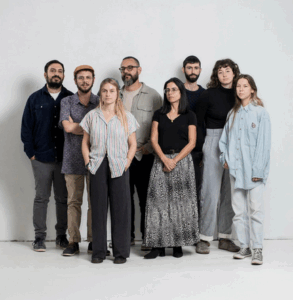
The leaders of the Smol Emuni movement, from left – Ariel Schwartz, Roy Kleitman, Amana Shlomo, Mikhael Manekin, Limor Yaakov Safrai, Dvir Warshavsky, Eliana Leissner and Ayala Chen Atkin
In the meantime, Smol Emuni has organized increasing numbers of activities. Indeed, from that conference a movement emerged that is spreading out in many directions, in a concrete and systematic way. In addition to establishing the above-mentioned Midrasha school for young men and women, the group has also established a publishing house; it includes one of the largest and most dedicated cohorts of young Israeli activists seeking to protect Palestinian shepherds and olive harvesters in the territories from attacks; and holds study sessions aimed at forging a new left-wing religious language. It disseminates humanistic-religious literature to soldiers, publishes a journal, offers a pre-army year of service program and coordinates what it calls a community of teachers from the state-religious education system. In short, movement activists are both bounding across the hills of the Jordan Valley and striking roots in education and training courses, in budgets and institutions. A sister Smol Emuni branch of predominantly observant Jews has been formed in the United States, and others are being organized in England and Italy.
Mikhael Manekin, one of Smol Emuni’s founders, recalls that after the assassination of Prime Minister Yitzhak Rabin 20 years ago, the religious Zionism movement made a decision to inculcate its values – “to settle in people’s hearts” – and he wants to do likewise.
“We encounter religious Zionism everywhere, from morning to night, at ceremonies and in the education system,” he says. “Not in terms of politics but as part of life. To do that, you have to roll up your sleeves and work with the state. We are very much religious Zionists in the way we work with state. There’s a justified feeling of emergency now, and the pressure is making us feel that we’re doing a sprint, but from my point of view it’s one big marathon. In another 20 years I would like to see municipal rabbis who sprang up from the institutions of Smol Emuni.”
Twenty years?
Manekin: “The eternal people isn’t afraid of a long road.”
Back to the Midrasha evening in Jaffa, where the Shabbat melodies barely overcome the music from the adjacent bar. Around the dinner table, which is set in a typical, traditional religious style, are a dozen graduates of the fourth class of the Midrasha, led by Kleitman and Shlomo. This is the last Shabbat of the program, which included three intensive weeks of study and another three such weekends in different places in the country. The morning routine is characterized by the study of religious and other subjects in chevruta – a method in which two people study a text together; in the afternoon there are political lectures.
“In the morning we build, in the afternoon we destroy,” Shlomo laughs.
The program is impressive. The 300 pages of learning materials distributed to the young people contain texts about Jewish morality and power, faith and politics, and Israel’s relations with other nations. The Torah and Maimonides are there, and also philosophers such as Emmanuel Levinas and Martin Buber, as well as chronicler of the Levant, Jacqueline Kahanoff. The lectures in the political program encompass subjects on colonialism and the occupation apparatus, Israel’s arms industry and what is dubbed “A Mizrahi Look at Zionism and the Conflict.”
There was a Nakba tour in Haifa, a talk by Haaretz journalist Amira Hass about Gaza and another by MK Ayman Odeh (Hadash-Ta’al) on the events of October 2000 (when police shot and killed 13 Arab demonstrators). Other tours were held in Lod, Hebron and “unrecognized villages” of Bedouin in the Negev – a comprehensive introduction to repressed Israeliness. “On the Shabbatot we spent in Haifa, the local branch of Hadash [the left-wing, communist-leaning Arab-Jewish party] in the wadi became our shul,” Kleitman says. “We lit candles under portraits of Lenin and Marx.”
Around the Shabbat table in Jaffa, among others, are settlers who describe themselves as having been raised on the principle of Jewish supremacy and driven by a thirst for blood and revenge, yet today they urge their friends online to learn about the occupation and join activism in the territories. There are also Haredim who speak of suffering from ignorance, their eyes hungry for information about the reality outside their bubble. Within a broader movement for social change, the Midrasha thus constitutes a kind of vanguard force, seeking to bring about the political transformation of the individual. For some, the experience is profoundly unsettling.
Shulamit Arnon, born in the Jewish settlement of Hebron, is one of the Midrasha’s 55 graduates. “I came in with certain suspicions about where my politics were heading,” she says. “For years it had been clear to me that I wasn’t exactly right wing, but the studies at the Midrasha validated those suspicions. That’s where my views took shape and became more coherent and historically grounded.” Arnon recalls a moment when she began trembling during a tour of Deir Yassin, site of a massacre of over 100 Arabs in 1948. “I could barely stand,” she remembers. “I had never in my life felt physically unable to listen. It was a bodily reaction I didn’t understand. At the Midrasha I also learned that the more I know, the less comfortable I feel within myself.”
We are very much religious Zionists in the way we work with state. There’s a justified feeling of emergency now, but from my point of view it’s one big marathon. In another 20 years I would like to see municipal rabbis who sprang up from Smol Emuni.
Mikhael Manekin
The Midrasha is the most promising source of new members of Bnei Avraham (Children of Abraham), the activist wing of Smol Emuni that claims to be the largest organization of young adults engaged in creating a “protective presence” in the territories. They accompany shepherds, help with the olive harvest and even spend a weekend in Palestinian villages that are being targeted by settlers. Whereas the Midrasha seeks to effect a deep change, activism is Smol Emuni’s front line. When dozens of its members arrive to support the beleaguered Palestinian shepherds and farmers, their encounter with “hilltop youth” – who grew up in the same sort of religious setting – is both exceptional and fascinating.
It’s a Friday afternoon in late October, not far from the village of Al-Lubban in the West Bank. Fifteen Bnei Avraham activists are clearing Palestinian-owned fields. Behind the ridge a hostile outpost has sprung up and these farmers have been subjected to various forms of harassment: irrigation hoses slashed, trees cut down, raids carried out. An ongoing and terrible situation here and elsewhere. We’re less than seven kilometers from the town of Shoham, a quarter of an hour from Petah Tikva, in central Israel. I ask the activists, who are busy repairing one of the village’s agricultural terraces, how the fact that they share a similar religious upbringing affects their interaction with the hostile settlers.
“There’s something very confusing about our presence,” Shlomo says, explaining that until a week or so beforehand she and her fellow activists thought their presence was having a moderating effect – but that was before they too “took a serious beating” from settlers from Ras al-Ein in the Jordan Valley. “They knew who I am, they knew my name, they knew that I grew up in [the settlement of] Tekoa. The brother of good friends of mine from the past stood there, opposite me, and it made no difference,” she continues. “‘You’re the first one who brought the guys to the settlers’ farm,'” they shouted to her, referring to her days as a popular group leader in the national-religious Bnei Akiva youth movement. Today, she acknowledges, a large number of those former group members are among the so-called hilltop youth.
In response to the same question of dealing with the latter, Avital Engel, a literature student from Jerusalem who comes from what she calls a “religious-religious” home, says, “Basically, it gives me the advantage of knowing where they’re coming from. My heart goes out to those kids. My feeling is that they are taking something that’s dear to my heart and distorting it.” She recalls an incident in a village called Al-Muarrajat, when she tried to talk to two armed settlers who rode horses into a Palestinian school. Their conversation touched on the precept of “loving the stranger,” the destruction of Amalek and so on. “Did they not hit me twice? They did,” she asserts.
For his part, Kleitman talks about a day when he and two other activists arrived to bring food to their Palestinian partners in Hebron, about a week after October 7. When they got to the city’s Tel Rumeida quarter, they encountered three masked soldiers. “They ran at us, knocked us to the ground, pressed their knee into our back, aimed their weapons at us and launched into a cross-examination,” he recalls. But when the soldiers heard that the detained activists were originally from the well-known Otniel Yeshiva in the West Bank, they were unnerved and let them go. A few weeks later, a national-religious friend told the activists, “I have a pal who met you in Hebron.”
A map of the Eretz Yisrael hangs on the wall in Tantur, an ecumenical institute south of Jerusalem. It is depicted lying on its side, pointing east, as it was once rendered in the past. Around a dozen scholars are sitting in a circle and splitting hairs over a text by Elijah Benamozegh, an Italian rabbi from the late 19th century. The group are staff at Makom, the publishing house of Smol Emuni, and members of the movement’s theological circle. Their work may seem like esoteric scholarship but they are at the heart of the organization’s activism.
“I’m using this text because it talks about nationalism and we tend to be mum when it comes to talking about other nations,” says Gabriel Abensour, a PhD candidate in history, who translated the text from French. The religious Zionism movement has in essence resurrected Benamozegh, because it needed a Torah-based language for nationalism, he explains, but it chose to translate very specific excerpts of his writings (the rabbi’s principal translator is none other than Rabbi Dr. Eliyahu Rachamim Zini, an uncle of David Zini, the recently installed head of the Shin Bet security service).
Abensour has found intriguing and radical views embedded in Benamozegh’s untranslated writings. “The nations must respect their mutual rights,” he reads out. “The sheer recognition of one another by the nations constitutes tacit acceptance of the yoke of the Kingdom of Heaven.”
One of the study group’s goals is to find cracks in religious conceptions that today may sound neutral and self-evident, but which are actually interpretations that serve a nationalist worldview. Their premise is that interpretations also exist and by using them, it’s possible to create a new left-wing religious language – a different narrative that will underlie a different politics.
“From the outside Jewish tradition looks as if it’s totally carved in stone,” explains Dvir Warshavsky, who is also a student, a member of the group and a key activist in Bnei Avraham. “But when you live within the tradition and look at it from the inside, it is very flexible. I design the house in which I live – I know there can be alternatives.”
The major theme of today’s session is an academic article about holy places that Warshavsky co-wrote with a fellow activist named Avraham Oriah Kelman, a PhD candidate in religious studies at Stanford. Throughout history, they maintain, holy places functioned as shared interreligious spaces and not just as focal points of friction.
“For 1,500 years Jews saw Joseph’s Tomb [in Nablus] as a place known for giving rise to agricultural abundance for everyone, and especially for Muslims living nearby,” Warshavsky notes. “And then suddenly settlers arrive in the 1980s and generate the complete opposite: From a place that cast its blessings on everyone around it, to a place that has to be protected from those around it who are [perceived to be] threatening its purity.” Recollection of such times and such forgotten traditions, the group at Tantur believes, is the first step in creating a political alternative.
“It’s far broader than just the issue of the holy places,” Kelman adds. “We think of Judaism as a type of lifeline from the standpoint of the nationalistic logic to which we are captive, because the liberal center-left in Israel doesn’t have an identity framework. There is one real narrative in Israeli society, and it’s that of religious Zionism; the alternative is secularism that is engaged mainly in denying identity symbols and cultural baggage. But every day in the synagogue, prayers are heard that were recited long before there was Jewish supremacism.
“We are trying to reconstruct tradition, to cleanse it of what happened to it after 1967, to teach and to learn the forgotten religion that’s called Judaism. That lifeline of tradition makes it possible to think in terms of something that preceded Israel and Zionism. We have wisdom to turn to – the wisdom of the generations.”
When you and the others talk about the wisdom of the generations of the religious, as a secular person I hear in the background the concept of the “full cart” and the “empty cart” [a parable relating to, respectively, religious wisdom vs. secular hollowness]. The secular left also has a tradition, it has values and cultural baggage – why is religion the lifeline?
Kelman: “I think about what the left-wing religious movement can contribute to the left-wing discourse. One of the things we are good at is thinking about the position of the individual against power, about permitted and forbidden, about virtue. Religious language possesses a great deal of power precisely because it is halakhic [based on religious law]. That’s something that is particularly lacking in liberal language. Liberalism organizes society as a collective and doesn’t deal with the life of the individual, because the individual is free. But now we need instructions, we are in a moral crisis.”
Smol Emuni activists working on Palestinian farmland near the village of Al-Lubban in the West Bank. According to Kleitman, ‘It does have an effect [on the settlers] that we are their brothers. But in the end, I’m afraid that one day they will shoot us.’
The question is whether you see in religious language an equal “sister” in this struggle, or do you think it holds any promise for the secular left as well. There is arrogance among the religious Zionism on which you were raised. Does your group also feel that you are coming from a loftier place?
Warshavsky: “In some way it’s the opposite. I left religious Zionism because I felt I was living in a very, very empty cart. When you live in a society that has something so aggressive about it, there’s a feeling of being orphaned. You’re dying to have a rabbi, a teacher, someone you can learn Torah from without being selective … It’s a harsh experience of loneliness.
“It was actually when I entered the space of the left that I felt that I was standing across from a full cart. I know that as a religious person I have a great many raw materials, I am arriving with rich baggage, but it’s not consolidated. Because in the end a discourse is organized around one segment of the population, a society, a stream. And I didn’t have that, because I was in an intolerable space that’s organized around a dangerous world of values.”
Kelman: “I really identify with that. I was in the yeshiva world for many years, engaged in an intellectual and spiritual search. As a boy I wanted to be a prophet. That was my dream, that God would speak to me. I studied Torah all the time and prayed. I wanted a connection to the transcendent – to what is beyond this world, that would provide me with some sort of clarity, because I had questions. At a certain stage I understood that this was of no interest to any of my teachers. That my milieu simply wanted me to marry a religious woman, for us to have lots of little settler children and fill a space in which Palestinians will not be able to live.
“The thinking in religious Zionism is very much in the box. Stay in your stream, vote for the right parties, in the end you’ll be alright. The deepest thing, the inner, human search that has accompanied mankind throughout history – even before we get to political questions – is very sparse, emptied out. That’s why religious Zionists travel to India. There’s a feeling of emptiness. And in a place that talks about religion all the time, that dissonance is very pronounced.
“At the same time, I do think that within the general crisis being experienced by the left in Israel, and by that of liberalism as a whole, the religious voice has a singular contribution. It’s very important that we learn from each other.”
The learning materials distributed to Midrasha students contain texts about Jewish morality and power, faith and politics, and Israel’s relations with other nations. The lectures encompass subjects on colonialism and the occupation and Israel’s arms industry.
Makom, the academic-philosophical arm of Smol Emuni, has published four books to date, with two more in the pipeline. It puts out both original works and new editions of texts that have been forgotten for political reasons. “We are effecting a ‘resurrection’ of left-wing religious thought that doesn’t have a place in the mainstream,” explains Ayala Chen Atkin, the coordinator of Makom. “We are trying to create a canon – a bookshelf for new audiences who are looking for this language.”
The staff is also working on the first issue of a biannual periodical in coordination with the Van Leer Jerusalem Institute. Also being planned is a virtual beit midrash (place of religious study) offering introductory, recorded lessons on subjects like “Hasidism, kabbala (mysticism), medieval thought – but with a left-wing orientation,” Atkin says, noting that the impetus for the initiative came from requests from teachers who want to teach about these topics, but “everything they find on the internet is very right-wing.”
The annual Smol Emuni conference, which was held this year in early September – before the cease-fire went into effect – brings together all the organization’s branches. The most recent event, like the others, was held at Heichal Shlomo in Jerusalem – a longtime center of religious Zionism and former seat of the Chief Rabbinate of Israel. The hall overflowed with people, the plastic chairs they carried above their heads seemingly floating through the air amid the human stream flooding the aisles.
On stage speakers came out against the starvation and destruction in Gaza as few have dared to do in the country. A Spoken Word artist improvised in Arabic; the rapper Sameh Zakout played a voice message from a relative of his in Deir al-Balah, in Gaza, who for two years eaten only peas. At times the texts sounded like part of the program at a future Memorial Day.
“We don’t have a policy paper, but the operative ethos is that of equality and compassion,” Manekin explains. “When I say that I am a leftist precisely because I am a believer – it’s because the religion I was raised on is occupied almost obsessively with dealing with the weak and with a recoil from the use of force. It’s clear to me that most people do not perceive Jewish religiosity in that way, but I think it was perceived like that throughout most of Jewish history. In other words, it’s only at this point in time that people like us are a minority.”
Today opposition to the killing of children is also considered left-wing. To what extent is Smol Emuni political in the narrow sense of the word?
Manekin: “The answer lies in the question. The term smol emuni is problematic for many reasons, but the word smol, left, is part of it. You can’t be apolitical and call yourself Smol Emuni, and it’s hard for me to imagine a right-winger who would feel at home here today. The whole story here is political, and we try to be direct about our intentions.”
Despite the ideology presented during the sessions, a secular left-winger might feel antagonism at this sort of gathering, especially if he is one of those who have been completely turned off religion by national-religious Judaism. The kippa, the colorful headgear, the speech spiced with quotes from the Jewish sources, their saccharine pathos – with every mention of “ways of pleasantness” or “a sukkah of peace,” one may feel the urge to flee. Suspicion toward the religion and the religious can easily overshadow what’s being heard.
“I know very well what it is to be a religious person in a secular space where I’m seen as a threat, or alternatively, as a cute religious ‘pet,'” says Manekin, who served as CEO of Breaking the Silence, an NGO that publishes soldiers’ testimonies about service in the territories, and as CEO of Molad – The Center for Renewal of Israeli Democracy. “There’s a feeling that we’re being seen as some sort of guests, and one of the dangers is that we will do the same to other groups. That we’ll say, ‘How lovely to see a secular person like yourself at the conference.’ The story is to find a way to talk without the sociological judgment” – even when the disparities are rooted in principled issues. “We need to conduct a dialogue with everyone. For example, it’s very important for us to speak with soldiers who are serving in Gaza, which is something that the ‘deep left’ doesn’t do.”
The need for such a dialogue is particularly great in terms of remedying the disconnect between the secular liberal public and the religious mainstream, he avers. “The majority of Israeli society today is traditionalist. You can’t conduct politics if you’re afraid of the majority of society. And I’m not saying that only in the utilitarian sense, of ‘what gets votes.’ Religiosity as it is represented by the religious leaderships is making itself hated, so I can’t complain about secular people who are put off by that – but even so we need a dialogue.”
Some would say that this is not a time for dialogue, that now we need to struggle.
“I will explain my answer by means of an example from deeper left-wing worlds. Let’s say you are engaged in providing protective presence in the territories, and a Palestinian is being expelled from his land. You need to conduct yourself with the settler or the soldier, so you need to develop an ability to speak, and that obligates you to try to understand what’s going through his head. That’s the dynamics I’m referring to. Not ‘Hey, ‘bro, I love you,’ or ‘Let’s put our disagreements aside,’ because that will likely turn out to be at the expense of the Palestinian.”
Manekin is today the infrastructure coordinator of Smol Emuni, an area that is fairly lean in terms of budgets and staff (“It’s all like very DIY in the meantime”). The movement’s activities are financed by the New Israel Fund and private philanthropists, most of them American Jews but the hope is that donations will also be forthcoming from the left-wing religious community in Israel itself.
Another hope, says Manekin, is that his colleagues will go on to hold significant bureaucratic positions in the country. “Many from Bnei Avraham and from the Midrasha could be directors of pre-army academies and of year-of-service programs, or senior officials in the finance, education and welfare ministries or lawmakers. We are not necessarily channeling them in that direction. It’s not a conspiracy, it’s civil awareness.”
Are you looking for such people who are in the civil service now?
“We don’t have to look for them, they’re already there. What’s happening now is that in all kinds of places there are left-wing religious people who feel alone. They say, ‘I would come to a lesson with more people like me.’ We have people in various positions, and many times they long for a discussion like that. We didn’t send them there. But we are saying to them, ‘You have company, we have your back.’ When you feel utterly alone, you’re a lot more afraid to speak your mind.”
The annual conference featured discussion groups on subjects such as “The War and the Messianic Era,” “Faithful-Humanistic Education” and “A Land for Everyone.” There was a closed session for reservists led by Aviad Houminer-Rosenblum, another Smol Emuni founder, where participants shared experiences from three, four and five tours of duty in Gaza. I focused on the expression of one young man with delicate features and a narrow wedding ring, tapping his fingers. His gaze was hollow. The others shared stories of war crimes but his facial muscles hardly shifted. One person related that he was diagnosed with post-traumatic stress disorder, another joined Breaking the Silence, a third was declared a moiser, a snitch, by his buddies, which means halakhically that he is condemned to death.
Like the Midrasha and Bnei Avraham, Smol Emuni U.S. was also not planned from the top down per se, but developed independently, and took its place under the movement’s umbrella. It began with the initiative of a circle of religious friends in New York, half of them former Israelis who about a year ago were driven by the gloom of living in a political wilderness to meet for left-wing parlor talks.
When interest grew and the group expanded, they decided to organize their own local conference and developed connections with their colleagues in the Holy Land. “It’s actually a group that didn’t have an identity, so we are growing in a very surprising and rapid way,” says Esther Sperber, a former Jerusalemite, who is the group’s executive director. She’s in touch with people in multiple cities across the United States who want to establish similar communities, and she’s also assisting the European Smol Emuni, which is currently taking shape.
From overseas developments we return to Smol Emuni’s work in Israel, specifically its school system. “There are sowers of wheat and planters of trees,” Manekin says. “Our challenge, and that of every political movement, is to be both.” Among the planters are the people involved in Hasadeh, the movement’s educational arm.
Yoel Ilani, a teacher in the Midrashiya High School for Girls in Jerusalem, under the auspices of the Shalom Hartman Institute, took part last summer in a two-day Hasadeh seminar for teachers. “It was very powerful,” he says. “A meeting with teachers who are coping with the same system of state-religious education, which takes no account of us.”
Smol Emuni is a precise definition of his identity, says Ilani, who grew up in a politically moderate religious home in the southern town of Yeruham and eventually, driven by a sense of mission, became an educator. “Before being a pragmatic organization with operational arms, it’s truly a community that allows many people to feel at home. My parents never identified with Gush Emunim [settlement movement] or with the stream that became increasingly central in religious Zionism. I grew up alienated from the education system that I attended, with some sort of instinct that I harbored different values but wasn’t able really to articulate that. The state-religious [education] institutions are very political and extremely monolithic – they represent a very specific proposal of what Judaism is.”
Hartman is indeed considered relatively left-wing in that system but the pedagogical supervision, the textbooks and other aspects of life there are implanted deep within national-religious ideology. “The history books were written in the Har Bracha Institute,” located in the eponymous right-wing settlement near Nablus. “It’s simply history as theology,” Ilani notes. “It always revolves around the Jews, divine providence and the Creation.”
Being endlessly occupied with opposition to religionizing and opposition to religious people is to throw out the baby with the bath water. If we want to succeed in this realm, we need partners within the broad, strong public.
Limor Yaakov Safrai
What’s most difficult, says Limor Yaakov Safrai, director of Hasadeh and one of the founders of Smol Emuni, is coping with the Religious Education Directorate which, for example, organized a recent conference where “the hostages weren’t even mentioned, or the pain and the difficulties [of their families]. Only lights and miracles.”
Hasadeh’s activities thus involve providing emotional as well as concrete pedagogical support for left-wing educators in the state-religious system – “for example, a workshop in which the issues we cope with on a daily basis are simulated,” Yaakov Safrai says. “Say, the students get on the school bus, and for some reason start to sing ‘Death to the Arabs,’ and the driver is an Arab. How do you react?”
“Our growth has been off the wall,” she adds. “We established our Teachers Community three months ago and it already has a hundred members.”
Hasadeh develops lesson plans and curricula for classes in civics, education and Bible, and content for ceremonies that are held during the year; it is now organizing a community of parents. Yaakov Safrai believes that all of those efforts will eventually bear fruit, as is typical in the long and sometimes unexpected processes seen in the realm of education.
Yaakov Safrai, who grew up in a national-religious home in a small moshav in Gush Katif, says she saw Palestinians from Gaza from her house, crossing the small checkpoint in Khan Yunis on the way to work in the fields, but didn’t really see them. The first intifada broke out when she was 5, at the end of 1987. Her father came home with the car’s windshield smashed and the neighbor was stabbed in the back – events that were part of the stressful and dangerous life in those settlements.
Limor Yaakov Safrai, of Hasadeh: ‘When you have a true inner fire, and create an infrastructure – it happens.” Credit: Ilya Melnikov
But political doubts began to surface. “Something didn’t work for me in terms of the exclamation marks, the passion,” she recalls. “There was something unresolved.” In high school, an aunt gave her David Grossman’s book “The Yellow Wind” – with its hard look at the occupation in the West Bank – as a gift, with the dedication, “To my thinking niece.” At 20 she voted for the left.
Although she had moved to Ma’aleh Gilboa, a religious kibbutz near Beit She’an, Yaakov Safrai returned to her parents’ home with her partner to help them before the disengagement from the Gaza communities in August 2005; they left the day before. Until last month, she was director of the Education Department in the Lower Galilee Regional Council, parallel to her activity in Smol Emuni. Now she has decided to devote herself to changing the system – from the outside.
Last week, Hasadeh announced the opening of registration for a religious-humanistic year of service before enlistment in the army, in cooperation with Hechalutz, a leadership-building organization in the spirit of Israel’s pioneers. The Be’er Sheva-based commune of 16 people will do volunteer work with Arab-Jewish organizations, as well as in local schools and with refugees; one day a week will be devoted to studying with left-wing religious teachers.
In the future, Hasadeh is due to offer teacher training and leadership programs, and fellowships. “The idea is to create an infrastructure of human capital that will influence the entire system in a broad way,” Yaakov Safrai says.
The state-religious education system is large and has sizeable budgets. You sound like a nice group of people who have found one another – but what chance do you have against such a juggernaut?
Yaakov Safrai: “The answer lies in the virtues of the program. Both the Religious Kibbutz Movement, on the one hand, and [extreme right-wing] Har Hamor Yeshiva, on the other, are very small bodies, yet each in its generation succeeded in influencing the entire religious Zionism movement – and, as a result, all of Israeli society. In other words, I don’t necessarily have to be big. I need to succeed in instilling a language … Most of the people I meet don’t want to destroy, they want peace. These are the ones we are going to mobilize.”
Where did you learn how to do this work?
“It’s not a strategic program from the basement of the elders of Zion. When you have a true inner fire, and you’re responding to a real need, and you work to create an infrastructure – linguistic-conceptual, political, activist and educational – it happens. I worked for years in the Religious Kibbutz Movement, and I learned their doctrine. The approach of Har Hamor I experienced first-hand as a girl, in the religious Zionism movement.”
Is there something you hope to get from the secular population?
“Yes. In the end we are creating a reality. One can term Smol Emuni esoteric, and that’s what it will be. Or one can give it a place, and it will trickle down. And now the question is: What is our motivation? We want a different Judaism, and that is a vested interest not only of those in the religious world. What am I saying? That being endlessly occupied with opposition to religionizing and opposition to religious people is to throw out the baby with the bath water. If we want to succeed in this realm, we need partners within the broad, strong public. Every battle like this distances [religious] people from the language of the left, because they panic when left-wingers reject them.”
But you understand why, in the present context, for certain elements on the left, religious Zionism is a red rag?
“There’s a deliberate mixing up here of religionizing with nationalism. I don’t expect secular people to be religious, I expect them only not to hate religion, not to think that Judaism is the root of all evil. I find that secular nationalists are often a lot tougher than religious nationalists, because theirs is a nationalism that doesn’t even have a foundation in a spiritual world.
“In that sense, Judaism can be seen as offering a message and the right things can be extracted, reappropriated from it. Just as in the regime coup protests the flag was reclaimed, I suggest that the secular public reclaim Judaism. Not cast it away. The moment it’s abandoned, someone else claims ownership.”
With me a red light goes on that says “Someone is trying to draw me closer to Judaism.”
“I understand that, so I’m making it clear that I am against religionizing in that sense. I will not teach you about Judaism. On one occasion, someone approached me and said, ‘What an amazing Judaism – maybe you’ll conduct your activities in our city, too? And I told her: ‘No way. You will organize them, the way you understand it.’ Judaism as a culture, as inspiration, as heritage, connects us identity-wise to this space, and it also has the potential for creating beautiful things. There is such a thing as secular Judaism.
“I understand where it’s coming from – that the secular public feels threatened by every manifestation of religion. But I think it is losing out. Instead of that, we can say: ‘You’re confused, I am no less Jewish than you, I simply see it differently. It’s not that I don’t want Judaism – I don’t want your Judaism.’ And I too want my Judaism, and I want us to live together in peace. With my worldview I don’t want to coerce anyone. It is not about drawing people to religion, it’s about drawing people who harbor a Jewish sentiment of one kind or another to a humanistic worldview.”
This article is reproduced in its entirety