

They survived the bombs, but not the virus: fatal illness spreads in Gaza
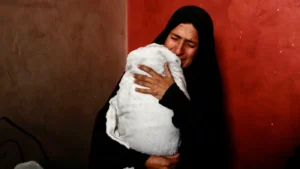
Hiba Abu Jarad, the mother of a three-month-old girl Shatha who died of hyperthermia, cries while holding Shatha’s twin sister Nada in Gaza City on 20 January 2026
Nada Nabil reports in Middle East Eye on 21 January 2026:
Even in her worst nightmares, Marwa Kalloub never imagined that her daughter Mariam would leave hospital lifeless after being admitted with flu-like symptoms. The 38-year-old mother believed her child’s natural immunity and basic medication would be enough.
But in Gaza, where months of Israeli starvation have weakened immunity and the health system has collapsed, a routine illness proved fatal. “Mariam had no prior health problems,” her aunt, Iman Kalloub, told Middle East Eye. “Before she died, Mariam had a severe cough, nausea and a high fever. She stopped eating completely,” Kalloub added. “So many people in Gaza were sick with this virus that we expected her recovery to take time. We never imagined it would end like this.”
In recent weeks, a mutated virus has been spreading rapidly across Gaza, striking communities already weakened by two years of genocide and a collapsing health system.
Health authorities have yet to identify the virus with certainty, citing limited testing capacity and severe shortages of medical equipment, leaving residents exposed to its unpredictable effects.
Mariam, eight, was admitted to Rantisi Hospital on 11 January, which was once a major centre for treating children with kidney disease and cancer. Now, after repeated damage to Gaza’s health infrastructure by Israeli forces, it has been repurposed to treat respiratory and gastrointestinal infections, as well as chronic conditions.
Despite efforts by the Palestinian Ministry of Health to repair the hospital and restore services, the facility is overwhelmed. Mariam’s mother rushed her to the hospital after she developed severe breathing difficulties. “She waited for hours before seeing a paediatrician, because of the overwhelming number of sick children,” said Kalloub. Doctors carried out scans and found her lungs were in a critical state, she added. Treatment was almost impossible.