

They behave like an army:’ Israeli settlers ramp up their annual onslaught on Palestinian olive growers
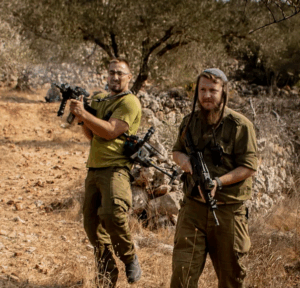
Members of the Revava settlement’s security squad evicting Palestinian farmers from a grove, November 2025
Matan Golan reports in Haaretz on 7 December 2025:
It’s becoming a more and more common sight: an all-terrain vehicle lurking around a Palestinian olive grove in the West Bank. “A lot of anarchists are messing things up here,” the driver says into his phone at one grove.
He’s a mature man wearing a hat, a beard and a gun on his hip. He makes no effort to veil the threat. On the contrary, local Palestinians say. They own the groves, but now he does whatever he likes, as if this were his land.
On paper – the yellowing paper of the Oslo Accords from the ’90s – this situation is supposed to be unimaginable. It’s Area B, under Palestinian civilian control and Israeli military control, an area where settlers aren’t supposed to be. But they block landowners from reaching their land.
“These settlers act freely under the protection of the Israeli government and the army,” says a landowner at Turmus Ayya in the middle of the West Bank. “One Friday, the army wouldn’t let me get to my olive grove. In the distance, I saw that settlers had cut down my olive trees.”
But this change in status of Area B was just one of several symptoms during this year’s olive harvest season, the most violent documented by the UN Office for the Coordination of Humanitarian Affairs since 2006. This season, the agency recorded 364 incidents of violence including assaults on Palestinians (two have been killed), theft, the burning of property and groves, the killing of livestock and the cutting down of trees.
“Mere” harassment isn’t in the figures, like herding sheep through Palestinians’ homes – from the living room to the bedroom and back. Also, a 13-year-old from the village of Beita died after he inhaled tear gas used by the army at a grove, and a youth from the town of Deir Jarir was shot dead by soldiers who arrived after a clash between settlers and villagers.
Such phenomena have become more frequent in recent years, and this year they’ve become much more numerous throughout the West Bank. There are also new elements, like the intrusion into Area B and the establishment of outposts there, giving settlers complete visual control of the area. Also, armed settlers wearing army uniforms wield unauthorized powers, arresting people, cordoning off areas and menacing people with their guns.
Entering Area B
Turmus Ayya is this season’s record holder, with no fewer than 13 attacks. The bearded settler on the all-terrain vehicle keeps popping up in people’s stories – hundreds of such vehicles have been supplied by the Settlement and National Missions Ministry, ostensibly to defend outposts.
Local Palestinians say the ATVs are being used more for offense. “We were harvesting olives by my house,” one landowner says, adding that the settler with the ATV showed up with two hooded friends. “These groves are very near town, not in some godforsaken place. The settlers go right by the houses.
He says the man in the ATV “told us to leave. An hour later, he went to another family who were harvesting a hundred meters away. He threatened them with a gun, drove them out and even stole some of their equipment.” The outpost from which this bearded settler came was established on privately owned Palestinian land very near Area B, where no one is allowed without permission from the army.
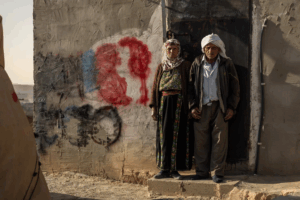
Sabha and Mahmoud Najar at their home in the West Bank village of Shib al-Butum. ‘Two settlers beat me with sticks and stones on my head, shoulder, back, ribs and arms’ Mahmoud says.
Another time, the ATV driver was seen in the groves of the nearby town of Sinjil. There, another new popular method has come into play: The settler appears, gives a warning, and then soldiers arrive. The area is declared a closed military zone, and people harvesting their land are removed from the area. “It’s as if he owns this land,” the landowner says. “They even harvested our trees and stole our olives. Last year, we harvested here without a hitch. This season ended without us being able to access our land.”
In the months before the olive harvest season, a number of outposts were established on the seam line between areas B and C, some of them deep into Area B. Area C is under full Israeli control.
‘We used to go hiking there, have a barbecue on our land. We can’t get there now. Settlers don’t care if it’s an older person, a sick person, a woman – they attack everybody.’
A landowner from the village of Beita
Most of these “frontline” outposts that were set up to obstruct the olive harvest serve as lookout points and logistics centers where youths from nearby settler outposts gather. All told, hundreds of outposts and settlements on the hills – around 470 such locations, according to the nongovernmental organization Kerem Navot – control large areas. Harvesters in open spaces have become sitting ducks.
“It doesn’t matter where you are,” one civil rights activist says. “There’s an outpost on every hill.”
Seven attacks have been launched from the outpost Mevaser Shalom, and 10 from an outpost west of the Kedumim industrial park. In one attack, settlers set fire to a car belonging to Hikmat Shteiwi, 54, while he was still in it, several people say. Shteiwi suffered a complex head injury and recently awoke from a month-long coma.
Twenty-one attacks on Turmus Ayya and Sinjil were launched from the bearded settler’s outpost. Some outposts have been dismantled by Israel’s Civil Administration in the West Bank, but settlers quickly come back.
Dozens of the 364 violent incidents documented by the UN originate from these outposts. At least nine of those attacks were launched from the outpost Kol Mevaser, including one where settlers set fire to five structures and used extreme violence including shooting. This happened on October 25 in the village of Mukhmas, while Israeli activists were staying at a nearby Bedouin community as part of a “protective presence.” Chased by settlers as a fire blazed, the activists tried to take cover.
“I sat behind the door, really close, so I wouldn’t be seen from the outside,” says N., a woman who took cover in one house. “For a second I thought this was working. They looked in through the window and yelled out that nobody was there. Then they started attacking and burning the houses.”
At one point, she recalls, one settler tried to break into the house. She held on to the door handle, so “he broke down the door, beat me with a stick and told me to get out. I went out with my hands up, and he told me that if they ever saw me there again, I was dead.” N. adds: “The settlers who burned down the houses, eight young people, surrounded me in a circle and started beating me with rocks and sticks until I fell to the ground.”
They finally left her alone. “I guess they saw that my head was bleeding and they didn’t want to get into trouble for killing me.” N. was brought to Jerusalem’s Hadassah University Hospital, Ein Karem, suffering from internal bleeding in her liver, cuts on her head and neck, and bruises on her ribs, chest, arms and legs.
According to the UN Office for the Coordination of Humanitarian Affairs, 102 of the 364 documented attacks resulted in injury; for example in mid-October, when dozens of hooded settlers attacked harvesters at Turmus Ayya. One man, Ariel Dahari, was filmed clubbing 53-year-old Afaf Abu Alia, a grandmother of nine. He was arrested a few weeks later and indicted late last month.
But dozens of attackers took part in that incident, and as far as Haaretz is aware, only Dahari has been arrested. The police declined to comment on whether there were other suspects; the Israel Police in the West Bank normally decline to give a precise figure on the number of detainees in the hundreds of crimes committed during the olive harvest season. They merely say that it’s a two-digit figure.
At the service of the settlers
Local Palestinians keep talking about cooperation between the settlers and the army. Officially, the army says soldiers must immediately detain settlers who trespass on Palestinian land during the olive harvest season and hand them over to the police. But evidence shows soldiers standing by during trespassing, stone-throwing and other harassment by settlers.
Also, conversations take place between soldiers and settlers. Such was the case once in Area B after the army dispersed harvesters with tear gas without warning or showing a warrant. An officer had a pleasant talk with a hooded settler, who told the officer: “All of the rioting and the attacks on shepherds are the result of the anarchists.” The officer replied: “I know, I’m familiar with the story.”
Sometimes the cooperation is more intense, involving communities’ security squads or the so-called regional defense units. Around 2,500 settlers are currently serving in these forces, armed with rifles.
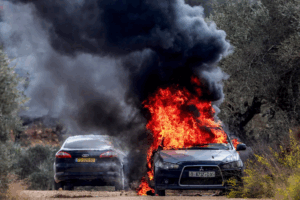
Photojournalist Jaafar Shtayyeh’s car burns after being set on fire by settlers near the West Bank village of Beita in October 2025
In at least one-quarter of the incidents documented by the group Yesh Din in the first two weeks of the olive harvest season, soldiers or uniform-wearing settlers were present. At best, they merely stood by; at worst, they took part in the violence.
A masked settler near the village of Beita in October. Credit: Jaafar Ashtiyeh/AFP
In footage, settlers armed with rifles are seen threatening harvesters and driving them off their land. In one incident, settlers, some holding clubs, blocked Palestinians from an olive grove.
“This is our home,” one of the armed settlers said. “This is Area C, and you’re not allowed here – not in peace and not in anything.” Another time, an armed settler partly dressed in fatigues is seen shouting at harvesters and driving them away.
‘This is the lowest, most dangerous abuse of IDF weapons and the uniform. Our army helped by standing by and sometimes actively aiding armed militias and Jewish terrorism on the ground.’
Avi Dabush, executive director of Rabbis for Human Rights
Another incident happened on November 4, on land belonging to the town of Qarawat Bani Hassan near the city of Ariel in the West Bank, in plain sight of Haaretz reporters. Members of the security squad of the nearby settlement of Revava attacked local residents using a drone. An Israeli woman was wounded by the drone’s propellers and needed stitches.
“This is the lowest, most dangerous abuse of IDF weapons and the uniform,” says Avi Dabush, executive director of the group Rabbis for Human Rights, who was at the scene. “This could easily have ended with wounded and dead. Our army helped by standing by and sometimes actively aiding armed militias and Jewish terrorism on the ground.”
The drone crashed, and two members of the security squad arrived to claim it at gunpoint, shooting in the air. The man who fired his gun has been dismissed. The other, who aimed his gun at Israelis the age of his grandmother, received a reprimand.
Beating civilians
West Bank olive growers were already expecting a meager crop this year; last year there was a bumper crop, but the war hurt business. Also, this past spring was warm. It’s the outposts that have flourished.
“In the three years since this government came to power, and especially since October 7, the map of West Bank outposts has been transformed,” says Dror Etkes of Kerem Navot, which monitors settlement construction in the West Bank. “Over 140 new outposts have been established, some of them in areas under Palestinian Authority control or nearby, with the intention of disrupting all Palestinian farming activity.”
These outposts joined 210 other settlement outposts, including some that have been legalized by the Israeli authorities or are on their way to that status. The 210 outposts were established before the war, Kerem Navot says.
“Closely aided by the army, settlers have blocked Palestinians from land … that used to be relatively safely accessible,” Etkes says. “This unprecedented spate of violence is another key element in the legacy of the sixth Netanyahu government.”
This legacy is well known to the Najar family from Shib al-Butum in the South Hebron Hills. Mahmoud, 75, is lying on a thin mattress on the cold floor, clearly in pain, a testament to the latest attack by settlers. It happened early last month when he and his wife, Sabha, finished their lunch. He went out to wash the teacups and saw a group of hooded men running toward him.
“I managed to flee 50 to 60 meters to call for help, but they’re quick and they overtook me,” he says. “”Two settlers beat me with sticks and stones on my head, shoulder, back, ribs and arms.. They broke their club beating me.”
They then moved on to Sabha, who is 70. “After they got Mahmoud, I looked back and fell to the ground,” she says. “One settler stood over me and beat me twice with his club on my head and back. I was terrified. I thought my screams would make me deaf; I yelled so loud for people to come rescue us.” Within minutes, the settlers wrecked the house and sheds in the yard.
Events such as this were preceded by two years of legal battles at the High Court of Justice, at the end of which coordination with the army was approved.
Right-wing groups online proudly shared a photo of the wounded Mahmoud Najar lying on the ground. That night, settlers went to the nearby village of Susya, cutting down nine more olive trees, with more destruction and looting done the next day. The army and the police arrived at the scene twice, but the settlers had already gone.
But at least once, the army came quickly enough – to take revenge on the local Palestinians. This happened in August, after Central Command chief Avi Bluth ordered 3,100 trees to be uprooted in the village of al-Mughayyir. The reason: an attempted terrorist attack the previous day at the Malachei Hashalom outpost in which one civilian suffered light wounds.
The army is doing “landscaping operations,” Bluth said at the time, to “keep everybody deterred.”
A blow to tradition
The violence eased somewhat in the last two weeks of the olive harvest season, after two incidents that were covered in the media. In one, settlers attacked Palestinian and Israeli olive harvesters near Nablus in the northern West Bank; in an incident at the town of Deir Sharaf nearby, soldiers were attacked by settlers, who had come to the aid of two detainees suspected of arson, helping them to escape.
But before the easing in the number of attacks, Haaretz counted 28 acts of settler violence within 48 hours in the last week of October. Most of this was harassment and trespassing, but also the cutting down of trees and violent assaults including arson attacks on farming structures and cars, stone-throwing that caused a car crash, and shooting that wounded Palestinians.
“Settlers stole olives from some people I know, and also prevented many from going to harvest,” a Beita landowner in his 50s says. “Olives are important for our livelihood. A container of oil now goes for 800 shekels [$247],” almost twice the price compared to last year. But this season, he was blocked from his land.
“The major blow is to the family, to the culture, to tradition,” the landowner says. “Children don’t come to the olive harvest anymore; they’re scared. We used to go hiking there, have a barbecue on our land. We can’t get there now. Settlers don’t care if it’s an older person, a sick person, a woman – they attack everybody.”
It’s hard for him to hide his frustration. “We’re in bad shape. These aren’t regular settlers – they behave like an army. It’s the first time I’ve seen such people,” he says. “They behave as if their grandfather planted those trees. They laugh at the army, and the army protects them. Everything is upside down.”
This article is reproduced in its entirety