

The Trump mandate: Who needs Palestinians to run their own lives in Gaza?
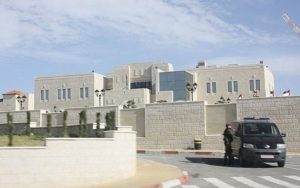
The Muqata’a in Ramallah, HQ of the Palestinian Authority
Jack Khoury writes in Haaretz on 18 January 2026:
President Donald Trump’s announcement of the official creation of the Gaza Board of Peace is not merely a new diplomatic initiative. It is a declaration with far deeper meaning: the restoration of an international – and above all American – protectorate over the Palestinian people.
Seventy-eight years after the Nakba and the end of the British Mandate, Palestinians once again find themselves living under a mandate – this time an American one, wrapped in the language of “peace, reconstruction and stability.”
The board announced by Trump, together with the accompanying Executive Board and Gaza Executive Board, includes no Palestinian representatives – not elected, not appointed and not even “broadly accepted.”
Trump’s Board of Peace
The Board of Peace
Comprised of heads of state, invited by Trump. Trump chairs the board, and its votes and decisions will be subject to his approval. Terms will be limited to three years and will be renewable with his approval, except for countries that contribute more than $1 billion in the first year.
The Executive Board
Will be tasked with setting the agenda for the Board of Peace.
Members include Steve Witkoff, Jared Kushner, Marco Rubio, Tony Blair, businessman Mark Rowan, World Bank President Ajay Banga and U.S. Deputy National Security Advisor Robert Gabriel. Aryeh Lightstone and Josh Gruenbaum are senior advisers.
Office of the High Representative
The Office of the High Representative will be headed by former UN Special Coordinator for the Middle East Peace Process Nickolay Mladenov. The White House described his role as an “on-the-ground link between the Board of Peace and the National Committee for the Administration of Gaza, or NCAG.”
Gaza Executive Board
The Gaza Executive Board will support the Office of the High Representative.
Though the scope of its authority is unclear, its members include Turkish Foreign Minister Hakan Fidan; Qatari diplomat Ali Al-Thawadi; Egypt’s spychief Hassan Rashad; Emirati Minister Ebrahim al-Hashimy; former Middle East envoy for the UN, Sigrid Kaag; Cypriot-Israeli businessman Yakir Gabay; Marc Rowan; Nickolay Mladneov; Tony Blair; Steve Witkoff; and Jared Kushner.
National Committee for the Administration of Gaza, or NCAG
The National Committee for the Administration of Gaza is a technocratic committee made up of Palestinians overseen by the Office of the High Representative. Dr. Nabil Ali Shaath, who previously served as deputy transportation minister in the Palestinian Authority, will lead the committee.
It is unclear whether the new administration will enjoy real freedom of action or broad public legitimacy. These bodies are meant to set policy, draw up plans and make fateful decisions. Even if some of those decisions are formally passed on to a technocratic committee in Gaza, this is merely the transmission of instructions. The members of that committee, though Palestinians from Gaza, wield no real influence. They are functionaries, not decision-makers. Any attempt to deviate from the line dictated from above could end in immediate replacement. That is how a mandate works, and that is how a system without sovereignty operates.
Within the Palestinian Authority’s corridors in Ramallah, officials are trying to project business as usual. President Mahmoud Abbas and his circle – primarily his deputy, Hussein al-Sheikh, and intelligence chief Majed Faraj – can point to consultations and contacts with Tony Blair and Nikolay Mladenov. Last week, they even rushed to welcome the establishment of the technocratic committee and to praise Trump, despite understanding that their own influence is marginal. The move is unfolding above their heads, without them, and the U.S. president does not see them as genuine partners.
At the same time, and as expected, Prime Minister Benjamin Netanyahu has already begun to obstruct the process. On Saturday, immediately after the end of the Sabbath, he voiced objections to the identity of the members of the Gaza Executive Committee. The implication is clear: until Israel’s “security reservations” are removed and Israel allows the Gaza Executive Committee and the technocratic committee to function normally, weeks or even months may pass – long enough to hollow out any decisions of real substance.
It should also be noted that Washington itself is in no hurry. Trump has made no secret of the fact that the Board of Peace operating under his patronage is intended to address other conflicts around the world as well. The Palestinian issue is only one among several, and not necessarily the most urgent. Moreover, it remains unclear where the tens of billions of dollars required to rebuild Gaza will come from.
In the reality of 2026, the fate of Palestinians in the Gaza Strip is not entrusted to any official Palestinian body. The Palestinian Authority, which hoped to return to Gaza through the “political gate,” is simultaneously losing its ability to govern the West Bank and facing ongoing erosion.
In Gaza itself, the discussion is entirely different. The questions are no longer who will rule and who will decide, but how to meet the most basic needs – food, medicine, shelter. The national dream has shrunk to daily survival. Any opening to hope, even when it comes under foreign patronage, is seen as a lifeline.
It is therefore essential to distinguish between dramatic Trump-style declarations and implementation on the ground. Yet whether the Board of Peace begins operating this week or is postponed again and again, the conclusion is the same. Palestinians, who for generations have dreamed of self-determination and sought to realize it, have lost even what remained of it. Without an official declaration and without flags – welcome to the mandate era, 2026 edition.
This article is reproduced in its entirety