

The theatre of ‘protection’ and repression of the Palestine solidarity movement
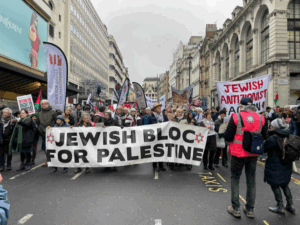
Jewish Bloc on the national Palestine solidarity demonstration, London 29 November 2025
Andrew Meyer writes in The Palestine Chronicle on 19 January 2026:
With grief and shock over the horrific attack on Bondi Beach still raw, influential figures in British politics wasted no time turning tragedy into political leverage. Almost immediately, the violence was seized upon as a pretext to revive a long-standing agenda – recasting the international movement against Israeli colonization and apartheid as an existential threat.
Bondi became the latest entry point in a familiar relay, where tragedy is converted into accusation, accusation into the criminalization of language, and language into guilt by association. Muslim presence is rendered suspect by default while the wider movement for Palestinian rights is disciplined as extremism by proximity. The question shifts accordingly – no longer concerning what happened in Sydney, or how violence might actually be prevented, but how far surveillance, restriction, and silencing can be expanded in the name of “safety.” Crucially, this grammar does not remain at the level of commentary. It travels through briefings, hearings, and police practice until it hardens into a domestic method.
Unsurprisingly, no one raced faster to operationalize this method than Dave Rich, Director of Policy at the Community Security Trust. Conceding in his recent Guardian op-ed that the world had “yet to discover the detailed motivations of the Bondi attackers,” he transformed this ignorance into indictment, stretching to implicate the global Palestine solidarity movement itself. The absurdity is worth quoting:
“Like it or not, it seems [the pro-Palestine movement] has generated and sustained a political culture in which violence is both conceivable and enacted. Shooting Jews celebrating Hanukkah is the most extreme manifestation of this hatred. But in sentiment, in the message it sends Jews, it is little different from the ‘Free Palestine’ graffiti scrawled on a Hanukkah menorah in north London…”
This is the hinge on which a wider operation turns, coming to bear significantly not only on the Palestine solidarity movement, but also on any political action which challenges the state’s position. The supposed violence endorsed or committed by such groups is not discovered, but produced, manufactured through strategically narrowed definitions that allow speech to be reclassified as crime. Once this maneuver is conceded, evidence becomes secondary. The state’s task is no longer to demonstrate harm, but to assert the authority to decide what words mean. From there, enforcement follows automatically.