

The settlers are not leaving: Decolonization, not coexistence
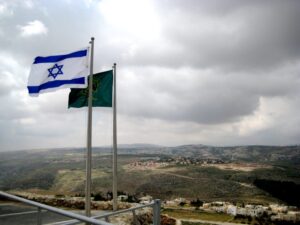
An Israeli flag overlooking an illegal Jewish settlement in the West Bank. Taken from the Israeli Herodian national park in the West Bank
Rima Najjar writes in Mondoweiss on 16 December 2025:
In her recent Mondoweiss essay, Lara Kilani observes that when Western liberals or segments of the international left promote a “one-state solution,” they often imagine a future in which Palestinians and Israelis become co-citizens, sharing institutions, civil rights, and an aspirational harmony. But for many Palestinians — especially those experiencing siege, displacement, bombardment, land confiscation, and the continual fracturing of their social and political worlds firsthand — this invitation to integration reads less as liberation and more as a demand to neutralize the political meaning of their suffering.
Kilani’s critique is incisive. She makes a compelling case for centering Palestinian perspectives and material realities rather than projecting externally conceived ideological solutions onto them: any one-state vision that fails to confront the structures of settler colonialism risks normalizing their outcomes. Her intervention exposes the conceptual shallowness of liberal fantasies that confuse coexistence with justice.
Yet to turn her insight into a broader political intervention, we must widen the frame she leaves underdeveloped: what Palestinians actually mean by “one democratic state,” the strongest decolonial versions of that vision, the structural death of the two-state paradigm, and — most difficult — what liberation can look like when the settler society refuses to leave.
What “one democratic state” actually means to Palestinians
Kilani notes, correctly, that Palestinian preferences are not monolithic and that support for a “one democratic state” is neither majoritarian nor stable across time and geography. But the crucial point is not simply that Palestinians disagree. It is that “one democratic state,” as imagined by many Western activists, bears little resemblance to what Palestinians themselves mean when they speak of a shared polity.