

The Religious Zionists now calling for their leaders to take action against settler violence
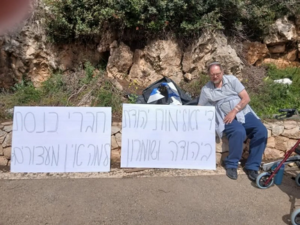
Rabbi Yitzchak Blau protesting outside the Knesset in Jerusalem on 23 March 2026. His signs read ‘Enough Jewish violence in Judea and Samaria’ and on the other ‘Knesset members, why are there no arrests’
Judy Maltz reports in Haaretz on 27 March 2026:
Last week, Rabbi Yehuda Gilad, a prominent figure in the religious Zionist movement, dropped a class he was scheduled to teach to take on a more urgent mission.
The director of Yeshivat Ma’ale Gilboa in northern Israel, Gilad headed to Khirbet Humsa, a Palestinian Bedouin village in the northern Jordan Valley often targeted by West Bank settlers. A particularly brutal assault carried out last week drew widespread media attention.
It was only a 30-minute drive from his yeshiva but might as well have been a world away.
Gilad had been invited by friends and colleagues who regularly engage in protective presence work in the West Bank. They wanted him to hear testimonies from the victims of this horrifying incident.
So profoundly shaken was this rabbi by what he saw and heard on this visit that he published a heart-felt post on his yeshiva’s Facebook page, in which he wondered: “Have we become the vilest of nations?”
A group of between 30 and 40 settlers, Gilad reported in his post, invaded the village in the middle of the night. They bound the men and brutally beat them with fists and clubs. They then stole their entire herd of 300 sheep. One of the victims had revealed “with deep shame” horrific details of the physical and sexual abuse he had experienced. Introducing the testimony of this man, Gilad wrote: “I find it difficult, and my hands tremble when I write this about Jews, but I will write it because I am convinced that it did happen.” The settlers, the rabbi recounted, had bound the man’s genitals with a zip-tie and forced his family members to watch.
He concluded his post with a question cast into the void: “What do we do? I feel that right now all I can do is cry out. Alas, what has become of us?”
Rabbi Yitzchak Blau, who lives with his family in the West Bank settlement of Alon Shvut, could also be described as a product of the religious Zionist movement through and through. Earlier this week, he, too, felt driven to take a stand against members of his own community.
Blau, who runs a gap year yeshiva program in the Old City of Jerusalem for American teenagers, staged a one-man protest outside the Knesset with two handmade signs in Hebrew. On one he had written, “Enough Jewish violence in Judea and Samaria,” and on the other, “Knesset members, why are there no arrests?”
“I have been frustrated with the militarism in the religious Zionism world for years, so that’s not a new thing,” Blau explained his solo demonstration in a phone call with Haaretz. “But recently, I’ve been frustrated not only with religious Zionism, but also with the larger Israeli community in terms of the silence that’s going on toward Palestinians, and every time you hear that no arrests have been made, one wonders how seriously the government is taking it. I just finally felt the need to do something.”
Blau posted a photo of himself with his signs on social media hoping to inspire something of a movement. It worked, he reports. “The post received hundreds of likes and comments from people who said they would have liked to join me. So next time, I’m going to try to bring a whole group of us out there.”
Brit Yakobi, a Tel Aviv-based social activist who helped found Smol Emuni – a relatively new Israeli movement of religious leftists that has since expanded to the United States – takes heart from these developments.
“We have heard in the past condemnations of settler violence from within the religious Zionist community, so that’s not really new,” she notes. “What stands out here is that it’s not only condemnation, but also calls for action.”
Jewish settler violence against Palestinians in the West Bank been on the rise since October 7, intensifying further in recent weeks, with Israelis distracted by the war with Iran. The usual pattern is that settlers establish an outpost, considered illegal even under Israeli law, in close proximity to a Palestinian community, from where they begin encroaching on Palestinian lands with their flocks.
This form of harassment often spreads to verbal abuse, vandalism, theft, beatings and even killings – until, out of desperation, the local Palestinians, effectively defenseless, pick up and leave. The police and army often turn a blind eye these acts of Jewish terrorism and ethnic cleansing. Israel’s far-right government, for its part, supports and encourages the vigilantes.
Israel’s religious Zionist community has gravitated far to the right over the years. Those Orthodox rabbis who have on occasion raised their voices against settler violence have suffered intense backlash, accused of betraying their community and playing into the hands of Israel’s fiercest enemies. They have tended to belong to the very small minority of left-leaning voices within the religious Zionist community.
What sets this moment apart is that those sounding the alarm include many from the mainstream religious Zionist establishment. That would include, for example, Rabbi Kenneth Brander, the president of the Ohr Torah Stone network of institutions. In a recent blog post, he wrote: “At a time when Israeli society is demonstrating extraordinary resilience, sacrifice and courage, a small minority of Jewish extremists have murdered Palestinians and committed more than 100 other acts of violence.
“Such behavior is morally wrong, violates Jewish law and risks undermining Israel’s moral strength as it fights an existential war against the Iranian regime and its terror proxies. Even more disturbing is that the perpetrators of this violence identify as observant Jews, allegedly acting in the name of religion and the protection of Israel.”
Other prominent voices in the religious Zionist community who have joined such calls to condemned the violence have done so for different, less principled, reasons.
Last week, for example, the rabbis of the Gush Etzion settlement bloc issued a joint statement denouncing what they described as the violent acts of “a few dozen teenagers.” Such behavior, the letter deemed, was “unworthy” not because it was immoral or in violation of Jewish values, but because it created bad publicity for the settlement enterprise, thereby jeopardizing its future.
Israel’s ambassador to Washington Yechiel Leiter, a settler himself, expressed such concerns in an interview on Wednesday with Yediot Ahronoth.
“I am so angry about the issue of Jewish violence in Judea and Samaria,” he said. “I know the truth: that there are 600,000 people there who respect the law, who respect their neighbors, who get up in the morning and only want to do good, but there’s a group of a few hundred guys who’ve dropped out of the system and who put a stain on the entire enterprise, and everyone is quiet.”
This coming Sunday, a relatively liberal religious group that supports the settlement movement called Hineni will be holding an online event, featuring prominent settler leaders, under the headline “Yes to the Land of Israel. No to Violence.” In an invitation published on social media, the organizers wrote: “Some things that should seem obvious still need to be said in a clear voice: Together we support settlements, together we support the armed forces, and together we oppose violence.”
Although the motivation in this case may well be preventing further reputational damage to the settler movement, Yakobi, the anti-occupation activist, nonetheless considers the initiative “worthy.” “Even if they have other interests,” she adds. It is no coincidence, asserts Yakobi, that more and more voices within the religious Zionist community are speaking out against settler violence.
“I think there’s a growing realization that this is not something that the human rights community in Israel can handle on its own any longer,” she says. “There’s also a feeling that this violence is spreading, that it’s much more institutionalized than any of us believed, and that if we don’t act now, it won’t be confined to the West Bank.”
This article is reproduced in its entirety