

Unprecedented displacement of Palestinian communities in the West Bank during past year
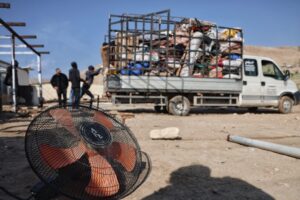
Palestinian Bedouin residents of Ras Ain al-Auja dismantle their homes as Israeli settlers forcibly expel them from their lands, January 2026
Qassam Muaddi reports in Mondoweiss on 18 January 2026:
The year 2025 saw the unprecedented displacement of Palestinian rural communities by Israeli settlers, who enjoy the Israeli army’s backing. At least 13 rural Palestinian communities in the West Bank were completely wiped off the map. This impacted at least 190 families and 1,090 individuals.
The wave of settler attacks has continued into 2026, with the displacement of the Ras Ain al-Auja community near Jericho last week.
The dramatic escalation of Israeli settler violence against the Palestinian countryside began after October 7, 2023, and has been particularly devastating to Bedouin communities in the Jordan Valley, the West Bank’s eastern slopes, and the South Hebron Hills. Palestinians from these areas consider their silent displacement a “second Nakba,” and an extension of Israel’s genocide in Gaza.
In 2025, Israeli settlers conducted 892 attacks on Palestinians, killing 14 people in the West Bank.
Last week, the head of the Palestinian Authority’s official Wall and Settlement Resistance Commission, Moayad Shaaban, announced the commission’s findings for the year 2025 at a press conference. According to the report, between January and December 2025, Israeli settlers conducted 892 attacks on Palestinians, killing 14 people in the West Bank. Settler attacks also provoked 434 fires, 127 of which affected farmland, and 307 fires against other Palestinian properties. These attacks concentrated in the areas surrounding Ramallah, Nablus, Hebron, and Tulkarem.
The report also indicated that in 2025, 35,273 trees were destroyed and poisoned, including 26,988 olive trees in the areas of Salfit, Nablus, Ramallah, Bethlehem, and Hebron. This was coupled with a wave of demolitions by the Israeli army, which leveled 1,400 Palestinian structures that year, including 304 inhabited homes, 74 uninhabited houses, 4,900 farming structures, and 270 other livelihood structures. Demolitions, according to the report, concentrated in Ramallah, Nablus, Tubas, Hebron, and Jerusalem.
A year ago, Shaaban told Mondoweiss that settlers’ violence was “an arm of Israel’s annexation policy.” Shaaban also said that his commission had pursued a strategy of establishing a humanitarian presence on the ground to confront these policies, especially through the mobilization of volunteers from local communities. Shaaban explained that the commission worked on “enhancing local steadfastness,” pointing out that volunteers supported Palestinian farmers in accessing their lands in almost 60 percent of the villages threatened by settler violence during the 2024 olive harvest season.
But conditions in the West Bank countryside have deteriorated dramatically since then. The olive harvest season marked a record low this past October, yielding a meager 7,000 tons of olive oil, compared to the 27,000 tons produced last year, according to estimates by the PA Ministry of Agriculture and other Palestinian research centers. The low production totals for 2025 are close to those in 2023, when the events of October 7 coincided with the height of the harvest season and were immediately followed by a dramatic spike in settler violence.