

The fast approaching moment when countries, companies & investors give up on business with Israel
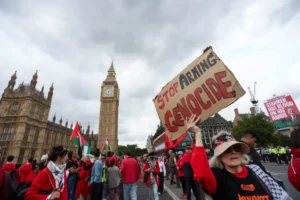
Thousands of protesters created a ‘Red Line for Palestine’, wearing red while encircling the Parliament building in London, 4 June 2025
Eytan Avriel writes in Haaretz on 29 July 2025:
Rightfully or not, Israel has in recent days been forced to face a new challenge: a significant part of the world is infuriated by what has been happening in Gaza and by images showing starvation and destruction among civilians, and is seeking to subject Israel to sanctions, restrictions and punishment in order to put a stop to it.
This has many ramifications in the defense and diplomatic spheres, but here we wish to focus on economics. Could the deterioration in Israel’s image and the growing international pressure harm the Israeli economy – the same economy that, against all odds and many predictions, has managed to hold on through almost two years of war?
The rapidly darkening sky over Israel’s reputation was evident this weekend on every major international news website. It starts in Europe: France has announced it will soon recognize a Palestinian state; in the United Kingdom, there is heavy political and parliamentary pressure to do the same, and both have been threatening sanctions. They are joined by Spain, demanding to cancel an important trade agreement, as well as Belgium, the Netherlands, Italy and Japan, all of which already restricted arms exports to Israel and are looking into wider sanctions.The situation is no better in the rest of the world, with the exception of the United States. Australia and New Zealand have not imposed sanctions on Israel so far, but are now considering sanctions on individuals involved in the occupation, according to their interpretation. Meanwhile, 12 countries this month signed a commitment to embargo arms shipments and energy exports to Israel and to prohibit government agencies from signing agreements with Israel.
Official sanctions by foreign governments are only part of the expected financial damage – and not necessarily the largest part. Unofficially, and without any obligatory external directive, businesses around the world are quietly choosing not to do business with Israel, whether due to managers’ solidarity with Palestinians in Gaza or consumer pressure. This damage is hard to quantify or even detect: who knows whether some exporter’s customer stopped buying from them because they got a cheaper offer from a competitor or because they no longer want to deal with Israelis?
Israeli academia has also been suffering. A host of universities, almost all of them European, have already announced they are severing ties with Israeli institutions. At this stage, no pan-European decision to remove Israel from the EU Horizon program, which distributes research and development grants to researchers, has been made, but pressure to cut ties with Israel is growing. This program has so far provided Israeli researchers with hundreds of millions of dollars each year in research grants, and suspending Israel from it would seriously damage Israeli research and the wider economy.
And this is not the end of it. Almost every Israeli travelling abroad has been reporting something people in Israel don’t realize – and that the media largely avoids covering: the extent of the change in public attitudes toward Israel, and how toxic the “Israel” brand has become to the person on the street. While Israeli media chooses not to show the harsh images coming from Gaza, many people around the world have been watching these pictures night after night – and drawing the conclusion that Israel is responsible.
A hard-to-quantify change
Unlike part of the Israeli public, foreign nationals don’t tell themselves that these are fabricated pictures, manipulations or material serving Hamas’ interests. They see starving children and bodies in the street and conclude that Israel – the strongest country in the region – is responsible, or at least is allowing this reality to happen. From here, it’s but a short step to an informal public embargo: a person who saw disturbing images at night is unlikely to choose an Israeli product or a service from an Israeli company the following day.
Tourism is one example of the blow to Israel’s reputation: foreign tourists won’t be coming to Israel, despite it being safe – for now – from missiles. At the same time Israeli tourists are thinking twice before travelling abroad, for fear of hostile reactions. Last week, for example, an Israeli cruise ship had to forgo anchoring in one Greek island, while teenagers got in a politically motivated fight on another Greek island.
It is difficult, at this stage to quantify the financial damage caused by such sanctions, most of which are still at the threat level, and which Israel and the United States occasionally succeed in deflecting. But nobody will be surprised when foreign countries take action, if images from Gaza – and quotes from Israeli ministers and Knesset members about the killing of innocent civilians and forced displacement – don’t stop.
According to the Bank of Israel’s Research Department, which this month released its summary for the first half of the year along with predictions for the next, the state of Israel’s economy does not appear dire. Israeli production has grown 3.7 percent in the first quarter of the year – a figure no different from before the war. Unemployment is very low at 3 percent, and Israeli production is predicted to grow by 4.6 percent next year.
The markets, too, have embraced this optimism: the Tel Aviv 35 Index has gone up 26 percent since the start of the year, reaching a new record, as did the Tel Aviv 125 Index, rising by 28 percent. The shekel has strengthened 8 percent against the dollar, and the cost of insuring five-year Israeli government bonds against bankruptcy has dropped by 50 percent, compared to the wartime peak. Even foreign investment in Israeli hi-tech and startups has gone up.
These are impressive figures, and they have surprised many. But can the Israeli economy continue to perform so well through a sustained period of international sanctions – not only from governments, but also from institutions and the public at large, including key markets for Israeli businesses such as Europe (about a third of Israeli trade) and the United States (around 15 percent)? That is far from certain.
To begin with, this new challenge comes after a period of economic hardship during which the government was compelled to flood the economy with money for war expenses – mainly payments to reservists and support for evacuees from the south, the north, and lately, also the central region. These funds are largely responsible for the strong domestic economic figures, as well as for the low unemployment rates.
In addition, it’s already clear that defense expenditure will grow next year well beyond what has been planned so far. According to the credit rating agency Moody’s, the budget deficit is already expected to exceed 8 percent this year, and the debt-to-GDP ratio will rise to 75 percent in the medium term, a figure that could mean further credit downgrades in the future.
This is a new and unprecedented reality. Until recently, the Western World viewed Israel as a victim of wars against terrorist organizations – even if it often reacted harshly. Israel is now becoming, in global public opinion, an aggressive country that has lost its moral compass – one that should be punished and restrained in order to force it to end the violence it has been employing in Gaza and against Palestinians in general.
This new image of Israel – and of Israelis – will intensify around the world as the chaos in Gaza continues. As with all matters of image, this shift will be very hard to reverse, even after the harsh images from Gaza stop appearing on screens abroad. It’s not inconceivable, for example, that the moment will come when foreign investors – such as venture capital funds that have been financing the Israeli ‘startup nation’ and so far remained undeterred by the war – will begin to feel uncomfortable investing in Israel.
Cumulative damage
Sanctions, restrictions and international isolation are tools that work slowly to influence economies, as can be learned from Russia’s invasion of Ukraine and the sanctions imposed in its wake. Russia registered 4 percent production growth in 2024 despite the war and the sanctions – but it also faced 10 percent inflation and an 18 percent interest rate.
Sooner or later, sanctions add up. Eventually, they reach the home of every citizen and the pocket of every inhabitant – because this is precisely their goal: to prompt the public of the offending country to cry out to its politicians – and perhaps pressure them to change course.
This article is reproduced in its entirety