

The harder hope becomes, the more urgent it is: a reckoning for Israelis and Palestinians in 2026
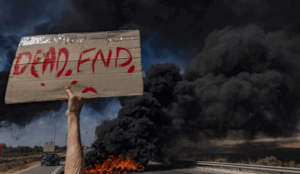
A protest for the return of the hostages on Highway 1, August 2025
David Issacharoff writes in Haaretz on 31 December 2025:
This year of destruction, ending today, began more than 16 months into the war in Gaza and marked the climax of the deepest crisis the people between the Jordan River and the Mediterranean Sea have ever faced. Israelis and Palestinians end 2025 entrenched in a widening animosity over a land that feels as if it is growing ever smaller.
Prime Minister Benjamin Netanyahu’s far-right government chose to turn Israel into a full-blown, menacing pariah, stirring resentment within its borders and isolating it abroad.
It deepened a brutal military offensive in Gaza that saw countless massacres of Palestinians, including 78 days in the spring that will live forever in infamy, as Israel closed Gaza’s gates to food. In an already ravaged enclave, Palestinians were forced to choose between finding bread and risking death. The war ended with some 70,000 Palestinians killed in Gaza, and counting.
Most Israelis found a sense of closure in the return of the hostages, some alive after almost 740 days in Gaza’s tunnels. Only the body of Ran Gvili is yet to be returned.
Israel after 2025 is a battered, tired country, more bewildered than before. 2026 will inevitably be a year of reckonings, one hinging on the other.
The most important reckoning Israel will face is over what it has done in Gaza. Since the war’s beginning, and even more so now at its end, Israelis must decide whether to look away, endorse it, or resist.
The choice to look away is a dangerous one, rooted in collective self-delusion. Above all, the indifference allows perpetrators of war crimes to claim victory, many of whom have vowed time and again not to stop until an Israeli flag is finally planted on land in Gaza where thousands of Palestinians once lived. If this is the choice, slowly but surely Jewish settlements will spread, and a project of ethnic cleansing will be taken to a new, unprecedented level.
But this ominous victory depends on another major reckoning Israelis will make at the polls this coming year. Will Netanyahu’s coalition win, or at least not lose, and cling to power?
That, in turn, rests on a crossroads Netanyahu’s centrist opposition must confront the day after the election, as most polls suggest it holds a majority: whether to form a governing coalition with the support of Arab parties. So far, leaders of the bloc have called for a “Zionist coalition,” which, in plainer terms, means a government by Jews, for Jews.
This, like apathy toward Gaza, would empower far-right sentiment and have concrete effects on the ground, allowing Netanyahu, Itamar Ben-Gvir and their allies to continue enacting racist policies toward Arabs and Palestinians, inside and outside Israel’s sovereign borders.
Israel does not have to be a bad place. This rare moment of isolation is an opportunity for honest introspection and self-examination. Most people here are good and willing, but many can no longer find the hope to build a bridge or extend a hand. Israelis, together with Palestinians, can begin to close this trench. If they continue alone, it can only be widened, making this tiny piece of land unlivable for all.
The harder it becomes to hope, the more urgent hope is. But it must turn into action – something infinitely braver than the destruction of Gaza: rebuilding a shared kinship over this land, rather than waging a blood-soaked war over it. This must begin in 2026, even if it takes an entire generation. Peace cannot be too much to ask; it is simply the only condition for living here.
This article is reproduced in its entirety