

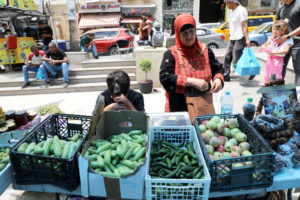
“We go back to the land as a refuge whenever there is a crisis. It’s natural, because it’s clear that the land is our mother,” said Farid Tamallah, an environmental activist and founder of Souq al-Fallahin, a local market connecting farmers directly to the consumer public in the West Bank. “After two years of a global pandemic, the question of food security has returned to the forefront, driving young farmers back to agriculture.”
Tamallah, a farmer himself and the founder of Sharaka 2011 (a community-based association organizing Souq al-Fallahin), clarifies that the pandemic exacerbated the already harsh conditions that have threatened the mere survival of the Palestinian agricultural sector.
“It is very important to support Palestinian peasants in their ability to survive,” he said. “And it’s not only for their food security — surviving means adopting an entire lifestyle where Palestinian farmers become defenders of the land. That is when protecting the land becomes as important as cultivating it.”
In recent years, Palestinian environmental activists have been calling on farmers to adhere to agroecological principles, defining them as a social movement advocating for a set of practices that address the ecological, socio-cultural, economic, and political factors that shape food systems, from production to consumption.
According to many of these activists, the principles of agroecology could help in the particularly dire political context in Palestine, which has been characterized by restrictive socio-economic conditions. In addition to climate changes — fluctuations in temperatures, rain, and shifting seasons — Palestinian farmers are at constant risk of Israeli colonial land confiscation, in addition to restrictions on the freedom of movement of Palestinian farmers, and the danger posed by colonial settlers in destroying Palestinians crops.