

Studying for high school finals in Gaza without electricity, adequate food or a home
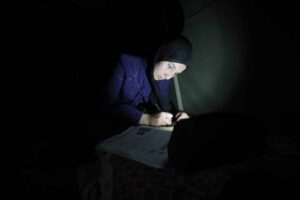
Dana Mohammed Abu Dalfa, a Palestinian high school student, reviews her lessons using the light of a mobile phone inside a displacement tent in the Gaza Strip, 20 June 2026
Tareq S. Hajjaj reports in Mondoweiss on 26 June 2026:
Sumaya Abdel Rahman finished her General Secondary Education Exams one year before the genocide; her younger sister, Dima, started her exams on June 20 this year. Between the two sisters, sharing a tent in Gaza City, the distance could not be greater: one crossed this milestone in a world that still had some semblance of normalcy, and the other is navigating it amid continued food shortages and a stifling blockade.
Memories of Sumaya’s year now seem distant. Life under siege in her time was not easy, but it was still better than “living in tents and experiencing a famine.”
“Watching my sister Dima prepare for the exams fills me with sadness,” Sumaya said. She recalls how their mother used to prepare special foods — honey, nuts, fruit, meals believed to sharpen concentration and memory. “Now Dima often studies while hungry, and she went to her first exam hungry as well.”
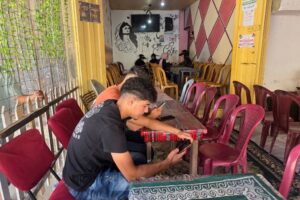
Palestinian students take their electronic General Secondary Education Certificate Examination (Tawjihi) at a café in Khan Younis, southern Gaza, on 20 June 2026
The General Secondary Education Examination, commonly known as “Tawjihi” in Palestine and Jordan, has been conducted online in Gaza for the third consecutive school year, amid the near-total absence of a functioning educational system in the Strip. There are no traditional desks or classrooms, no answer sheets or exam booklets. Instead, students gather in cafes and other locations where electricity and internet access are available, sitting shoulder to shoulder as they complete their exams.
‘I study on the sand’
Dima does not have a quiet room. She has a mattress on the ground inside a tent in Gaza City, no private space of her own, and nowhere to store her textbooks, pens, or school supplies. Several younger siblings share the same tent.
Before the genocide, Tawjihi was inseparable from the atmosphere families created around it. Students were surrounded by care and encouragement throughout the academic year, then sat for exams in unfamiliar schools under strict supervision. Exam papers arrived sealed from the Ministry of Education, sometimes guarded by police in the minutes before the test, while ministry officials inspected the examination halls.