

Satellite images show Israel continues Gaza demolition efforts despite ceasefire
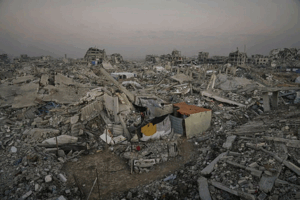
A makeshift tent stands amid widespread devastation in Gaza City in November 2025
Avi Scharf and Nir Hasson report in Haaretz on 22 December 2025:
The IDF continues to engage in systematic demolitions of buildings in areas under its control in the Gaza Strip even after the cease-fire went into effect, recent satellite images show. Produced by Planet Labs, the images show eastern Gaza City and the Shujaiyeh neighborhood as they were last week and how they appeared several days after the cease-fire went into effect in October.
The comparison shows that the IDF flattened hundreds of buildings in this area alone. Some had been damaged during the war and were later razed using heavy equipment. Others appear to be pretty much untouched. The flattened areas cover dozens or hundreds of acres east of the Yellow Line to which the IDF withdrew under the terms of the cease-fire.
The satellite images also show that in five areas under Hamas control, new encampments have been erected in recent weeks, each comprising between dozens and hundreds of tents for displaced residents. Two of the areas are adjacent to the Netzarim corridor, south of Gaza City; three are north of the city, near the beach.
Palestinian sources say that before the war, about one million people lived in areas now under IDF control, mainly east of Gaza City, Khan Yunis and Rafah. These Gazans aren’t expected to be able to return to their homes anytime in the near future and will be forced to live in tents and temporary shelters. This is in addition to the hundreds of thousands of Gazans who continue living in displaced persons camps because their homes were destroyed.
The U.K. based Forensic Architecture group released its own analysis of satellite photos of Gaza last week. The group says that after the cease-fire went into effect, Israel erected 13 new outposts along the Yellow Line, mainly in northern Gaza and east of Khan Yunis. Forensic Architecture said the army has 48 outposts along the Yellow Line, linked by roads to Israeli territory, and has built a new road in eastern Khan Yunis. It said that the army had razed more buildings in the Khan Yunis area and had cleared rubble in the Rafah area.
The United Nations Satellite Center said in October that during the war 81 percent of all buildings and infrastructure in Gaza were partly or fully destroyed. It said 123,44 buildings were destroyed, 12,116 badly damaged and 33,857 moderately damaged.
In recent weeks, due to heavy rainfall in Gaza, buildings partially damaged in the war have reportedly collapsed, in some cases injuring people. On Sunday, five people were reportedly killed when a building collapsed in the Gaza City neighborhood of Sheikh Radwan.
The IDF’s demolition policy changed over the course of the war. Initially, the destruction was a side effect of operations. Following the invasion of Rafah in May 2024, the IDF began hiring civilian contractors to systematically raze entire neighborhoods all over Gaza.
Estimates are that due to this policy, nearly 100 percent of the buildings in Rafah, Abasan al-Kabira, Khirbet Khizeh, Jabalya and other areas. In addition, over the course of the war, 80 percent of greenhouses were demolished, 87 percent of agricultural areas and 80 percent of roads. Experts estimated that the destruction has created 61 million tons of rubble.
The IDF had not responded to requests for comment by press time.
This article is reproduced in its entirety