

Rewriting the laws of war: Israel, Iran and the collapse of the old order
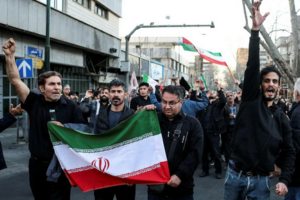
Iranians chant slogans during a mourning rally in Tehran on March 1, a day after Iran’s supreme leader, Ayatollah Ali Khamenei, was killed. (Crowds in the street but not as the attackers hoped.}
Michael Sfard writes in Haaretz on 15 March 2026:
These days, amid the Israeli-U.S. attack on Iran, there are no real newsrooms left in Israel. It seems that all television channels have been taken over by a group composed, with few exceptions, of warmongers who adore anything that smells of the IDF or American uniforms, get high on the scent of gunpowder, and are almost erotically enthusiastic about the air force’s performance.
In this situation, it is no wonder that in hundreds of broadcast hours, amid the incessant chatter of hosts and panel members, almost all of them men, no one asked a simple question: Is this war legal? Worldwide, this question is often asked. Leading experts in the laws of war are addressing it because the global public wants and needs to know what the law says about the use of massive force that causes hundreds, perhaps thousands, of deaths. But in Israel, it turns out, this question does not interest news producers.
The troubling answer is that there is a rare consensus among leading international experts in the laws of war that this war in Iran is an illegal war.
There are rules governing when it is permissible to start a war, and they were written in blood. A lot of blood. The laws regulating the use of force were shaped after thousands of years of atrocities resulting from wars, and especially following the two World Wars that devastated continents and killed tens of millions of people.
The UN Charter, drafted in June 1945, included a revolutionary prohibition for its time on the use of force in international relations. The only exceptions are force authorized by the UN Security Council, which therefore expresses (with distortions, sometimes severe ones) a broad consensus among the nations of the world, and the use of force that meets the definition of self-defense. There is fierce debate among legal scholars about whether self-defense applies only as a response to an attack on the state under attack, or whether an “anticipatory self-defense,” which means a strike intended to preempt an imminent military action, is also included.
In my opinion, in the nuclear age it is difficult to accept that one must wait for an attack before defending oneself. On the other hand, broadening the definition of defense to include preemptive war creates great danger. Every aggressor will claim to be preempting an attack, and we will return to a world where, in practice, there is no limit on the use of force. Therefore, for a preemptive strike to qualify as self-defense, it must be based on strong evidence proving the other side’s capability and intent to attack, and on the absence of any alternative to prevent that attack other than a preemptive strike now.
Israel and the United States launched a war without receiving authorization from the UN Security Council or from a significant coalition of states. Such a coalition would not have made the war legal, but it might have increased its political legitimacy. But can the war be seen as an act of self-defense on Israel’s part?
Iran wants to destroy Israel. Its leaders have declared this for years. They have armed terror groups in the region and around the world and have advanced toward nuclear capability. But is this legally sufficient to justify launching a war against it? The question is not only what Iran wants, but what it intended and was capable of doing in the immediate term.
Let us recall that just eight months ago, U.S. President Donald Trump boasted that the Iranian nuclear program had been “obliterated.” Prime Minister Benjamin Netanyahu said that a historic victory had been achieved that would “stand for generations,” and that existential threats from Iran to Israel had been removed. At the same time, according to reports, Iran was recently willing to reach an agreement that would prevent it from developing nuclear weapons, even if it insisted on retaining the right to enrich uranium to a limited degree.
At first glance, this suggests that on the eve of the war there was no Iranian threat, certainly not an imminent one. Moreover, any attempt to present the war as defensive collapses when confronted with the rhetoric of its aggressors, which makes clear that the goal was regime change in Iran. As such, the war cannot be considered defensive by any accepted standard of the term.
For several years now, it has seemed that the world is striving to return to the Darwinian political and military reality that existed before the two World Wars, which produced humanity’s greatest atrocities, and which humanity swore never to return to.
The fact that a wicked regime rules in the Islamic Republic of Iran, an oppressive fundamentalist dictatorship whose downfall every humanist should desire, is irrelevant. If it becomes permissible to wage war that does not meet the definition of self-defense and has not been approved by the UN Security Council, then there are no rules. Everything goes. If Trump and Netanyahu are allowed to do this, then Putin is allowed to do it, and so are Iran’s leaders. And so, we have officially replaced the rule of law with the rule of the gun.
There is indeed a serious problem with the functioning of international institutions. Their record in dealing with cruel regimes like the Iranian regime, which oppress their citizens, create terror cells, and nurture an obsession with destroying a country with which they do not even share a border, is very poor. The cynicism of international politics, the prioritization of interests over values, and the veto system that paralyzes the UN Security Council and prevents it from fulfilling its role of maintaining world peace and security all point to the need for deep reform of the institutions meant to protect us.
However, Trump and Netanyahu are not trying to repair a flawed world order in order to protect the values it was meant to promote. Without concealing it, they are seeking to shatter international law entirely. They are outlining a world very different from that envisioned by the drafters of the UN Charter or by those who advocate reform of the UN system: a dark and violent world reminiscent of epic fantasy series depicting a medieval-like world in which military force and cruelty are legitimate and central tools for achieving goals in international relations.
For example, when Donald Trump returned to the White House for a second term, he and Netanyahu turned the idea of ethnically cleansing the Gaza Strip of its two million residents – once whispered only among the most racist and messianic fringes of Israeli politics, a crime against humanity for which there can be no forgiveness – into a plan that was seriously considered and even examined operationally.
lIn addition to hostility toward international law, Trump and Netanyahu share another characteristic. Both are leading intensive and forceful processes that strip away democratic governmental features in their countries. They are weakening and dismantling institutional gatekeepers, appointing unqualified loyalists to sensitive positions, launching relentless attacks on academia, media, culture, and the judiciary, and unleashing political violence and corruption. A lot of violence and a lot of corruption.
For hundreds of years in the United States and for decades in Israel, painstaking efforts created governmental systems and cultures of governance that, despite their flaws, are based on separation of powers, on civil society functioning as a check on government power, on an independent and professional judiciary, and on guarantees of political freedom for opposition voices. All of these institutions became targets of the political and legal barrage unleashed by Trump and Netanyahu. Alongside their undermining of international law, they also mounted a powerful assault on liberal democracy and on the idea of constitutionalism.
That is not surprising: just as liberal democracy and the post-World War II rules-based international order were intertwined, democratic backsliding and the erosion of international law also go hand in hand.
None of this has prevented Benjamin Netanyahu – who faces trial in Israel on multiple corruption charges, is wanted by the International Criminal Court for alleged war crimes and crimes against humanity in Gaza, has spent three decades denying freedom and independence to millions of Palestinians, and is steering Israel toward an anti-democratic, authoritarian system to secure his own political survival – from presenting the war against Iran as a campaign to bring freedom and human rights to the Iranian people.
In Hebrew, this is called hypocrisy. In Yiddish, it is called “chutzpah.”
This article is reproduced in its entirety