

Residents of this Palestinian village are slowly suffocating. Their land is being taken and so are their lives
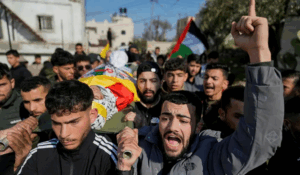
Mourners chant while they carry the body of Palestinian boy Mohammad Na’san, 14, who was killed by Israeli forces, in the West Bank village of al-Mughayyir
Gideon Levy reports in Haaretz on 31 January 2026:
A village grieves for a native son – a 15-year-old boy who was shot to death by an Israel Defense Forces soldier from inside an armored jeep. When we visited the village and sat with the bereaved father in the local council’s offices, children’s voices rose from the street, chanting: “Throw flowers on the body of the shahid [martyr], we shall march to Al-Quds with millions of shahids.”
The children, schoolbags on their backs, didn’t realize that the father of the latest victim was at that moment telling the story of his son, the latest shahid. For them, the chanting is a daily ritual on their way home from school. And little wonder: Their village, Al-Mughayyir, is being suffocated. When, in the course of two years, it lays to rest four of its sons; when 98 percent of its land is plundered; when its main entrance has been blocked for over two years; and when new and violent settler outposts are cropping up on every nearby hill – it’s easy to understand why the children are singing about a million shahids and dreaming of a march on Jerusalem.
The latest of the local shahids was cut down here two weeks ago. He was in 11th grade and dreamed of traveling to America to visit his sister, and was apparently about to throw a stone at the convoy of armored vehicles that hurtles through town nearly every day, mainly to provoke the inhabitants. The soldiers also make a point of showing up every Friday, at the conclusion of the midday prayers, in the plaza next to the local mosque. After all, it’s a good opportunity to demonstrate control and power, and to provoke young people.
Mohammed Naasan and his father, Saad, had just left the mosque after prayers on Friday, January 16, when explosions, probably caused by stun grenades, were heard. The boy broke away from his father and ran toward the sound of the explosions, to the scene of the clashes.
Based on testimonies collected by Muhammad Rumana, a field researcher for B’Tselem – The Israeli Information Center for Human Rights in the Occupied Territories, as Mohammed picked up a stone, a bullet was instantly fired at his upper body, possibly with the intent to kill. The soldier-shooter didn’t bother to get out of his jeep: He took aim, squeezed the trigger and took the boy’s life. Saad, who had heard the shot from afar, quickly learned from young people in the area that his son had been the target.
Al-Mughayyir is a village of some 4,000 in the Ramallah area. Many of its streets are unpaved; there’s a pervasive air of poverty. The council head, Amin Abu Aaliya, says that his village has lost almost all of its farmland during all the years of the occupation. Only 950 dunams (238 acres) remain of the 43,000 dunams (10,750 acres) the villagers originally owned.
During the war in the Gaza Strip, a number of violent settler outposts sprang up in the vicinity. Indeed, at present, 10 outposts are suffocating Al-Mughayyir from all sides. One of them is only a few dozen meters from the village’s homes.
Saad is waiting for us in the rundown council building, wearing a dark sweat suit, his face a study in profound grief. He’s 44 and has six children, including Mohammed. He is a maintenance worker in Al-Quds Open University, Ramallah, and also at a gym in the neighboring village of Mazra’a a-Sharqiya, which helps make ends meet.
Mohammed had no big dreams other, perhaps, than to join his 19-year-old sister, Duah, who lives in California. She emigrated to the United States two years ago and married a Palestinian who lives there. Saad obtained a Palestinian passport for Mohammed three months ago.
Now Duah is grief-stricken in her American home over her brother’s death. The two were very close and spoke by video almost every day. She was not able to travel to attend the funeral because she doesn’t yet have a Green Card and might not be allowed back in if she leaves the States.
In the morning of that Friday, father and son got up as usual and as midday approached went to the mosque for the weekly prayers. The village was quiet, Saad recalls. Toward the end of the service they heard explosions, and Mohammed rushed off to the scene of the event, a few hundred meters away, without saying a word to his father.
According to the testimonies compiled by Rumana, from B’Tselem, the three military vehicles were stoned by local youths. The witnesses confirm that Mohammed had only just picked up a stone when the shot rang out. Rumana measured the distance between shooter and victim: 65 meters (213 ft.).
Saad rushed to the scene but Mohammed had already been evacuated in a private car to a medical clinic in Abu Falah, a nearby village. The youth was lifeless when Saad got to the clinic, but the physician there went on trying to revive him. Later the body was then taken in a Palestinian ambulance to Ramallah Government Hospital. The bullet had entered his chest on the left side and exited from his lower left back, slicing through the heart. Death was instantaneous.
In the meantime, the IDF blocked all the entrances to Al-Mughayyir, so the many relatives who had rushed to the hospital in Ramallah could not return home with Mohammed’s body. They went back to the clinic in Abu Falah, placed the body in the morgue and waited for the siege to be lifted. They were only able to bury the boy the next day, but as the time for the funeral approached, the army again blocked entry to the village, preventing the many people who came from outside to attend. Rumana himself was denied entry.
During the three days of mourning that followed, when those who came to pay their condolences were received in the diwan, the village gathering site, soldiers occasionally showed up and fired tear-gas grenades and also live ammunition into the walls of the structure. Saad showed us the bullet holes and related that hours for condolence calls were reduced for fear of the troops. A Shin Bet security service agent, “Abu Nimr,” phoned one of the family members and through him warned those present not to let the situation escalate.
The IDF Spokesperson’s Unit this week stated, in reply to a query from Haaretz: “On January 16, IDF forces arrived in the area of the village of al-Mughayyir, in the Binyamin Brigade sector, following a delayed report that several militants had thrown stones at Israeli civilians, set tires on fire and blocked the access road to the area.
“Upon the forces’ arrival, dozens of militants were identified throwing stones. The forces acted in accordance with regulations, opened fire to neutralize an immediate threat, and killed a militant who was running toward them with a rock, after carrying out the suspect-apprehension procedure, which included warning shots fired into the air. Contrary to the claims made, the IDF did not prevent or delay the burial of the militant or the holding of his funeral. The funeral took place the day after his death, with no connection to the IDF.”
Showing us his phone, Saad scrolls through scores of photographs of his son, since early childhood. In one shot, taken three months ago, Mohammed strikes a model’s pose, attractively dressed, his face pointed toward the horizon.
Abu Aaliya, the council head, is sitting in his shabby office, an open package of Petit Beurre biscuits on his desk. He immediately extended a comforting arm to the grieving father. Twelve villagers have been killed over the years by soldiers, Abu Aaliya tells us, including four since the start of the war in Gaza. And four of the 10 settler outposts crowding out Al-Mughayyir were established since October 7.
The largest pogrom in the village was perpetrated in April 2024. Hundreds of settlers raided all the villages in the area, after the body of 14-year-old Binyamin Ahimeir, from the nearby outpost of Malakhei Hashalom (Angels of Peace), was discovered. Fifty-six inhabitants of Al-Mughayyir were wounded in the assault, 30 by soldiers and 26 by settlers, the council head explains. The marauders also set ablaze 50 homes and 15 vehicles.
Abu Aaliya says that he himself was arrested by the army that day and taken to Megiddo Prison, where he was stripped naked and brutally abused – several of his teeth were broken. He was only released after nine days. His interrogators accused him of inciting the local population, he says, asking us now: “Am I supposed to say ‘thank you’ to the army and the settlers for killing our children?”
We drove to the site of the killing. Mohammed and another boy had stood in a low area by the dirt road, where cars park; perhaps they were trying to hide from the soldiers. The troops, as said, were some distance away down. There is no way a stone thrown by Mohammed could even have hit the soldiers, even if they had left their armored vehicles, which they did not do.
We make our way to the eastern edge of Al-Mughayyir. All the cultivated land in the valley belongs to the village – and they are denied access to virtually all of it. In the last two years, we are told, the army and the settlers have uprooted and/or cut down 11,000 olive trees in the area.
On every hill an ill-intentioned settler outpost is perched; the exit from Al-Mughayyir to the Alon Road is blocked. When the most recent (to date) outpost was erected here, the army moved the barrier to allow its new residents free movement in this non-apartheid land. Quite frequently, all the entrances to Al-Mughayyir are blocked, in which case the schools are shut down, because most of the teachers come from outside.
“Let’s get out of here,” the bereaved father says suddenly, in a whisper, “before the settlers show up.”
This article is reproduced in its entirety