

Palestinians living along the Gaza ‘Yellow Line’ endure daily Israeli attacks
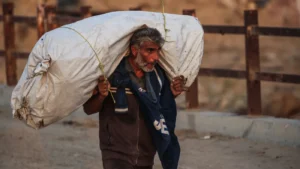
A Palestinian man carries his belongings along a bridge in Nuseirat, Gaza Strip on 11 November 2025
Ahmed Dremly and Ahmed Alsammak report in Middle East Eye on 12 February 2026:
Every night, Hamed drifts off to sleep knowing the explosions and gunfire from Israeli forces will likely jolt him awake several times. He lives along the Israeli-imposed demarcation zone known as the “Yellow Line”, where Israeli ceasefire violations have become routine.
“The explosions wake people up every day,” the Palestinian man, who wished to remain anonymous for safety reasons, told Middle East Eye. “We also hear bullets whistling overhead. The shooting doesn’t stop all night”. Hamed, from Khan Younis in southern Gaza, said the gunfire usually begins in the evening and continues until dawn, punctuated by the deafening blasts of homes being demolished beyond the line.
On one occasion, he narrowly escaped death when a bullet struck his home. “Thankfully, it hit the wall. If it had gone through the plastic tarp, one of us would certainly have been hit”.
Since the ceasefire was signed in October, Israeli forces have repeatedly violated it through numerous air strikes, shootings, home demolitions and detentions. According to the Palestinian health ministry, Israeli forces have killed at least 591 people since the truce began four months ago.
Many of the killings have occurred near the so-called Yellow Line. The line stretches across northern, eastern and southern Gaza. It was established under the ceasefire agreement as a temporary withdrawal boundary.
Israeli troops remain stationed behind it, controlling up to 58 percent of the territory, pending the next phase of the US-brokered ceasefire, which envisages further Israeli withdrawal.
On the ground, however, residents say the line has been pushed deeper into Gaza, limiting Palestinians’ access to their homes and vital agricultural lands. The shifting boundary has also triggered repeated displacement, leaving families without a stable shelter.
For Hamed, the danger has been drawing closer in recent weeks. What was once nearly two kilometres away is now less than one. With that shift, the intensity of the fire has increased. “Now we see the tank when it approaches, opens fire and pulls back. It’s extremely scary,” the 25-year-old said. The threat, he said, is both physical and psychological.
With several of his neighbours having been wounded by gunfire while inside their homes, this has created panic in his family.