

Palestinian UNRWA vocational training center faces closure by Israel
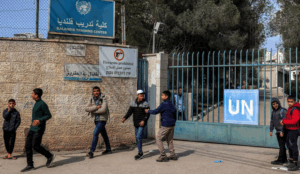
UNRWA’s Kalandia Vocational and Technological Training Center, 2025
Amira Hass reports in Haaretz on 16 January 2026:
The United Nations agency for Palestinian refugees was notified on Monday by the Jerusalem District Electricity Company that, following a recent amendment to a Knesset law, it will cut power to ten of the organization’s health and education facilities in Jerusalem – including the Kalandia Training Center – within 15 days.
The center, disconnected from Jerusalem by the Separation Wall built 250 meters to the south, continued operating over the past year even after Israel ordered the closure of all UNRWA educational institutions in greater Jerusalem, including in territory annexed in 1967. Now its closure appears to be imminent, as Israel intensifies its crackdown on the agency.
On Sunday, 325 students and 70 staff members are scheduled to return to classes following the semester break. The students, ages 15 to 19, come from across the West Bank, with 143 living in dormitories due to distance and checkpoints.
UNRWA has told students and parents that those enrolled will complete their training this year as promised. But officials said they do not know what could happen on Sunday, including whether the Israeli army, police or both might raid the center to enforce its closure or demonstrate a “governance” presence.
Recently, both army and police have intensified their raids on areas that are included in Jerusalem municipality borders yet separated from the city by the wall. Moreover, if power and water are to be cut, as the amendment to the Knesset law instructs, relocating large workshops – including heavy machinery and equipment – to other UNRWA facilities in Ramallah or to rented buildings would be a complex challenge.
The difficulty stems from logistical constraints and the agency’s reduced budget, compounded by heavy expenses linked to the war in Gaza as well as the displacement of residents from the Jenin and Tulkarm refugee camps and the destruction of more than half their homes.
“The main concern is what will happen in September 2026,” said UNRWA spokesperson Abeer Ismail. “Will we be able to continue training hundreds of young people every year in in-demand technical professions and help them find jobs and livelihoods in their fields?”
The Kalandia Center has provided vocational training for tens of thousands of Palestinian refugee youth since it was founded in 1953, on an 88-dunam plot of land that the State of Jordan owns and handed to the organization. UNRWA officials say they find it hard to believe Israel would move to take over the plot and the buildings, since it is Jordanian property. However, the agency has been told that a small strip on the southern end was purchased by Jews before Israel’s establishment and transferred after 1948 to the Jordanian custodian of enemy property.
Under a special arrangement with Palestinian Authority ministries and the Palestinian private sector, UNRWA tailors its curriculum to market needs. Kalandia provides two-year programs for boys in automotive mechanics and agricultural machinery, as well as one-year courses in vehicle repair, welding, carpentry and construction, plumbing, electrical work, computer and phone technology, and computer security systems.
The agency says more than 80 percent of graduates find employment. The center features lawns and trees, thus being the only green space in the dense maze of alleys and concrete buildings of the Kalandia refugee camp and Kufr Aqab, which transformed from a pastoral village with gardens until the 1990s into a crowded area of high-rise buildings.
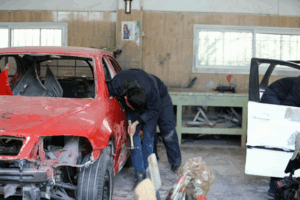
A vocational training workshops at the UNRWA Kalandia Center
Roland Friedrich, UNRWA’s director of operations in the West Bank (including East Jerusalem), who has been barred from entering the territory for a year, told Haaretz that “these children have no other opportunity to receive good vocational training. Every additional group of young people who are neither studying nor earning a living increases poverty and despair. I don’t know how this contributes to security.”
Friedrich was appointed to his current post in late 2023. Previously, since 2005, he worked with international organizations – including the United Nations – in Mediterranean countries on governance and security assistance and transitions from violent conflict to what is defined as peacebuilding.
Drawing on that experience, he said he is not aware of another state that has acted as systematically against international organizations and their work as Israel has, including disregarding diplomatic immunity for their staff and violating the obligations of a UN member state.
This article is reproduced in its enirety