

Over 300 women in Israel killed in the past decade – more than half from Arab community
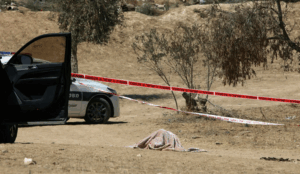
The scene of a murder in the Negev in September 2025
Ran Shimoni reports in Haaretz on 25 November 2025:
Since 2015, 304 women have been murdered in Israel, a Knesset report found ahead of International Day for the Elimination of Violence Against Women on Tuesday, with figures in 2025 expected to reach the highest they’ve been in at least a decade. While femicide is increasing, police solve and enforces more such crimes in the Jewish community than in the Arab community.
In 2024, 35 women were murdered – the highest figure in the past 10 years. Those figures have already been matched this year: The rate is 48 percent higher compared to the corresponding period last year, according to the Israel Women’s Network.
The report, written by the Knesset Research and Information Center at the request of the Committee on the Status of Women and Gender Equality, chaired by MK Meirav Cohen (Yesh Atid), examined femicide between 2015 and 2025. The center only recently obtained the data after the National Security Ministry delayed making the police data available for months, despite repeated requests from Cohen and by the center’s staff. The delay violates the Knesset Law, which states that the center may demand data from government ministries at the behest of the Knesset’s committees, members and institutions.
The report states that Arab women account for 53 percent of femicide in the past ten years, despite making up 21 percent of all Israeli women. The femicide rate has increased steadily since 2019. Of femicide in Arab communities, 46 percent are not solved, compared with nine percent in cases of a murdered Jewish woman. In 30 percent of all femicides over the past decade, police have failed to arrest any suspect or file indictments, the report found.
“The data should shock the country,” says Cohen. “Not only is the government not taking the expected emergency measures, it isn’t increasing budgets to mitigate violence against women, it stopped financing the Michal Sela Forum, conceals data – and ministers avoid relevant hearings. It’s apparently the worst government for women in Israeli history. As the responsible parties can’t be bothered to do it themselves, the committee I chair will convene and write an emergency plan to deal with the violence against women crisis as soon as possible, and submit it to the cabinet for approval.”
Almost half the victims – 49 percent – in solved cases of femicide were murdered by their spouses and a third were murdered by different relative. In the Arab community, a non-spouse family member accounts for 41 percent and a quarter were murdered by someone who isn’t a relative – almost twice the ratio of that among Jewish women.
The Women’s Network’s tracking data show that 80 percent of femicides in 2025 involved family violence. A supplementary figure states that 36 percent of victims in 2024 and 2025 had previously filed a complaint about family violence with the police.
In 2025, in contrast to previous years, nine femicides were committed by suspects classified as mentally challenged, most of them non-spouse relatives.
The Women’s Network states that 2025 saw a record number of femicides by firearms – 17 cases, as part of a steady rise. In 2024, there were 13 such cases, and the group recorded seven murders each in 2023 and 2022.
The Women’s Network and other civil society organizations say the main factor contributing to the increase is looser restrictions on firearms licenses. “The government is permitting a serious state of lawlessness when it comes to firearms,” says Tal Hochman, the Israel Women’s Network executive director. “Firearms are being widely distributed without cross-checking information with the Welfare Ministry and without adequate regulations preventing violent men from carrying firearms – an inadequate protection for women who have warned that their lives are at risk.”
Tahalil Amer, 28, who was shot to death in her car near an olive grove outside Kafr Qasem on November 13, was the latest victim this year. The mother of two was born in Kafr Qasem and had lived in Ashkelon in recent years. She had been active on social media, posting about her daily life to thousands of followers. Her four brothers were detained on suspicion of involvement, but were released within a day.
Shirley Yehuda, 35, a mother of two, was murdered in October and her burned body was found in a public garden in Tel Aviv. The primary suspect is a coworker, Oren Danan, who was released after serving a 23-year sentence for abducting, sexually abusing and attempting to murder a 10-year-old girl. Haaretz reported that he was under the supervision by the Prison Service’s released sex offenders monitoring unit, which classified him as possible repeat offender.
This article is reproduced in its entirety