

Off the rails? Israel may no longer be shielded from European sanctions, even by its allies
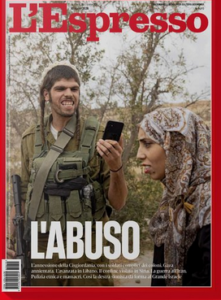
The controversial cover of Italian magazine L’Espresso, 13 April 2026
Liza Rozovsky writes in Haaretz on 20 April 2026:
The cover of Italy’s popular L’Espresso sparked yet another diplomatic incident, underscoring a growing crisis in Israel’s ties with key European allies. The image, depicting an Israeli soldier smiling as he photographed a worried hijab-wearing woman in the West Bank, drew accusations of antisemitic imagery.
Israel’s ambassador to Italy, Jonathan Peled, denounced it as “manipulative,” while the magazine’s deputy editor defended it as “holding up a mirror” in a response that went viral.
Tensions rose further as Italian Foreign Minister Antonio Tajani visited Beirut days after major Israeli airstrikes in Lebanon, dubbed “Operation Eternal Darkness” by Israel and “Black Wednesday” elsewhere. The Israel Defense Forces said 250 Hezbollah militants were killed, while Lebanon reported 357 dead.
Ahead of the visit, Israeli Foreign Minister Gideon Sa’ar sought to ease tensions, defending the strikes and opposing a cease-fire, but failed to shift Italy’s stance. Tajani condemned the attacks, prompting Israel to summon Italy’s ambassador.
Soon after, Prime Minister Giorgia Meloni suspended a defense cooperation agreement with Israel. According to an Italian source, this continued a de facto policy adopted shortly after the war with Hamas in Gaza began in October 2023, under which Italy has refused to sell weapons to Israel.
“This step is more symbolic than concrete,” said Arturo Varvelli, head of the Rome office of the European Council on Foreign Relations. “But it signals that Italy sees this behavior as intolerable, particularly the pressure the Netanyahu government is exerting on UNIFIL. The Italian government does not believe these incidents are coincidental,” he added, referring to recent confrontations between the IDF and UNIFIL.
Italy is the largest contributor of troops to UNIFIL, with more than 700 soldiers in Lebanon. Varvelli also pointed to additional factors behind Italy’s shift in tone. The war with Iran has hurt Italy’s economy, which depends heavily on Gulf energy, especially natural gas from Qatar.
This has pushed Meloni to distance herself further from U.S. President Donald Trump and Prime Minister Benjamin Netanyahu in response to domestic public opinion. Her recent defeat in a referendum on judicial reforms has also made her more attentive to public sentiment. Italian public opinion is highly critical of Israel, a trend that intensified during the war in Gaza and has deepened further amid developments in Lebanon and the West Bank.
Losing Orbán
The crisis with Italy came as Netanyahu lost his closest European ally, Hungary’s Viktor Orbán, who was defeated in his reelection bid. That same week, German Chancellor Friedrich Merz warned against de facto annexation in the West Bank, reiterating his concerns on X. Far-right Finance Minister Bezalel Smotrich hit back, demanding Merz “apologize a thousand times” and saying Germany would not “force us into ghettos again.”
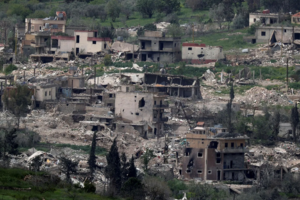
Southern Lebanon, April 2026
At the same time, Israel’s ambassador in Washington, Yechiel Leiter, criticized France as “not a positive influence” and said Israel did not want it involved in Lebanon talks. The deepening rift with European countries that have adopted a sharply critical stance toward Israel, such as Ireland and Spain, alongside growing tensions with states traditionally seen as friendly, like Germany and Italy – or those Israel no longer regards as such, like France – is evident across multiple arenas. It ranges from a sense of insecurity among Israeli tourists in Europe to mounting difficulties faced by the defense establishment in importing weapons.
One of the most sensitive fronts where this deterioration could manifest is in Brussels. The push for a death penalty law applying only to Palestinians, the war with Iran that has drawn sweeping criticism across Europe, the extensive harm to civilians in Lebanon, rising violence in the West Bank, and the absence of a solution to the Gaza crisis – taken together, these factors are pushing European patience with Israel to the brink.
Some steps now appear almost certain.
The expected removal of Hungary’s automatic veto on measures requiring unanimity is likely to lead, in the near term, to an expansion of European Union sanctions against violent settlers and far-right organizations. So far, the EU has approved two rounds of sanctions targeting nine Israelis, including Elisha Yered, Yinon Levi and Bentzi Gopstein, as well as five extremist groups such as Lehava and Tzav 9.
Since 2024, however, attempts to broaden the list have been blocked by Budapest. Hungary’s incoming leader, Péter Magyar, has said that under his leadership, the country will lift the automatic veto and review each case individually. The issue is expected to return to the agenda following the change of government in Hungary.
But Israel’s challenges within the EU extend far beyond this. In Jerusalem, officials are waging a prolonged rearguard effort to prevent a partial suspension of the EU–Israel Association Agreement, a move now likely to regain momentum. The threat of suspension was raised by the EU in the spring and summer, at the height of the hunger crisis in Gaza. While it was not carried out, it was never formally withdrawn, even after the cease-fire took effect.
Unlike personal sanctions, suspending parts of the Association Agreement – for example, freezing the free trade framework between the EU and Israel or halting cooperation in science and technology, both critical to Israel’s research and development sector – does not require unanimity, but only a qualified majority. Germany and Italy, large member states that have so far helped block moves against Israel, are pivotal to forming such a majority. As Meloni has signaled, that support cannot be taken for granted indefinitely.
In Jerusalem, officials believe it is premature to write off ties with Italy or its support. At the same time, some in Israel point to serious flaws in the public diplomacy approach championed, among others, by Foreign Minister Gideon Sa’ar, both toward European and global audiences and toward decision-makers. They cite a tendency to recite a defensive narrative rather than acknowledge mistakes, and to sidestep widely visible facts instead of confronting them.
According to Israeli sources, for example, expressing regret over the killing of civilians in Lebanon and committing to minimizing loss of life could have steered the discourse with Italy, which has deep ties to Christian communities in Lebanon, in a more constructive direction. Statements by senior Israeli officials, such as Defense Minister Israel Katz, regarding the flattening of villages in Lebanon, and remarks by Smotrich hinting at annexation plans in Lebanon, Syria and Gaza, have likewise not helped Israel’s dialogue with Europe.
Tension in Jerusalem
A similar pattern was evident on Thursday at a meeting Sa’ar held with foreign ambassadors at the Foreign Ministry. Some diplomats described the atmosphere as highly tense, while others said it amounted to another exchange of familiar positions.
When the EU ambassador noted European disappointment with Israel’s harsh rhetoric, Sa’ar responded that Israel, too, was disappointed with the EU, and for good reason. He also corrected Norway’s ambassador for using the term “West Bank” instead of “Judea and Samaria.” Most of the discussion focused on Lebanon, shortly before a cease-fire was announced there, though this was absent from Sa’ar’s subsequent public statements.
During the meeting, Sa’ar defended the scope of Israel’s military operation, insisting it was not politically motivated, as some abroad suspect, given that it came just hours after the cease-fire announcement with Iran, but rather based on intelligence. He said the operation resulted in the deaths of “more than 200 militants” and did not express regret over civilian casualties.
The overarching aim of Israeli diplomacy at this stage is to make clear to EU member states – particularly those still considered friendly – that a distinction should be drawn between the Israeli public and its government, and that any punitive steps should be held off at least until the elections expected in October, to avoid harming Israel as a whole.
At the upcoming meeting of EU foreign ministers on Tuesday, the issue of suspending the Association Agreement is expected to return to the agenda. In a sharply worded letter to EU foreign policy chief Kaja Kallas, the foreign ministers of Spain, Slovenia and Ireland cited the recently passed death penalty law as a “latest example” of a blatant violation of human rights, a retreat from democratic principles, and “another step in the persecution, repression, violence and systematic discrimination against the Palestinian population.”
Beyond the legislation, the ministers pointed to the humanitarian situation in Gaza, Israeli strikes they say violate the cease-fire, and settler violence alongside military actions that have led to what they described as the “unbearable killing of innocent civilians” in the West Bank.
The three countries called on the EU “to uphold its moral and political responsibility and protect the core values underpinning the European project.” They also wrote that Israel had acted in Lebanon with “complete disregard for international law,” while welcoming the cease-fire there. According to an EU source, the meeting is not expected to produce decisions on suspending the agreement.
Another concern identified in Jerusalem is the possibility that Israel could be excluded from the follow-up framework to the Horizon Europe program for 2028–2034. Removing Israel from the list of participating countries would not require a qualified majority, unlike a suspension of cooperation with Israeli universities or startups, a step that was considered within the EU but blocked by Germany and Italy last July.
Israeli officials do not currently believe there is a concrete intention among professional or political actors in the EU to pursue such a move, but they are treating the issue seriously. Pro-Palestinian organizations have launched a targeted campaign, including protests in Brussels, against Israel’s inclusion in the scientific and technological program. In addition, a petition calling for the suspension of the EU–Israel Association Agreement reached one million signatures from EU citizens last week, a threshold that, under EU law, obliges the European Commission to address the issue.
This article is reproduced in its entirety