

Norway FM hopes US pushes Israel to transfer PA taxes amid talks on phase two of Gaza ceasefire
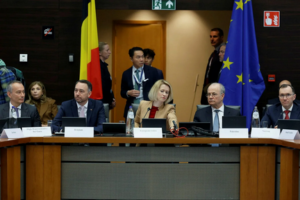
From left, High Representative for Gaza Nikolay Mladenov, Belgium’s Foreign Minister Maxime Prevot, European Union foreign policy chief Kaja Kallas, Palestinian Prime Minister Mohammad Mustafa and Norway’s Foreign Minister Espen Barth Eide during a meeting of the Global Alliance for the Implementation of the Two-State Solution in Brussels, 20 April 2026
Liza Rozovsky reports in Haaretz on 23 April 23 2026:
Norway hopes the United States will pressure Israel to release the Palestinian Authority’s tax revenues, Foreign Minister Espen Barth Eide recently told Haaretz. Eide, whose country chairs the Ad Hoc Liaison Committee for the Palestinian Authority, said he hopes cooperation between the committee and the Gaza Board of Peace will help Norway and the European Union pressure Israel through the United States.
“The fact that we are now incorporating the American institutions, which they enthusiastically have set up, might actually be the best way also to influence Israel,” Eide said, referencing the Board of Peace and the Palestinian Technocratic Committee, “because after all, the U.S. administration still has some influence on Israel since there are not so many other friends left.”
The Ad Hoc Liaison Committee was established following the Oslo Accords in 1993, and its members have been meeting twice a year since then. On Monday, a committee meeting was held in Brussels, attended by, among others, the Board of Peace’s High Representative for Gaza, Nickolay Mladenov, Palestinian Technocratic Committee chairman Ali Shaath, and Palestinian Prime Minister Mohammad Mustafa.
The European Union and the United States are considered to be the committee’s sponsors, but the rift between the United States and Europe due to the Trump administration’s policies renders this partnership hollow. In recent years, Israel has boycotted the committee’s meetings and was absent this time as well.
Speaking to Haaretz after the meeting, Eide criticized Israeli claims that the Palestinian Authority funds the families of convicted terrorists. “Mustafa demonstrated how this issue, which is quite erroneously called ‘pay for slay,’ which is an Israeli government slogan, is actually over,” the minister said. “This has been converted to a normal kind of welfare program that is, for instance, not dependent on the years in prison, and in that sense, not connected to what kind of activity the person has had.”
Eide emphasized that there has been a “rather serious effort from the Palestinian Authority to change this, to accommodate the demands that many donors have expected Palestine to deliver on,” adding that donors were influenced by elements in Israel to demand the changes.
“I think this issue is being solved or has been solved,” he concluded, “maybe not to the liking of the Israeli right, but I think basically to the liking of the donors.”
Senior Israeli officials typically accuse the Palestinian Authority of continuing “salary” payments to terrorists. Late last year, Foreign Minister Gideon Sa’ar claimed that these payments had almost doubled in 2025 compared to 2024.
Another goal for Norway and the European Union is to remove the threat by Israel’s Finance Minister Bezalel Smotrich to crush the Palestinian economy by disconnecting banks operating in the PA from the global banking system.
At the donors’ meeting, Eide announced that Norway is increasing its contribution to the Palestinian Authority to help it cope with Israel’s withholding of its tax revenues. According to him, Norway intends to contribute $80 million to the Palestinian Authority in 2026 and is transferring an additional $380 million for efforts undertaken by the United Nations to clear the rubble in the Gaza Strip.
European Union Foreign Minister Kaja Kallas, who co-chaired the meeting with Eide, noted that the European Union has pledged 1.6 billion euros to the Palestinian Authority over three years, from 2025 to 2027. Eide and Kallas also called on other donors to increase their contributions.
The minister also expressed hope that cooperation between the Ad Hoc Liaison Committee and the Board of Peace will help ensure the Palestinian Authority is entrusted with managing the Gaza Strip.
“[This] was the first [meeting] after the cease-fire in Gaza and the first one after the establishment of the Board of Peace and the National Committee for the Administration of Gaza,” Eide said, “and thanks to Norwegian diplomacy, we managed to get everybody into the same room.”
According to Eide, it was important to incorporate the Board of Peace and the technocratic committee into the liaison committee, as “we are, after all, working towards the same purpose.” It was also important that the Palestinian government “be reassured that there is still going to be one Palestine in the end,” he added, “and that the activities of the Board of Peace and the technocratic committee will not lead to a division between the West Bank and Gaza.”
According to Eide, Norway “managed to get the established structures, meaning the AHLC, the World Bank, the UN, the EU, the European donors, Japan, Canada” and others, to join “the new structures that came out of the cease-fire in Gaza.” Eide said he was hopeful “they will now successfully work together.”
The Norwegian foreign minister also told Haaretz that committee chairman Shaath, addressing the AHLC, clarified that the technocratic committee, which is set to manage Gaza, is temporary. “Ali Shaаth very clearly confirmed that this is temporary, it’s an arrangement that is supposed to last until the end of 2027,” he said, adding, “One day in the future, all of this will be returned to united Palestinian governance under the Palestinian Authority.
According to Eide, the Palestinian prime minister told the gathering he would ensure employees of the Palestinian Authority in Gaza would cooperate with the technocratic committee.
Hamas on second phase of Gaza cease-fire
Board of Peace High Representative Nickolay Mladenov arrived in Brussels after about a week of intense negotiations with Hamas in Cairo, which are expected to continue in the coming days.
The purpose of the negotiations is to persuade Hamas to agree to a gradual disarmament plan that was first presented to it last month. Mladenov briefed the committee members on the progress of the negotiations.
In an interview to Reuters last week in Brussels, he said the negotiations concern, among other things, the Yellow Line demarcating the territory of the Gaza Strip Israel has been holding since the October 2025 cease-fire. In January, Haaretz reported Israel had moved the boundary hundreds of meters westwards.
Nickolay Mladenov, the Board of Peace’s lead envoy for Gaza, speaks during an interview with Reuters during a visit to Brussels, Belgium on Monday. Credit: Christian Levaux/Reuters
According to Mladenov’s assessment, the parties have “a matter of days, maximum a couple of weeks” to reach an agreement. “Otherwise, we will lose the momentum of what we have, and then every decision will become even more difficult.”
Mladenov also told Reuters that the Board of Peace has in recent days succeeded in “gradually and very carefully increasing the number of people that are allowed to cross through the Rafah crossing.”
Under the cease-fire agreement, movement of residents to and from Gaza through the crossing is to remain unrestricted, but in practice, Israel and Egypt are limiting passage. While Egypt fears a mass displacement of Palestinians into its territory, Israel is trying to prevent a massive return of Palestinians to the Gaza Strip.
In the past week, under pressure of the Trump administration, the number of people permitted to leave the Gaza Strip has increased, but Egypt has restricted access to its territory to the sick and wounded. According to an Israeli defense establishment source, the number of people crossing the Rafah crossing in both directions has indeed increased in the past week. Data from the European Union Border Assistance Mission at Rafah (EUBAM), provided to Haaretz, reflects this increase. On several dates for which EUBAM provided information, between 100 and 125 people crossed in each direction, whereas previously about 50 people crossed in each direction.
This article is reproduced in its entirety