

Jewish Israelis showed up for Arab Israelis. Here’s why it’s nowhere near enough
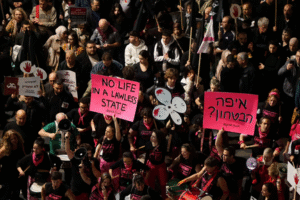
Members of the Pink Front, an anti-Netanyahu Israeli protest movement, marching in the Arab-Jewish rally on 31 January 2026 in Tel Aviv
Dahlia Scheindlin writes in Haaretz on 3 February 2026:
This doesn’t happen often. Three weeks ago, this column criticized the failure of Jewish Israelis to join the most obvious, urgent and potentially unifying priority of citizens: demanding government action against organized crime in the Arab-Palestinian community in Israel, which claims lives almost daily. Suddenly, a low-bar, no-brainer wish came true.
Last week, there was a flurry of activity from Jewish Israelis – mostly left-wing activists – who joined Arab citizens mounting a major demonstration in the northern Israeli city of Sakhnin on Thursday. Then on Saturday evening, throngs of Arab citizens arrived in the heart of Tel Aviv, traveling from Kfar Manda, Kfar Qasem, Rahat and many other towns, for a large-scale demonstration. This time they were met by an outpouring of support from Jewish Israelis. They too came from around the country – Rehovot, Mevasseret Zion, even the West Bank settlement of Efrat.
The mainstream was moved
The most devoted groups advocating for Jewish Arab solidarity were there, as ever, with a large presence of youth associated with AJEEC NISPED, the Jewish-Arab Negev coexistence organization, and Standing Together, another activist solidarity group, with support from numerous other organizations.
Many Jewish Israelis attended with no organizational urging. Some wore t-shirts or bore symbols – sometimes discreet – of very mainstream organizations. These included Brothers and Sisters in Arms, the reservist group that emerged from the anti-government protest in 2023, and represents a sociological heartland of Israel, and center-left Darkenu (“Our Path”) – distinct from the firm left usually associated with this effort.
Lawmakers including Naama Lazimi, Gilad Kariv, Merav Michaeli from the Democrats party. Visiting Sakhnin last Thursday, President Isaac Herzog said: “The fight against crime and violence in Arab society must be at the top of the national priorities… This is a national mission. It is also a moral obligation.”
But the most moving expressions of support came in response to a mother, Hitam Abu Fani, who spoke of losing her son. Some wept; then scattered cries could be heard in Hebrew: “We are with you! You’re not alone!” – the same chants heard for two years to support hostage families.
While powerful, these actions don’t actually deserve special credit; they are the minimum effort needed. And they won’t be enough to stop the wave of criminal violence, since the current government isn’t interested.
But the value of the genuinely joint Arab and Jewish efforts in Sakhnin and in Tel Aviv goes beyond the direct demands to fight crime, and it was the Arab protestors who articulated these gains. Dr. Kamal Zbeedat, a 65-year-old high school Arabic teacher from Sakhnin, said he was actually “moved to tears” to see thousands of Jews turn out on Saturday night.
“I know for sure that only a Jewish-Arab struggle can stop crime and pressure the government,” he said. “As long as Arabs are alone, as a minority, they can’t achieve anything – only a Jewish-Arab struggle that believes in peace.”
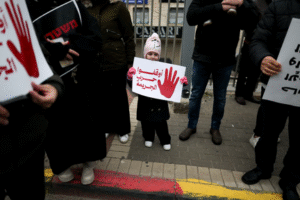
A child holding a sign that reads ‘Stop the crime war’ at the Sakhnin protest on 22 January 20
Rima, 21, also from Sakhnin, came with her mother, her brother and her friends alongside her. Gazing at the crowd, she said she hadn’t expected to see so many Jews. “I feel hope, I feel solidarity, I feel resistance and I feel we are powerful together,” she said.
At a time of rock-bottom expectations – finding people who experienced a sense of hope that partnership in Israel can improve their lives is something.
Translating hope
Civic good will won’t change policy – political leaders do that. Rami Reiner, a professor of Jewish thought from Efrat, came to the Tel Aviv demonstration because he believes the government is not using its legitimate power to treat what he views as one of the most acute social issues in the country. Drorlee, his wife, said the issue “is so critical, we couldn’t stay at home.” Rami hinted that demonstrations could be more effective if they include people closer to the base of the leadership.
But ultimately, the only way Israel’s leaders will truly confront organized crime among Arab citizens is when the current leaders are gone, and Israel elects new ones.
Arab voters in Israel have serious reason to suspect that voting won’t change anything for them – or for Palestinians under occupation for that matter. And Israel’s opposition has proven its lack of courage and vision. But there is no other path.
In fact, the ideologically diverse “change” coalition that governed Israel from mid-2021 through late 2022 did save Arab lives from crime. A minister of internal security from the Labor party and his deputy from Yesh Atid implemented new programs that saw the first decline in the number of murders among Arab citizens in five years. When Benjamin Netanyahu returned to power and gave the Jewish supremacist Itamar Ben-Gvir the portfolio, the number of murders more than doubled in 2023.
This same government recently slashed funding for social programs such as education, which could address root causes, in the name of funding for brute force policing that probably won’t help – after tolerating three wretched years of the rising murder rate. Sometimes, politics really do matter.
One heartwarming demonstration is no quick fix for convincing Arabs to vote. Rima, the 21-year-old about to embark on her double-major program at Hebrew University, is a first-time voter, and she’s not sure she’ll exercise her right: “I will need to think more about this.” She said she might vote “if I see that there will be true change with [the] parties,” – implying that she’ll want to see the parties focus on this issue – “but I’m not that hopeful, to be honest.”
By contrast, Dr. Zbeedat, the teacher from Sakhnin, felt so encouraged that he believed “this demonstration can only increase the percentage of Arab voters,” by contrast to the war in Gaza which, he explained, generated “dissonance between Jews and Arabs.” Still, he said the issue of turnout “depends also on Jews,” and related that he had invited the Democrats MK Naama Lazimi to hold a parlor meeting in Sakhnin.
Whether or not that meeting happens could be a thrill or a disappointment for him. It’s easy to imagine all the other demonstrators harboring hopes after such a strong activity on Saturday evening, but becoming deeply discouraged, perhaps demotivated to vote, if there is no follow up. It’s hard to think of how to maintain such energy, such open solidarity, for many months until the election (scheduled for October). In the meantime, there will surely be more murders.
There are few glimmers of hope these days. Twenty-seven Arab citizens of Israel were murdered in January – and two more while writing this article – before they appeared. It would be even more tragic if the momentum peters out before real change comes around.
Two hours after this article was published, three more people were murdered near Tira in central Israel.
This article is reproduced in its entirety