

It’s time for Israelis to talk about the mass killings of Palestinians in Gaza
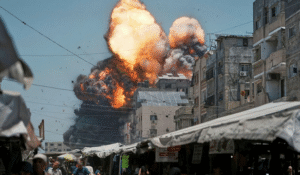
Thick smoke and flames erupt from an Israeli airstrike in Gaza City in July 2025
Uri Bar-Joseph writes in Haaretz on 26 January 2026:
In an op-ed last week (Haaretz, Jan. 20), Yagil Levy put his finger on one of the most painful issues surrounding the October 7 War – the discourse of revenge as a motivation for harming innocent people in Gaza.
Levy was referring to combat soldiers and presented two motivations for vengeance in this context: theological meaning for soldiers from the Haredi Zionist stream and, for combat soldiers with a blue-collar background, the right to take pride in the unfettered use of force.
In fact there was also a third group, large and important, that used an amount of violence that was unprecedented in the history of Israel’s wars and that was responsible for most of the civilian deaths in Gaza in the war. These are the members of the elite units, mainly intelligence, operations and air crews.
It’s too early to determine whether and how they were affected by the discourse of revenge, but it’s clear that this group demonstrated a high degree of conformity throughout the war – unprecedented in the history of the Israel Defense Forces and certainly in the history of the Israel Air Force.
To put things in perspective, here are two relevant events from the past.
On October 9, 1973, one of the most difficult days in the Yom Kippur War, Defense Minister Moshe Dayan and IDF Chief of Staff David Elazar decided to put most of their resources into winning the war in the Golan Heights. The dramatic component in the course of the battle was supposed to be the bombing of major military targets in Damascus. Prime Minister Golda Meir, who feared civilian casualties, agreed to approve this only after heavy pressure, and after she was told that there had in fact been civilian casualties, she later vetoed similar attacks.
In the 1982 Lebanon war, concern about possible civilian casualties and unnecessary destruction from airstrikes arose during two incidents that occurred on the same day. This had significant implications for the willingness of aircrews to continue to attack similar targets. When IAF commander David Ivry learned of this, he issued an order specifying that in any situation where aircrews feared significant civilian casualties, they were to contact him directly, and he – not they – would make the decision.
That was not the case in this war. To date, about 70,000 people have been killed and about 170,000 have been injured in Gaza. Most were civilians, and most of the casualties were from airstrikes.
Investigations in the first months of the war found that the decision-making regarding strike targets was based on artificial intelligence systems that identified individuals to kill, structures to destroy and opportunities for hitting the target. Final approval for striking the target was given by intelligence officers, but it is clear that it was almost automatic and usually given within a few seconds. That was the case even when, according to the systems’ data output there was no certainty that the identification of the target was correct and even when the systems’ calculation of “collateral damage” reached 10, 15 and sometimes even 100 innocent people.
It’s difficult to know how many service members were involved in the process, from those who built and operated the systems that received data and output targets, to those who approved the strikes and, finally, those who pulled the trigger. By even a conservative estimate, however, there were hundreds of people who, in one way or another, killed or injured tens of thousands of innocent civilians and caused unprecedented civil destruction.
And here comes the question that no investigative committee, whether a state commission of inquiry or any other kind, will try to confront: How could it be that even within this large group, most of whose members were raised in stable, well-off families and received a liberal, secular education, not a single person, as far as we know, said “no more” and refused to obey an order.
It’s impossible to claim that they didn’t know. It’s true that the Israeli media for the most part imposed a voluntary censorship of the ongoing tragedy, but anyone could have watched the broadcasts of the foreign networks and understood what was happening in Gaza. In rare instances, like that of Mohammed Abu al-Qumsan, who went out to get birth certificates for the twins his wife had given birth four days earlier and returned to find that all three had been killed in an Israeli airstrike, even Ynet reported on it.
There can be many explanations for this collective obedience, and the October 7 massacre and the discourse of revenge that followed are a good starting point. But considering the background of the group that operated the system, that’s not sufficient. Some of the explanations are environmental: an absence of physical contact with the target of the strike; responsibility shared among many entities, which obscures the sense of personal responsibility; the tendency to rely on technological means as a solution for moral hesitation, and professional jargon that neutralizes gut feelings.
Other explanations touch on the schools that don’t teach students to ask tough questions; the ongoing occupation, which blurs the identity of the Palestinians as human beings and the manner in which media outlets mediated the war to Israelis. To that we should also add certain components of universal culture in general and Israeli culture in particular, which cause the tendency toward conformity and obedience to be more dominant.
But all that isn’t sufficient. After the Six-Day War, which was universally considered to be justified and in which the IDF for the most part maintained combat ethics, “siah lohamim” – a dialogue among combat veterans about their experiences – arose. That’s not the case now. The moral vacuum created by this terrible war requires answers. The time has come to begin talking about that.
Uri Bar-Joseph is an Israeli political scientist and professor emeritus of international relations at the University of Haifa.
This article is reproduced in its entirety