

Israel’s annexation drive has sped up – because the world allows it
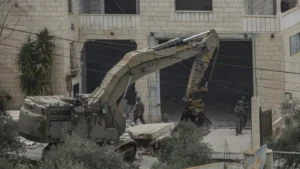
Israeli soldiers demolish a house in the village of Silat al-Harithiya in the occupied West Bank on 17 February 2026
Abed Abou Shhadeh writes in Middle East Eye on 18 February 2026:
While the world debates statements of condemnation over Israel’s policy in the occupied West Bank, mulling whether annexation will proceed, Israel is already implementing its decision on the ground: expelling communities, confiscating land, and transferring powers from the army to civil authorities.
Yet even after two years of an ongoing genocide in Gaza, there are still people around the world who believe Israel is deterred by international condemnations.
They choose, consciously or unconsciously, to ignore a simple reality: as long as there is no meaningful force standing in the way of Israeli policy, it will move towards further conquests – and it is doubtful that this process will stop at the occupied West Bank and Gaza alone.
Israel’s plan accelerated this week, as the cabinet approved an initial budget of around 244 million shekels ($79m) to establish a mechanism for land registration in Area C of the occupied West Bank. Current landowners will have to prove ownership, and if they can’t, the land will be registered by the Israeli state.
The move came amid a slew of recent decisions, including repealing a Jordanian-era law that prevented the sale of land to Israelis; applying Israeli civilian law in the occupied West Bank, in violation of international law; transferring authority over the Ibrahimi Mosque from the Hebron municipality to the Israeli civil administration; increasing Israeli control in Areas A and B by shifting authority away from the Palestinian leadership; and further expanding the settlement enterprise.
Naturally, Arab states have condemned this policy shift. But after the genocide in Gaza – and in the Trump era, where military and economic discourse sets the tone – Israel has come to understand that beyond empty statements, there will be no meaningful response in terms of sanctions, severing ties, or cancelling trade and arms agreements.
Worse still, in a nonstop news cycle, it is likely that by next week, the world will be focused elsewhere, perhaps on another crime Israel has committed – whether in the occupied West Bank, Gaza, Lebanon, Syria, or even a war with Iran.
Deepening the occupation
Even if we examine Israeli policy in the occupied West Bank before the genocide in Gaza began, we find a steady, gradual strategy aimed at deepening the occupation and creating facts on the ground. From before the Oslo Accords all the way up to the past week, the one meaningful difference is in how Israel reads the international mood.