

Israeli court cancels order blocking West Bank settler outpost construction after settlers defy it
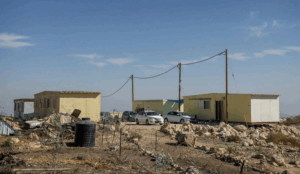
Mobile homes established in the new outpost near the Carmel settlement and the Palestinian village of Umm al-Khair in the West Bank, October 2025
Matan Golan reports in Haaretz on 2 December 2025:
A temporary court order barring settlers from moving into an illegal outpost built near the Palestinian village of Umm al-Khair and prohibiting any further construction on the site was canceled by a district court, after settlers ignored the injunction’s orders and Israeli authorities failed to enforce it.
The injunction, which was issued in October by the Jerusalem District Court following a petition filed by veteran Israeli anti-occupation movement Peace Now and residents of the Palestinian village, prohibited Jewish settlers from carrying out construction work of a new outpost in the South Hebron Hills and populating mobile homes in the area. Jerusalem District Court Judge Oded Shaham decided that the injunction would be in force “until further notice.”
A day after the interim order was issued, a group of settlers violated it and moved into the outpost. Law-enforcement authorities did not act against them to enforce the court order. Moreover, the IDF has since officially adopted the name given to the outpost by the settlers in official documents. The respondents in the petition – the IDF and the South Hebron Hills Regional Council – were aware of the violation, and did not take action to prevent it.
The injunction was issued in October following a petition by Peace Now, which demanded the outpost be vacated after Awdah Hathaleen, a Palestinian activist from the village of Umm al-Khair, was shot dead by settler Yinon Levi in July, while a minor employed by his contracting firm was operating an excavator during the construction of the outpost. Levy was standing outside “guarding” the excavator.
When asked for comment in response to the violation of the court order, the IDF argued that “an inspection conducted on the day the outpost was populated, found that the mobile homes were already occupied.”
In response, Peace Now filed an additional motion for the mobile homes to be removed from the site, and demanded an answer as to the reason the violation of the interim order was not enforced.
However, by the time the court issued a decision on the matter, the IDF had already adopted the name the settlers had given to the outpost – Barkai Neighborhood – and has since been using it in official military documents.
The Palestinian village of Umm al-Khair in the South Hebron Hills of the West Bank. Credit: Courtesy of Peace Now
In the decision issued by Jerusalem District Court Judge Oded Shaham to cancel the temporary court order after it was violated, he wrote that while he “did not minimize the importance of complying with court orders or the seriousness of violating them,” the court found that there was no sufficient basis for the injunction, and there was no longer justification for issuing additional mandatory orders “aimed at restoring the situation to what it had been before the interim order was issued.”
Judge Shaham explained that his primary consideration was the “balance of convenience,” seeing as the mobile homes were set up on land belonging to the Carmel settlement and on state-owned land, and did not infringe upon the private property of the residents of the Palestinian village Umm al-Khair.
While the mobile homes are within an enclave falling in the jurisdiction of the Carmel settlement, they are outside the perimeter fence and are not contiguous with the rest of the settlement’s houses. Moreover, they were erected upon state land zoned exclusively for agriculture. Under Israeli law applicable to the site since the establishment of the Carmel settlement in 1991, no residential infrastructure may be built on agricultural land.
Following the issuing of the temporary injunction in October, prohibiting any further construction on the site, a special South Hebron Hills Planning and Building Committee adopted a plan regulating construction in the area. This decision allowed the special committee and the Carmel settlement to argue in court that a construction plan that “could be easily approved” should be preferred.
In his ruling, Judge Shaham also said that since the mobile homes can be easily moved out of and dismantled, the status of their legality could be discussed at a later stage of the petition. Therefore, in his opinion, there is no justification for issuing an additional injunction prohibiting the occupation order that was violated. Peace Now explains that by this ruling, the court effectively permitted the illegal construction of an outpost that has no approved outline plan or building permits.
The court’s decision also indicated that the mobile home structures were built without a building permit. Since they were constructed within the settlement’s territory, the IDF, South Hebron Hills and Carmel settlement all opine that the regional council holds the authority to enforce it, and that the courts have no grounds to intervene in the matter.
However, later in the hearing, it was revealed that the position of the supervisor tasked with addressing illegal construction complaints in the regional council has been vacant since February of this year. Nonetheless, the Civil Administration’s supervisory subcommittee failed to assume the authority, and for most of 2025, no state official has enforced illegal Israeli construction in the South Hebron Hills area.
Meanwhile, the IDF continues to deploy legal enforcement measures against illegal construction in the Palestinian villages in the West Bank.
Peace Now said in response to the court’s cancellation of the temporary order that “the decision to ignore the violation of the injunction, which the court itself had issued, is a direct consequence of the judicial coup that the government is leading.”
The peace movement accused the court of “effectively giving a green light to the government and settlers to show contempt for the provisions of the law and the court’s own injunctions, and surrender even the semblance of the rule of law.”
“The residents of Umm al-Khair, who suffer daily harassment and bullying by settlers, are the direct victims of the regime’s systems that have become slaves to an ideology that seeks to impose Jewish supremacy in the West Bank,” they added.
This article is reproduced in its entirety