

Israeli border tech is not about security, it’s a tool for ethnic cleansing
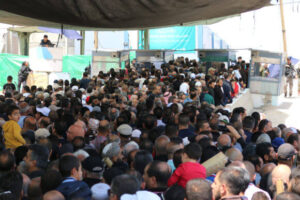
West Bank Palestinians queue at the Qalandiya military checkpoint, May 2019
Issa Amro writes in Open Democracy on 6 February 2026:
I am sitting around a fire outside my home. Above me, a drone circles my house, stopping every few minutes to hover some 15 meters away. Its camera points directly at me, unsubtly filming me in my own yard.
This is not unusual. I am filmed, photographed, tracked and surveilled wherever I go.
In Hebron, the largest city in the occupied West Bank, where my family has lived for generations, the presence of the Israeli state is everywhere. For the 215,000 or so Palestinians here, there is no such thing as privacy.
We are the unwilling test subjects for advancements in methods of population control. Israel uses technology as a tool for ethnic cleansing, designed to drive us out of Hebron’s city centre and make way for the Israeli settlement expansion taking place in breach of international law. My own family is no longer allowed near the house we own and lived in when I was young; the Israeli army evicted us and shut down the area as an Israeli settlement sprang up there.
Now, as we are confined to an increasingly smaller area, Palestinians’ daily lives are being recorded without our consent and turned into data points for the Israeli military and its private-sector partners in the defence industry.
Even as we live under this high-tech occupation, we are denied basic resources. Hebron requires roughly 150 megawatts of power every day, yet there is practically no independent Palestinian production of electricity. Israel holds the power, literally. The West Bank is reliant on the Israel Electric Corporation, which sells Palestinians only two-thirds of what we need.
In winter, we get just ten hours of daylight and temperatures drop to lows of 0℃. The bitter cold creeps into our poorly insulated homes, forcing us to rely on electric heaters. As demand for electricity increases and our underdeveloped infrastructure struggles to cope, electricity is rationed, and the city experiences repeated power outages. During particularly cold spells, these can occur up to several times a day, plunging whole neighbourhoods into darkness over and over for hours at a time.
With our lights, internet and heaters depowered, we sit by the glow of the fire, waiting. A minute or two later, some lights come back on; not ours, those of the Israeli army base and illegal settlement next to my home. The Israeli military and settlements are connected to a separate back-up power grid that does not provide electricity to us. Bright white military floodlights are cast at my house, watching it, watching us.