

Israel weaponises winter in Gaza and must allow the immediate entry of temporary housing
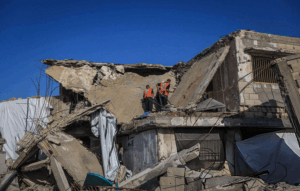
Civil defense teams inspect the rubble of a severely damaged house after its roof collapsed in the Gaza Port area of western Gaza City on 19 November 2025
Euro-Med Human Rights Monitor writes on 22 December 2025:
The international community, including the United Nations and its member states, particularly the High Contracting Parties to the Geneva Conventions, must take all necessary measures to pressure Israel to lift its ban on the entry of temporary housing units (caravans) and essential shelter materials into the Gaza Strip, and to ensure their unrestricted entry and distribution without political or security conditions.
Euro-Med Human Rights Monitor warns of an imminent catastrophe with the onset of winter, including the potential collapse of hundreds of severely damaged homes on their inhabitants due to the absence of safe and liveable housing. Thousands of families are forced to live in cracked buildings or under fragile tents that offer no protection from cold or rain, exposing them to collapse, injury, death, and an increased loss of life.
The illegal Israeli blockade and ban on the entry of temporary housing units have effectively eliminated all options for thousands of families, forcing them to remain in destroyed or severely damaged homes that have become time bombs liable to collapse at any moment. This month alone, 18 civilians have been killed when residential buildings collapsed on them, with Euro-Med Monitor documenting the collapse of 50 buildings since last October.
Israel is using the blockade as a tool of genocide and the creation of deadly living conditions by blocking reconstruction and repair, preventing the entry of materials and equipment needed to clear rubble and restore homes, water and sanitation systems, and electricity networks, and by obstructing humanitarian response efforts and undermining relief agencies’ ability to provide even minimal protection.
As a result, civilians are forced to choose between remaining in dilapidated buildings on the verge of collapse or sheltering in fragile tents that offer no protection from winter cold or rain. Meanwhile, Gaza’s residents are confined to a shrinking and overcrowded area, with families subjected to repeated and involuntary displacement between devastated locations that lack even the most basic safety and services, entrenching a deadly reality in which the threat to life is constant and foreseeable.
Winter weather and rainfall sharply increase the risk of collapse of homes with compromised structural integrity due to bombing and the absence of any reinforcement or restoration. Rainwater seepage into foundations and cracked walls accelerates erosion and significantly heightens the risk of sudden collapse, particularly in light of Israel’s comprehensive ban on the entry of building materials, reinforcement supplies, and temporary protection measures, placing residents’ lives in constant and imminent danger.
Hundreds of thousands of displaced people sheltering in tents face equally dire conditions with the onset of winter. Bitter cold caused the deaths of at least five children in December alone, while heavy rains destroyed around 27,000 tents along with the food and belongings inside. Many tents are concentrated in low-lying areas prone to flooding or on rubble-strewn land, in an environment that lacks even minimal drainage infrastructure or the capacity to withstand continuous rainfall and sharply falling temperatures.
Israel’s policy of blocking the entry of housing units seeks to destroy the urban environment of Palestinians in the Gaza Strip and to deprive them of the right to housing and a safe life. The destruction of entire cities and neighbourhoods, the obstruction of repair and reconstruction, and the ban on all temporary housing alternatives cannot be viewed as incidental to military operations, but constitute a deliberate pattern aimed at depopulating the enclave by making housing effectively impossible and forcing families into displacement.