

Israel uproots thousands of grapevines in Hebron to expand settler road
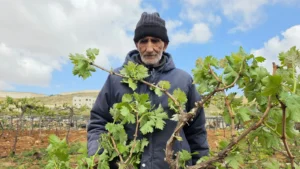
A Palestinian man inspects damaged grapevines after Israeli forces began bulldozing vineyards in Hebron, occupied West Bank, 5 May 2026
Sari Jaradat and Fayha Shalash report in Middle East Eye on 6 May 2026:
Zuhur Tarwa stood in shock as Israeli army markers appeared across her vineyard, declaring it confiscated. The 68-year-old Palestinian had spent years tending the land with her two daughters in the fertile Baqa’a Valley, east of Hebron in the occupied West Bank. Their 200 grapevines once filled the plot with broad green leaves, promising a strong harvest.
Before that could happen, the confiscation order arrived – followed soon after by bulldozers. “They razed the entire land, uprooting the grapevines and other crops,” Tarwa told Middle East Eye.
“We are left with nothing but sorrow at this sight.” Her family’s loss is part of a wider pattern unfolding across Hebron, an area long known for producing some of the region’s finest grapes.
The Israeli army recently confiscated large swathes of agricultural land to expand Route 60, a major settlement road linking key settlements across the West Bank. The project to expand the road, which stretches for 235km, has involved the seizure of tens of thousands of dunams of Palestinian-owned land.
Bulldozing began earlier this week in parts of Hebron, with local sources reporting that it is affecting at least 400 dunams of vineyards, and some 40,000 grapevines. Among them were the 2.8 dunams belonging to Tarwa’s daughters. Nearby land owned by her brother-in-law has already been reduced from a cultivated vineyard to bare ground.
“Nothing can stop their plans or their bulldozers,” she said. “We can’t do anything – only grieve.”
Heart of Hebron life
In Hebron, grapes are more than a crop. They are a symbol of identity, rooted in centuries of cultivation, and a vital source of income for many families. After olives, grapes are Palestine’s second-largest agricultural product, with dozens of families in al-Baqa’a relying on them for their livelihoods.