

Israel police alter Ramadan protocol at Jerusalem’s Temple Mount, extending non-Muslim hours
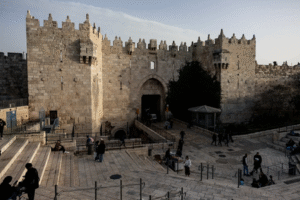
The Damascus Gate of the Old City of Jerusalem, 18 February 2026
Nir Hasson and Jack Khoury report in Haaretz on 18 February 2026:
Israel Police extended morning visiting hours for Jews and tourists on the Temple Mount (Haram al-Sharif) on Wednesday, marking a significant departure from long-standing Ramadan protocols at the holy site.
According to the status quo established after the Six-Day War, the Temple Mount is a site of worship for Muslims and a place of visitation for non-Muslims. Under this arrangement, the site is typically closed to non-Muslims in the afternoons during the month of Ramadan.
This year, visiting hours for Jews were extended during the morning hours, as “compensation” for the closing of the site at noon. The Palestinian Authority has described this decision as a “dangerous escalation” in an announcement published by the Wafa news agency.
On Wednesday, the Temple Mount was open to visitors at 6:30 A.M. instead of 7:00 A.M., and was closed at 11:30 A.M. instead of 10:00 A.M. According to the status quo, which has been in place since 1967, the compound is open to visits by non-Muslims for four hours in the morning and one more hour midday.
During the month of Ramadan, midday visits are canceled to allow the Waqf custodians of the site to prepare for the massive evening prayers.
Since the appointment of Maj. Gen. Avshalom Peled as commander of Israel Police’s Jerusalem District, police have been apparently trying to placate Jewish activists. The police recently approved the introduction of prayer sheets to the compound, and, in contrast to the past, unlimited prayers, singing and bowing by Jewish visitors.
According to the status quo reached in 1967, the Temple Mount is a site of worship for Muslims and a site for visiting by non-Muslims.
Guided by this principle, as determined by the government, the police used to forbid Jews to bring their tefillin phylacteries, prayer books or sheets into the compound, prohibiting prayers, singing and bowing – which is permitted on the Temple Mount according to Jewish precepts – as well as other customs.
Jewish activists have demanded for years that they receive some compensation for the closing of the Temple Mount during Ramadan. In their decision to extend visiting hours, the police have acceded to this request. The Palestinian Authority has expressed its concern that this step would become a permanent policy after Ramadan.
It said that the decision harmed the historical and legal status of the site and constituted a blatant provocation directed at the sentiments of Muslims in Jerusalem, Palestine and the entire world.
According to the Authority, “the al-Aqsa Mosque is an exclusively Muslim site of prayer,” and any step taken by Israel on this site is “a blatant violation of international law and of decisions made by the relevant international community.”
The army announced that it would allow 10,000 Palestinians to participate in the Friday prayers in the Al-Aqsa Compound based on police recommendations. This marks a cutback compared to the number of people police would let in before the war.
The army said that only men aged 55 or older, women aged 50 or over, and children up to the age of 12, accompanied by an adult member of their immediate family, would be allowed to enter the compound.
This article is reproduced in its entirety