

International law and the Trump Board of Peace charter
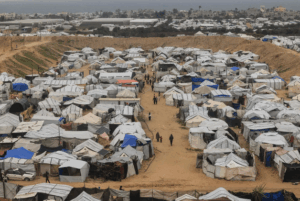
A ‘tent city’ for displaced Palestinians on the sand in the Khan Yunis refugee camp, southern Gaza, on 27 December 2025
Brian Brivati writes in BPP Substack on 19 January 2026:
Trump’s Board of Peace (BoP) and NCAG -National Committee for the Administration of Gaza raise several international significant legal issues – most flow from the Board of Pease which provides the authority for the NCAG. Its self-declared global conflict-resolution mandate lacks a clear basis in international law beyond the claim that UNSC 2803 provides a legal basis for its operation in Gaza. [See here for an analysis of what is missing from UNSC 2803]. The Board’s draft governance structure , which could still be changed, concentrates power in one individual (President Trump as life-long Chair) and ties extended membership to hefty financial contributions, ($1billion in first year) an arrangement unusual in treaty-based organisations. Questions of legal personality and legitimacy arise, as the BoP was recognised by a UN Security Council resolution in Gaza as a “transitional administration with international legal personality” but operates outside the UN system without clear oversight. Membership is by invitation and consent – states are not bound unless they choose to join, consistent with the Vienna Convention principle that treaties create no obligations for non-consenting states. Finally, the Board’s role in Gaza (an occupied/post-conflict territory) implicates the law of occupation, self-determination, and human rights: the international administration must not entrench external control in violation of the Palestinian people’s rights.
Under the UN Charter, primary responsibility for international peace and security rests with the UN Security Council (UNSC) (Article 24). Any “global mandate” to resolve conflicts typically requires UNSC authorisation or a multilateral treaty among states. In the BoP’s case, Resolution 2803 authorised the Board only for Gaza and only through 2027, as part of the ceasefire’s transitional governance plan. That mandate is narrow – “solely focused on the Gaza conflict”– and time-limited. By contrast, the BoP Charter’s language and Trump’s letters suggest an intent to expand to other conflicts indefinitely. There is no existing Security Council resolution or treaty conferring a global peacekeeping or governance role on the Board outside Gaza. Thus, any claim of authority to intervene in conflicts worldwide would lack clear legal basis unless new UNSC resolutions or international agreements expressly grant it. Acting without such authority could conflict with the UN Charter’s framework, which does not recognise independent bodies imposing peace settlements globally without UN or host state consent.
Indeed, diplomats have warned that Trump’s Board appears to “ignore the fundamentals of the U.N. Charter” in its bid for a broad mandate