

In the shadow of the live feed: Avi Shlaim’s ‘Genocide in Gaza’
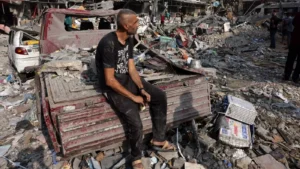
A Palestinian sits amid the destruction following Israeli air strikes on al-Shati camp in Gaza City on 28 October 2023
Hossam el-Hamalawy writes a review of Avi Shlaim’s Genocide in Gaza: Israel’s Long War on Palestine
in Middle East Eye on 14 January 2026:
Avi Shlaim’s Genocide in Gaza: Israel’s Long War on Palestine is a book written in the midst of catastrophe, not after its dust has settled. It is a work shaped by urgency rather than hindsight, driven by the need to establish a record while the destruction is still ongoing and the project of denialism is already taking form.
The Oxford scholar writes with the awareness that what is not fixed in language now risks being softened, relativised, or erased altogether. Suffused with grief, the book does not, however, plead. It documents, argues and indicts. The author writes with the awareness that this is a war that has been livestreamed, normalised, and justified in real time.
It comes as future denials of the genocide ongoing in Gaza are already being rehearsed. The book’s purpose is to interrupt that process, to leave behind a written record that resists erasure.
Shlaim’s authority does not come from moral posturing but from a long, uncomfortable intimacy with his subject. Born in Baghdad in 1945 to an Iraqi Jewish family, Shlaim migrated in 1951 to the newly born Zionist state, served in the Israeli army, and moved to Britain in 1966 to study at Cambridge. When war broke out the following year between Israel and a coalition of Arab states, he returned briefly to Israel to serve, before resuming his life in the UK.
That trajectory matters. Shlaim is not writing from outside the story, nor from the safety of abstraction. Over subsequent decades, he became one of the most prominent members of the group known as Israel’s “new historians”, scholars who challenged official state narratives using newly opened archives. His earlier work dismantled myths surrounding Israel’s founding, its wars with neighbouring Arab states, and its claims of perpetual victimhood. As a professor of international relations at Oxford, Shlaim built a reputation for archival rigour and a willingness to confront political orthodoxies.
Genocide in Gaza marks a further step. This is not a book written primarily for fellow historians. It is a public intervention by someone who believes that scholarly detachment becomes a form of complicity when mass killing is rationalised in legalistic language.
Settler colonialism without euphemisms
At the heart of the book is a structural argument. Gaza is not treated as an anomaly, nor as a humanitarian tragedy that erupted suddenly after 7 October 2023.
It is presented as a pressure chamber within a broader settler colonial system, one designed to contain, fragment and ultimately neutralise Palestinian political existence. Shlaim returns repeatedly to the idea that Israeli policy has been guided not by conflict resolution but by conflict management.
Gaza, in this framing, functions as a laboratory for control. Periodic assaults are not failures but features. The infamous military phrase “mowing the lawn” is cited not as a rhetorical flourish but as evidence of intent. It conveys routinisation, maintenance and the reduction of human lives to a technical problem.
This insistence on structure is what gives the book its oppressive weight. Shlaim is not interested in moral shocks detached from history. He wants the reader to see continuity, to recognise how siege, blockade and repeated destruction form a single political grammar. Once that grammar is recognised, the language of surprise and regret collapses.
The arithmetic of destruction
Despite its moral intensity, Genocide in Gaza is grounded in painstaking detail. Shlaim catalogues the destruction not to overwhelm but to establish a pattern. Entire residential neighbourhoods flattened. Hospitals bombed or rendered inoperable. Universities erased. Water systems destroyed. Agricultural land poisoned or bulldozed.