

In Gaza, IDF drones infiltrate every moment of Palestinians’ lives
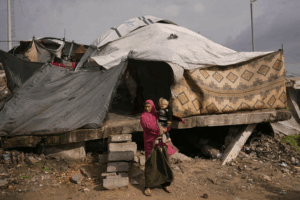
A displaced persons camp in Gaza, January 2026
Nagham Zbeedat and Rawan Suleiman report in Haaretz on 4 January 2026:
For more than two years, the sound of drones has been a constant in Gaza City – even when the streets are empty, and despite the cease-fire that went into effect in mid-October.
For 24-year-old Mohammed Abdel Hai, the buzzing sound from above has become part of daily life. “You stop noticing it,” he tells Haaretz. “But in your mind, you stay aware that it is there.”
In Gaza, privacy has always been limited. Homes are close together. Walls are thin. Life happens in public. But the war has introduced a different kind of invasion – one that comes from above.
Abdel Hai lives in al-Daraj, the most crowded quarter of Gaza’s Old City. He grew up there, played football in its narrow streets and learned to recognize neighbors by their footsteps. Today, he says, the area feels exposed to surveillance as quadcopters – small drones that almost every Israeli army unit possesses today for observation and intelligence-gathering purposes – hover low over neighborhoods.
“The quadcopters come mostly at night,” he says. “From evening until dawn, they move slowly, and sometimes they stay in one street, going back and forth.” Residents say they can hear them clearly, sometimes close enough to feel. Many fear that ordinary movements – stepping outside, turning on a light, standing on a roof – could be misinterpreted. He describes how behavior changes without anyone being commanded: Men stop gathering at night in cafes, families stop visiting each other after sunset.
“You think twice before going out,” Abdel Hai says. “At night, we stay away from the windows. You don’t know what they see. Even getting water from the tank on the roof can be seen as suspicious.”
An Iftar dinner in Gaza, March. A displaced person’s camp in Gaza City, this week.Omar al-Qattaa/AFP; Jehad Alshrafi/AP
“We don’t sit on the roof anymore,” says Abdel Hai. “We no longer stand near the windows. Even inside his own room, a person does not feel alone.” He pauses, then adds: “Sometimes I feel more exposed inside the house than outside it, because when you are inside, there is nowhere to escape.”
The idea of privacy, Abdel Hai says, now feels like something from another life. “Privacy is when you feel safe,” he says. “We don’t have that.” He recalls one night during Israel’s intense bombardment of the neighborhood in September, when the electricity was cut and the area went dark. “The drones were very close,” he says. “You could hear them moving between the streets and dropping bombs.”
This sense of surveillance, Abdel Hai says, extends beyond physical space When asked whether he feels his phone is monitored, he answers without hesitation. “Yes, of course. All the time,” he says. “When we want to talk about a relative, whether they were martyred or are still alive, we put our phones away, or we turn them off.” He explains that he censors himself when he speaks. Other times, he chooses to imagine no one is listening or watching. “Sometimes I feel like I have complete privacy. I tell myself I have nothing left to lose.”
Above him, the sound of drones remains constant. “We hear the zanana all the time,” he says, referring to Israeli reconnaissance aircraft. “The quadcopters are less frequent.”
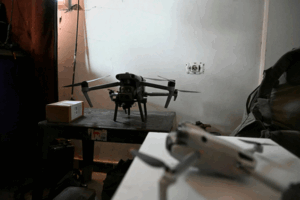
A photo taken during an IDF-led press tour of a drone sitting idly between IDF operations in Shujaiyeh, a quarter of the Old City of Gaza
He says residents have learned to distinguish between them. “Phones emit electromagnetic signals, and the zanana can detect them. Quadcopters detect heat in our bodies.” When asked how he knows this, Abdel Hai shrugs. “We have to know,” he says. “We’ve lived with this for so long that it becomes necessary.”
Drones as a ‘tool for psychological warfare’
It is impossible to live like this over time, Abdel Hai is convinced, and he is not the only one. Just last month, an editorial in the medical journal The Lancet stated that “The consequences of the rising use of drones are not only physical. The presence of a drone or multiple drones flying overhead produces anxiety in those below who are unable to discern whether they are merely under surveillance or in imminent danger of attack.” It further described how civilians living under the constant threat of drone strikes report mental health struggles, including symptoms of post-traumatic stress disorder.
These words will surely sound familiar to Dr. Fadel Ashour, a specialist psychologist from Gaza. “The consequences of this [drone] situation will persist even after the war ends,” he recently said on a podcast. “More than 78 percent of people in society will suffer from PTSD to varying degrees.” According to him, patients have told him in previous years that “the buzzing of the drones brought them back to traumatic places from previous wars.” Therefore, he has no doubt that “the buzzing will be a painful memory that stays with them.”
But before the future, these sounds are very much alive in the present. In a reality where schools have ceased to function, new “study materials” have entered children’s lives. Instead of the differences between active and passive sentences, they now specialize in the distinctions between the incessant background noises.
“My youngest is 7, and he has come to differentiate between the sounds of airstrikes, tank shells and drones. Why should a child know these things?” asks Fouad Haj, 42, a father-of-three from the Sheikh Radwan neighborhood of Gaza City. “Before the war, they played outside and visited their cousins down the street. Now I don’t let them go out after Maghrib [sunset] prayer.”
Haj also imposes restrictions on himself: He works odd jobs when possible, but traveling to work is still dangerous. He says that even going to buy bread can feel like a risk calculation.
“Especially with the ambiguity of the Yellow Line, you become more cautious on where to go and how far you can go away from home,” Haj explains. “It’s not only fear of death. It’s the fear of going out to bring food and getting killed while doing it, leaving my kids and wife to starve and desperate for anyone’s help.”
The buzzing of a drone.
The fact that everything is done under the watchful eye of the drones doubles the fears. He recalls an incident when a neighbor was followed by a quadcopter after stepping out at night to check on relatives nearby. “It followed him for two streets. He came back shaking. He said, ‘I didn’t do anything. I just walked.'”
After that, Haj says, the whole block is wary of going out or being spotted. “You feel like your life is paused,” he says. “Like someone else controls when you move, when you breathe. Even when you are with your family, you are not relaxed. You feel like someone is always there.”
On a podcast dedicated to women in war, Bisan, a Gaza native who has since managed to leave, said the buzzing still hasn’t left her and has become a part of her daily routine, even abroad. “Imagine that the sky is following you at all times,” she said. “The army says it’s only for surveillance, but for us, it’s a tool for psychological warfare.”
Another participant in the podcast, Mai, a resident of Gaza City, emphasizes that “even if there is a cease-fire, it’s there all the time.” The fact that some drones monitor while others kill raises anxiety levels even further. “We are afraid even now; we know the drone is looking for someone to kill,” she notes. “We are afraid of what is going to happen.”
Far from Gaza, and still hearing the buzz
For Malek, drones are not a new story in Gaza. First used by the IDF in the Strip in 2000, he feels like he grew up with them. “I remember it from when I played soccer in the neighborhood, when I was in school, when I got married, and when I taught my daughter to walk – during war, during hunger, during cease-fires,” he tells Haaretz.
Now in his 30s and married with two children, Malek currently lives in a displaced persons camp in southern Gaza. “Any time you look at the sky, you can find a buzzing drone; sometimes there are three or four of them in the air, some with a loud sound and some quieter. They are Israeli-made, some are American, French, British. Some that kill and some that gather information – I can identify them all.”
In a poem he wrote about “this thing called ‘The Buzzer,'” he described it: “Everything has changed, except for this voice that never tires of chasing me.” Now, it is chasing his children as well.
“They think it’s a natural sound; they don’t know there are children in the world who aren’t familiar with this buzzing,” he says with sorrow, fearing that this isn’t something that will simply pass. As someone who grew up with it, the buzzing affects the consciousness like a fear that won’t let up. “When I hear it, I feel something strange,” he says, adding that he hopes that before he dies, he and his children “will earn a few days of peace, without the buzzing.”
Shareef no longer hears the buzzing. At least not physically. Today, he lives in Alexandria, Egypt. But the fact that he left the Strip has not stopped the feeling that he is on someone’s radar. “It follows me,” he says. “But in a different way.”
Ahmed Muin Abu-Amsha singing a song he wrote a song about the drones’ constant presence with others in Gaza.
He fears that his phone calls are being monitored, that his social media activity is being tracked, and that if he speaks out publicly, there could be consequences for his family in Gaza. “The war didn’t stop at its borders; it follows you into your phone,” he says, illustrating his fears.
That is why, when Haaretz made contact, he insisted on speaking via Telegram, without video, and revealing only a few identifying details: his first name, his age (29) and the fact that he works in digital marketing. “I am not afraid for myself,” he clarifies once again. “I am afraid for my family.”
Shareef’s mother and two sisters are still in Gaza. His father was killed a few months into the war. His older brother, Wisam, became the family’s main support, emotionally and financially. Then, a few months ago, Wisam died of a heart attack. “The pressure killed him,” he says quietly. Now, Shareef is the only provider left. “I send money every month,” he says. “Food, medicine, rent. Everything depends on me.”
This responsibility shapes every decision he makes, including what he says, what he posts, and who he speaks to. “I think before writing anything,” he says. “Before liking a social media post and before replying to messages. I have [a substantial amount of] followers and that makes me more careful, not more free, because if I say something someone could misinterpret it and bad outcomes might happen.”
This fear paralyzes him, and also silences him: “I have opinions, I have anger, I have grief, but I keep them inside, and it affects me and my mental health. …At night, I think: what if my words bring danger to my mother? This thought is enough to stop me from speaking.”
And so, Sharif’s conversations with his family members are also shaped by fear, whether real or imagined. “We don’t speak freely,” he says. “They mostly tell me what they need, how much their needs might cost, and that’s about it.” When his mother asks how he is doing, he lies. “I say I’m fine, because she has enough to deal with as it is.”
Whether inside Gaza or outside it, Palestinians describe the same feeling: that their lives are exposed and controlled. In Gaza, it comes from drones in the sky. Outside, it comes from phones, platforms, and imagined consequences.
The invasion of privacy does not stop at Gaza’s borders. In the West Bank, Palestinians say the sense of being watched has also entered their homes, their phones and even their online thoughts.
Recently, a photo circulated widely on Palestinian social media showing a printed poster reportedly left by Israeli forces on the entrance of a Palestinian home in Tubas, a town in the West Bank near Nablus, after an arrest. The paper, written in Arabic, carried a clear warning.
“We are monitoring what you are doing on the internet,” the notice reads. “Circulating inciting content, writing inciting content or publishing inciting content online is a terrorist crime in every sense of the word and may expose you to arrest and imprisonment, as happened in this home. We warned you.”
The message was not addressed to a specific person. It was not signed. It did not explain what content was considered “incitement.” But for many Palestinians who saw it, the meaning was clear. The language of the poster – “we are monitoring” – echoes the fears voiced by Palestinians inside Gaza and those who left it. Whether through drones in the sky, soldiers in the streets or warnings tied to digital footprints, many describe the same feeling: that there is no clear line anymore between public and private life. What emerges is the sense that small acts of normal life feel like defiance.
“Sometimes I sit by the window on purpose,” Abdel Hai says. Haj says when his children sleep through the night, it feels like victory. For Shareef, resistance looks like survival. “I keep going,” he says. “That is all I can do.”
This article is reproduced in its entirety