

IDF turns Palestinian family home into army lookout to secure West Bank settlement inauguration
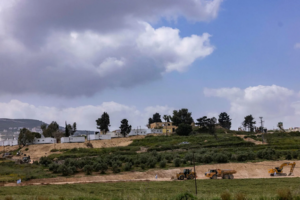
The inauguration ceremony for the Sa-Nur settlement in April 2026
Jack Khoury and Matan Golan report in Haaretz on 9 August 2026:
Israeli soldiers removed a Palestinian family from its home in the northern West Bank and turned the house into a temporary military outpost ahead of the inauguration of a new settlement nearby, in a ceremony attended by ministers and lawmakers.
In the northern West Bank, there had been almost no Israeli civilian presence for decades – not since Israel’s 2005 pullout from the area, when four settlements were evacuated.
Since Prime Minister Benjamin Netanyahu’s government took power, Jewish development in the area has massively increased, with 19 new settlements approved by the security cabinet, including the four settlements evacuated in 2005. The rapid acceleration in settlement expansion has brought a host of new restrictions on the Palestinian population.
Homeowner Hazem Hamad, a resident of Arraba, south of Jenin, told Haaretz that the army notified him of the evacuation last night. At 7 A.M., he left the house with his wife and children and returned after 1 P.M. after forces left. Hamad emphasized that the soldiers did not damage the family’s property or harm his home. According to Hamad, the forces took over the entire house. He stressed that it is a residential home where he lives with his wife and five children – four daughters and a son – and not a building under construction. This is the first time, he said, that the army has taken over his home in this manner.
The army also blocked the road connecting Arraba with the nearby village of Ya’bad.
Earlier on Sunday, families began moving into permanent homes in the new settlement, Emek Dotan, which was established on a hill whose entry to Israelis had been prohibited by Israeli law until the relevant provision was repealed by the Netanyahu coalition in March 2023. Since the current government was established, the cabinet has authorized 104 settlements throughout the West Bank.
Four settlements – Homesh, Sa-Nur, Eival and now Emek Dotan – have already been established in the north. During the summer, founding groups are expected to move into several settlements in the area, including Ganim, Kadim, Emek Dotan, Noa, Alonei Shomron and Shalem. In recent weeks, development and construction work at the sites has progressed rapidly.
MK Zeev Elkin (New Hope) celebrated the inauguration of Emek Dotan: “It is difficult to describe the excitement when you see our dream coming true, and after the return to Homesh and Sa-Nur,” which were evacuated in 2005, “We are participating today in the establishment of another new settlement in the area.”
Education Minister Yoav Kisch celebrated the inauguration on Sunday, saying it sends a “super-super significant message here. I thank God for giving me the privilege of being here.” United Torah Judaism chairman Yitzchak Goldknopf also joined in the congratulations. “When I see these children and what is destined to grow on this mountain, compared to what our enemies tried to bring about here, I know that this place will provide an answer and response to the whole world,” he said.
The establishment of settlements leads to restrictions on Palestinians living in their vicinity: land seizure, clearing of agricultural land, demolition of buildings and residences alongside roads, checkpoints at village entrances that can be suddenly closed, and once open spaces which are now blocked for entry.
All of this takes place under the justification of “security needs” to protect Israelis in the area, while Palestinian freedom of movement and property rights are curtailed.
About two weeks ago, the army issued requisition/seizure orders for land around the settlement. Most of that area – about 60 dunams (15 acres) according to one of the landowners – is olive groves. The orders allow the IDF to uproot the trees in the area.
Ahmad Zaki al-Aridi said that he and the other landowners found out about the order through social media, just three days before it was due to take effect. Al-Aridi said that about 50 Palestinians are set to be affected by the measure.
“The land is not just a number on a title document for us. It is the family’s livelihood, its history, and an investment passed down from generation to generation,” he told Haaretz. He also said that the Arraba municipality had begun collecting land registry extracts and legal ownership documents in order to file an objection to the order.
Last month, Central Command Chief Avi Bluth signed 15 land requisition orders to take control of land – ostensibly controlled by the Palestinian Authority according to the Oslo Accords – intended to connect the new settlements of Noa and Emek Dotan, which are near Kadim. A seizure order allows the military to take possession of real estate or property. International law permits an occupying power to use such orders only for a clearly defined security purpose and temporarily.
However, according to the research organization Kerem Navot, this is the first time the IDF has used such orders in Area A – under full PA administration – to connect settlements, in a move intended to serve a civilian purpose.
In an investigation published by Haaretz this June, several research organizations warned that the locations of the new settlements had been chosen to cause the collapse of the Oslo Accords.
According to the organizations, the most likely route between the two settlements necessarily passes through Area A – and several weeks later, Central Command Chief Maj. Gen. Avi Bluth did indeed sign a series of such orders. The army explained that they were intended for operational needs against the backdrop of the establishment of the new settlements, but did not answer Haaretz’s question as to whether it would prohibit Israeli civilians from using them.
Last week, the first structures were placed in the Kadim settlement in the northern West Bank. Kadim is one of four settlements in the northern West Bank that were evacuated as part of the 2005 disengagement plan. Their resettlement became possible following the repeal of the Disengagement Law in March 2023. The settlement, whose area is expected to be larger than it was previously, is intended to be home to a religious group from Tel Aviv.
This article is reproduced in its entirety