

High Court upholds rules requiring Gaza, West Bank aid groups to hand over employee lists
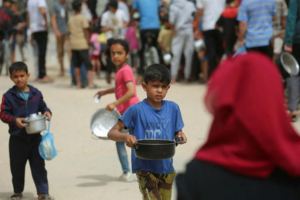
Displaced children queue to receive food at a community kitchen in al-Bureij refugee camp in central Gaza, May 2026
Nir Hasson reports in Haaretz on 20 May 2026:
High Court justices rejected a petition filed by international aid organizations operating in the Gaza Strip and the West Bank against new government procedures that make it more difficult for them to obtain the permits needed to operate.
As a result, the humanitarian groups will now be required to submit their employee lists to the state or else be forced to cease their activities – most groups are expected to refuse to hand over the lists. The procedure is expected to worsen the humanitarian situation, particularly in Gaza.
Last year, the government implemented new NGO registration rules for international aid organizations operating in the West Bank, East Jerusalem and Gaza.
The reform transfers oversight from Israel’s Social Affairs Ministry to a committee led by the Diaspora Affairs Ministry, which includes representatives from the Defense Ministry, COGAT, and other government and security bodies. As part of the change, new conditions were set for obtaining a permit to operate, including a demand to transfer details of Palestinian employees to the state.
That committee can refuse registry to organizations, or revoke their approval to work in Israel, if they or their staff members published calls to boycott Israel in the past seven years; if there is “reasonable basis to assume” that they oppose Israel’s existence as a Jewish and democratic state; if they incite racism; support armed struggle against the State of Israel; or “actively advance delegitimization activities against the State of Israel.” Denying the Holocaust and the atrocities of October 7 are also grounds to be delisted.
Most organizations refused to transfer the details, claiming it could expose them to legal claims from their employees, since European privacy regulations prohibit the practice.
As a result, 37 organizations did not receive permits to continue operating. Nineteen of them, including AIDA, an umbrella group of nearly 100 nonprofits that work in the Palestinian territories, filed a petition against the new procedure, arguing that it is illegal under international and European law to which their organizations are bound.
The High Court ruled that the state has broad discretion over authorizing the entry of foreign workers into the country. Their ruling says that even within European privacy regulation, there are circumstances that allow the transfer of employee information for security reasons. “Conducting a screening and inspection process to maintain security is one of the government’s central authorities,” the ruling stated. However, the justices ordered that the organizations be allowed an additional 30 days to resubmit petitions.
Some of the organizations whose licenses have already been revoked continue to operate in Gaza, but without the international employees who were forced to leave. The groups are also barred from bringing aid, food, or medical equipment into Gaza, forcing them to purchase goods within the besieged territory amid a sharp surge in food prices due to shortages, thus reducing their ability to assist the population.
According to the organizations, the loss of international oversight in the territory exposes humanitarian aid groups to threats from local militias.
Attorneys Yotam Ben Hillel and Alva Kolan, who represented the humanitarian aid organizations, stated that the ruling reflects the limited status of international law in the Israeli legal system: “In the midst of a severe humanitarian crisis, including the collapse of the medical system and extreme living conditions in Gaza, Israel chooses to prohibit the entry of essential aid and professional staff.” They said that without the NGOs, “a severe and unavoidable deterioration in the situation on the ground will unfold.”
According to the lawyers, when Israel tried to replace humanitarian aid groups with the Gaza Humanitarian Fund (GHF), “it ended in disaster and 2,600 killed.” Ben Hillel and Kolan said that “Israel is abdicating itself from the responsibility to meet humanitarian needs, while at the same time blocking the activities of international agencies that fill the vacuum.”
Before the GHF announced the completion of its emergency mission, during which Israel had halted all aid from entering the territory and closed all crossings, NGOs called to revert to UN-led mechanisms. “Palestinians in Gaza face an impossible choice: starve or risk being shot while trying desperately to reach food to feed their families.”
In June, Israeli soldiers in Gaza told Haaretz that the army had deliberately fired at Palestinians near aid distribution sites. Commanders ordered troops to shoot at crowds to drive them away or disperse them, even though it was clear they posed no threat. One U.S. officer referred to it as the “Gaza Olympics.”
Diaspora Affairs Minister Amichai Chikli, whose ministry manages the inter-ministerial committee, welcomed the High Court’s ruling. “The rejection of the petition sends a sharp and clear message – the State of Israel will not allow terrorist activity under the guise of humanitarian activity, the party is over!”
Yaniv Kubovich, Linda Dayan, Bar Peleg, Avi Scharf and Sheren Falah Saab contributed to this report.
This article is reproduced in its entirety