

Gaza Board of Peace chief presses Israel, Egypt to ease Rafah crossing restrictions
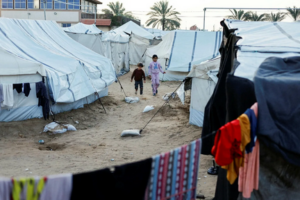
Gazan refugees in the Zuwayida camp in the central Gaza Strip, March 2026
Liza Rozovsky reports in Haaretz on 25 March 2026:
The director general of Trump’s Board of Peace initiative, Bulgarian diplomat Nikolay Mladenov, said on Tuesday that his team is “working hard” with Israel and Egypt to significantly increase the number of people entering and exiting the Gaza Strip through the Rafah crossing.
Since the crossing opened on a limited basis in early February, fewer than 900 people have passed through it in total. In a briefing to the UN Security Council on the Council’s activities since the adoption of Resolution 2803, which supports the 20-point plan for the Gaza Strip, Mladenov reiterated his demand to bring caravans and tents into the Strip to provide temporary living solutions for residents.
“More than two million people cannot continue to suffer from degrading living conditions,” he said. Mladenov’s demand clashes with the position of Israel, which views the entry of caravans as part of the step of reconstructing the Strip, which it has insisted cannot move forward until Hamas is demilitarized.
Mladenov insists that the entry of these items does not constitute reconstruction and therefore should be immediately implemented, adding that his office “has formulated a framework for the decommissioning and reintegration of armed groups in Gaza.” The framework does not set defined timelines, but states that weapons will need to be handed over to the Gaza technocratic committee.
Mladenov noted that the proposal to disarm Hamas was submitted to all relevant parties. According to him, representatives of his office and the guarantor states of the agreement – the U.S., Egypt, Turkey, and Qatar – explained to representatives of the Palestinian factions that the proposed framework is essential for the implementation of Resolution 2803.
During the briefing, Mladenov detailed the principles of the process: reciprocity – the disarmament process will proceed in parallel with a gradual Israeli withdrawal from the Strip; gradualism – initially, rockets, heavy ammunition, explosive devices will be addressed and “the tunnels neutralized,” and at a later stage, personal weapons will be addressed “through a process of registration and collection”; and, finally, verification – the reconstruction process can only begin after verification of the implementation of the weapons handover stages.
According to Mladenov, the framework for the decommissioning and reintegration of armed groups in Gaza also includes “pathways through which individuals associated with armed organizations can return to civilian life with dignity.” These pathways include “structured amnesty arrangements and reintegration programs.”
The timeframe for completing the disarmament, including the handover of personal weapons, across the entire Gaza Strip, is more than six months, but Mladenov noted that his office will act flexibly and can allow the parties to deviate from the set timelines if necessary
This article is reproduced in its entirety