

From cash brokers to crypto, Gazans struggle to stay financially afloat
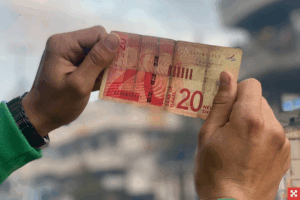
A worn-out banknote in Gaza, 19 December 2025
Ahmed Ahmed reports in +972 on 19 December 2025:
For four years, Waseem Abd Alnabi has run a small children’s clothing stall in the Al-Rimal neighborhood of Gaza City. Over the course of Israel’s genocidal war on the Strip, repeated ground invasions forced the 30-year-old to close his shop for months on end. But even during periods of relative calm, when he was able to reopen the stall, he struggled to conduct basic financial transactions with customers.
Gaza’s currency is the Israeli shekel, and because Israel has prevented new banknotes from entering since the beginning of the war, the limited cash in circulation has seriously deteriorated — sometimes so torn and faded that it’s no longer recognizable. Merchants like Abd Alnabi can’t accept damaged notes because their suppliers refuse them, so residents are often left without any form of physical payment.
“I used to take the worn-out banknotes with small tears until I realized that the traders I buy my goods from wouldn’t accept them,” Abd Alnabi told +972. “These damaged notes are practically useless.”
Since the ceasefire took effect in October, Abd Alnabi has been able to rebuild and reopen his stall, after clearing the rubble left by Israeli forces during the most recent invasion of northern Gaza. But like most Gazans, who face a severe liquidity crisis and an economy shattered by Israel’s war on the Strip, he is now stuck in financial paralysis.
“The main and sole reason for our financial suffering in Gaza is the Israeli occupation,” Abd Alnabi affirmed. “They bombed the banks in Gaza and continue to prevent cash from entering. “The majority of people in Gaza depend on bank transfers or salaries that go into their accounts, but with ATMs and banks closed, people can’t access their money,” he added.
As the sole breadwinner for his family of seven, Abd Alnabi tries to use his own worn banknotes to buy goods for his family, but the few stalls that still accept them charge higher prices as a transaction fee. “They sell their goods at an overcharged rate [if I use damaged banknotes] — sometimes 40 percent above the regular price,” he explained.
Even as the intensity of Israel’s assault has slowed since the October ceasefire, Gaza’s economy shows few signs of recovery. Some banks have reopened, but still have no cash. At the end of November, the UN Conference on Trade and Development (UNCTAD) warned that Gaza was going through “the fastest and most damaging economic collapse ever recorded,” with the economy having lost 87 percent of its prewar value. In 2024, UNCTAD reported, Gaza’s GDP per capita fell to $161 and inflation rose 238 percent, pushing all 2.3 million of its residents below the poverty line.