

For Gaza’s orphans, the safety of childhood vanished with their parents
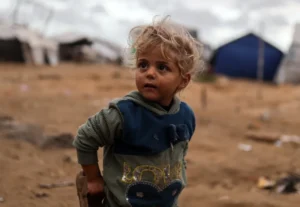
A displaced Palestinian child outside a tent along the seafront in Gaza City, 9 January 2026
Bahzad al Akhras writes in Middle East Eye on 16 January 2026:
In Gaza today, tens of thousands of children wake up without a parent’s voice calling their name. This is not because of illness or accident, but because Israel’s war on the Palestinian enclave erased the people who made them feel safe.
As of last March, more than 39,000 children in Gaza were estimated to have lost one or both parents in Israel’s ongoing aggression, including 17,000 who were fully orphaned, according to the Palestinian Central Bureau of Statistics.
This is one of the largest orphan crises in modern history. And these figures are not just statistics; they represent a mass unravelling of childhood itself.
For a child, parents are not simply caregivers; they are the world’s first promise of safety. The steady presence of a mother or father represents a familiar voice, a predictable routine, a hand held in the dark. It is how a child learns that fear can pass, that hunger can be soothed, that danger has limits.
When that anchor is torn away violently, the child’s entire sense of reality shifts. The world becomes unstable. Trust becomes fragile. Safety becomes a memory.
In Gaza, this rupture is happening at scale. The loss of caregivers is not only through death, but also through severe injury, detention, enforced disappearance, or separation in the chaos of repeated displacement.
Some children have been pulled from rubble, only to find no one left to call “mine”. Others have a living parent, but one so injured, traumatised, or absent that the child is left without real protection.
Switching off
Among younger children, the consequences are immediate and heartbreaking. Many become inconsolable. They cry for hours, cling to any adult nearby, and panic when a caregiver leaves their sight – even for a moment. Some lose words they once had, or start bedwetting again.
Some go quiet, as if switching off is the only way to survive what their minds cannot process. In crowded shelters, where adults are themselves exhausted and grieving, children often attach to whoever is available, because their need for safety is urgent and unmet.
For older children, especially those entering adolescence, the damage takes a different form: they become adults overnight. When a parent is killed, detained or severely injured, the child often inherits the role of provider, protector and decision-maker. In Gaza, I have seen children, especially eldest daughters, carrying responsibilities that would break most adults: securing food, caring for siblings, managing a traumatised surviving parent, and keeping the family functioning under bombardment and hunger.
This role reversal does not build resilience. It steals development. It teaches emotional suppression as a survival skill, and turns fear into permanent background noise.