

Fifty years on, does Land Day still matter for Palestinians in Israel?
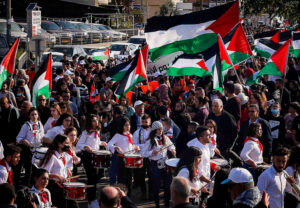
Palestinian citizens of Israel march during Land Day, in Arrabe, northern Israel, 30 March 2021
Noor Dadosh writes in +972 on 30 March 2026:
March 30, 1976 is widely regarded as a foundational moment in the political history of Palestinians inside Israel. The killing by Israeli soldiers and police of six unarmed Palestinians, during nationwide protests against the government’s plans to confiscate land for the “Judaization” of the Galilee, has been commemorated every year since as Land Day.
Fifty years on, its legacy continues to shape the community’s political and public consciousness. Yet this anniversary arrives under exceptionally grim circumstances: Israel’s ongoing war of annihilation in Gaza, escalating state-backed violence and displacement in the West Bank, and the crisis of organized crime ravaging Palestinian citizens of Israel.
To reflect on the meaning of Land Day today, I spoke with Dr. Nabia Bashir, a leading Palestinian scholar of sociology, political science, and Jewish thought. A native of the northern city of Sakhnin, Bashir has engaged with Land Day over the years through both research and his own experience as an activist; in his 2006 book “Land Day — Between the National and the Civil,” he offers one of the first comprehensive analytical studies of the event, examining how it continues to function as a national and political compass.
In our interview, Bashir discusses the place of Land Day in historical memory, the transformations within Palestinian society since 1976, the impasse facing Palestinian political mobilization today, and the challenge of preserving the spirit of this day as a living political idea rather than a static memory.