

Elections without sovereignty: what Palestine’s local vote represents
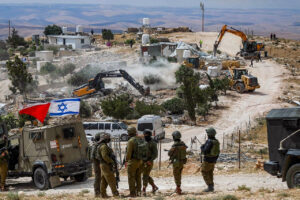
Israeli forces demolish buildings in Khirbet Khilet Al-Dabe, in Masafer Yatta, occupied West Bank, 5 May 2025
Mariam Barghouti writes in Al Jazeera on 25 April 2026:
On April 25, Palestinians will vote in local elections to choose representatives to municipal and village councils for four-year terms. These elections come after years of repeated postponements of national votes, with no legislative elections held since 2006.
In cities across the occupied West Bank, such as Ramallah, el-Bireh and Nablus, billboards featuring local candidates line the streets, while in villages, posters of candidates have been erected in public spaces.
There is both cynicism and cautious anticipation surrounding these elections, which have become the only remaining electoral mechanism through which Palestinians, however limited, can exercise a form of political participation.
Rather than marking a moment of democratic renewal, these elections reflect the reproduction of governance under constraint. They are both performative and revealing: they demonstrate how, despite constant strain, the absence of sociopolitical stability, depleted resources and Israeli-engineered fragmentation, Palestinians are compelled to assert their survival through the very structures that constrain them.
This reality is also reflected in where — and for whom — these elections are taking place. Voting is occurring across the occupied West Bank, but in Gaza, it is limited to a single municipality: Deir el-Balah, exposing the fractured political and geographic landscape that Palestinians are forced to navigate.
Representation with no sovereignty
The Palestinian context is fundamentally undemocratic, not simply because Palestinians have not held national elections for nearly two decades, but because they are ruled by an oppressive power they did not choose.
The Israeli occupation of Palestine, supported by the United States and Western governments, controls and forcibly manages every aspect of Palestinian life. To live in Palestine is to be segregated by force from your own people, to be held hostage under the constant threat of detention or arrest for political thought and participation, and, amid escalating settler expansion, to exist in a permanent state of emergency. This leaves little room for functional or genuine political development.