A recent book documents the rampant looting of Palestinian belongings in 1948, but fails to recognize it as part of Israel's wider goal of dispossession.
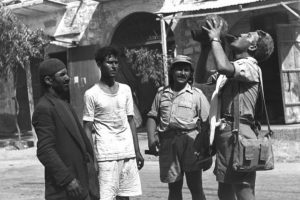
.An Israeli soldier drinks water as Palestinians look on after Israeli forces conquer Be’er Sheva during the 1948 war, October 22, 1948
“Looting of Arab Property in the War of Independence,” Adam Raz, Carmel Publishing House, 2020 (Hebrew).
I brought a few nice things from Safed. I found for Sarah and myself some beautiful embroidered Arab dresses that our local tailor might be able to fix up. Spoons, neckerchiefs, bracelets, a Damascene table and a coffee set of beautiful silver cups, and then yesterday Sarah also brought a gorgeous, completely new Persian carpet, I’ve never seen something so beautiful. A living room like that can hold its own even among the richest folks in Tel Aviv.
These gushing lines from a letter don’t describe shopping items, but bounty: an Israeli soldier’s private profits from the ethnic cleansing of Palestinians from the city of Safed during the war of 1948.
Alongside the massacres, expulsions, and expropriations of that war, Israelis — combatants and civilians alike — stole and looted an astonishing range of Palestinian belongings: personal items, musical instruments, livestock, agricultural produce, agricultural machinery, antiquities, and the contents of entire stores and libraries. The full scale and value of private plunder has never been established conclusively, as only items expropriated by or handed over to the state were documented in detail.
This mass theft is the subject of “Looting of Arab Property in the War of Independence,” a new book by historian Adam Raz, who works as a researcher at the Israeli archival group Akevot. The book concentrates specifically on the looting of movable assets belonging to Palestinians who were expelled from their land in 1948 and never permitted to return.
Raz separates this particular practice from the expropriation of Palestinian land by the nascent Israeli state, in a bid to trace acts initiated not from the top “by political decree,” but rather “from the bottom up” — by neighbors who cohabited in a shared space until the very eve of war. This experience, Raz believes, proved formative in shaping the position of the wider Jewish community against the return of Palestinian refugees.
Part One of the book is dedicated to a dense and rich documentation of the looting, utilizing documents from Israeli archives, clippings from contemporary Hebrew newspapers, diaries and memoirs by Zionist statesmen, and commemorative brigade books and memoirs by Israeli veterans of 1948. In Part Two, Raz offers his analysis of the political ramifications of the looting, arguing that individual acts of looting had considerable influence on the establishment of Israel’s policy of wholly rejecting the repatriation of Palestinian refugees to their homeland.
Through their acts of looting, Raz argues, the looters became “passive partners in the policy that sought to empty the land of its Arab residents,” even as various patterns of national denial and suppression endowed the looters with a kind of social amnesty for their crimes. The looting turned the prospect of Palestinian return into a concrete threat against the economic interests of the looters, who would ostensibly have to return the stolen goods to their rightful owners. The lack of a proactive policy to secure Palestinian property, Raz adds, amounted to a key mechanism for acquiring Israeli society’s support for creating a Jewish-only, Arab-free space — a policy which Raz says became “hegemonic over the course of the war.”
More …