

Burial Society seeks payment from East Jerusalem residents for using path to their homes
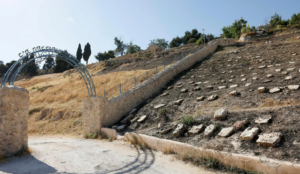
The cemetery near Silwan, a Palestinian neighborhood in East Jerusalem, 21 June 2026
Nir Hasson reports in Haaretz on 24 June 2026:
An Israeli organization that oversees Jewish burial has in recent weeks claimed hundreds of thousands of shekels from Palestinian residents of an East Jerusalem neighborhood who use a dirt road leading to their homes, arguing the route passes through an ancient Jewish cemetery and that traveling on it violates the site’s sanctity, residents told Haaretz.
Residents say they have used the path for generations without dispute and allege the move is another attempt to push them out of the area, while the burial society insists it is protecting a historic cemetery. The road is the only access route to parts of the neighborhood.
The residents say the graves seen in the area are fake, and that this is part of the move to push them out. The organization is a local Chevra Kadisha, a Jewish burial society responsible for preparing bodies for burial and maintaining cemeteries in accordance with Jewish religious law.
In Israel, most cities have one, usually affiliated with Orthodox religious authorities, to oversee burial practices and cemetery management. They are regulated by the Chief Rabbinate, a government institution.
The Sambuski Cemetery was established hundreds of years ago on the slopes of Mount Zion for the poor among Jerusalem’s Jewish residents. Most of the graves never had headstones.
Over the years, Silwan residents purchased land and built homes adjacent to the cemetery – some of which appear in photographs from before 1967, when Israel captured East Jerusalem along with the West Bank. Dozens of families still live there today, and the only access road to the neighborhood is a dirt path next to the cemetery.
Residents say they had no dispute with the cemetery’s wards for about a hundred years, and recount that the rabbi who managed the cemetery was a regular guest in their homes.
But in recent years, the City of David Foundation, commonly known as Elad, began acquiring properties in the area. The government has also permitted the pro-settler foundation to establish a tourist farm on land belonging to Palestinian residents living in the neighborhood, which lies south of the Old City.
About two years ago, the burial society that manages the area installed a new entrance gate to the neighborhood with a sign reading “Sambuski Cemetery.”
About three weeks ago, an additional sign was placed next to it, stating in both Hebrew and Arabic that “the entire area, including its dirt paths, is a Jewish cemetery and burial site. Any intrusion or entry of vehicles is prohibited.”
Even before that, the burial society began suing residents, demanding 50,000 shekels (about $16,700) for each vehicle that entered and parked in the area.
“The defendants or those on their behalf are unlawfully using the cemetery to park their vehicles, thereby desecrating the holy site, harming the dignity of the dead, and harming the dignity of the families and the general public,” the lawsuits stated.
Some families received lawsuits totaling hundreds of thousands of shekels, depending on the number of residents in the household.
“They are demanding 100,000 for each person, even from my 75-year-old mother, who hasn’t left the house for two years. They said she was a pedestrian,” one resident recounted.
In another lawsuit, filed about three years ago, a judgment was already issued, ordering Abdullah Ghanem, a neighborhood resident, to pay 250,000 shekels ($83,435). However, he claims he was unaware of the judgment, and the amounts swelled to 350,000 for the burial society and 350,000 for the Bailiff’s Office. “What am I supposed to do?” Ghanem wondered. “My father died 15 years ago when he was 80. We’ve been here for over a hundred years. Where are we supposed to go? What are we supposed to do?”
The road adjacent to the cemetery remains the only access route to the area in Jerusalem’s Silwan neighborhood. “My 84-year-old mother, how is she supposed to get home?” wondered another resident, Hisham Abu Tin.
Responding to Haaretz’s inquiries, the burial society said, “The Sambuski Cemetery is a historic cemetery where Jerusalem’s poor have been buried for the past 600 years, throughout the entire cemetery area.”
The cemetery “has been desecrated for decades by trespassers, and only recently were headstones located beneath paved roads within the cemetery,” the society added. “The burial society has filed lawsuits for the eviction of trespassers and desecrators and will file additional lawsuits as needed.”
The burial society added that “the existence of the cemetery is well known to the Arab families living nearby. Many of the trespassers understood, after a lawsuit was filed against them, that this is an ancient Jewish cemetery and agreed to cease the intrusion.”
Their agreement “received the force of a legal ruling,” it added. “No Jewish family resides or parks in the cemetery area, and the burial society operates in accordance with Jewish religious law (halakha) applicable to any other Jewish cemetery.”
The Jerusalem Magistrate’s Court heard a lawsuit by the burial society against one of the families on Monday. Attorney Avraham Segal, representing the burial society, presented a letter from the Custodian General – a powerful body responsible for managing Palestinian property in East Jerusalem – authorizing it to take legal action against the Palestinian residents.
The letter was signed by Hananel Gurfinkel, a right-wing activist appointed in 2024 to manage the East Jerusalem portfolio within the Justice Ministry’s custodian unit. The unit is responsible for managing Jewish properties that remained outside Israel’s borders in 1948.
According to attorney Qusai Jaber, the letter contradicts the law, which prohibits the Custodian General from transferring such powers to bodies managing areas on its behalf.
Historical photographs presented by neighborhood residents to Haaretz clearly show the dirt path leading to the homes. In recent years, burial society members placed square, unengraved stones in neat rows in the areas adjacent to the homes. According to residents, these are not real graves but “scenery.” The burial society itself, along with Jerusalem municipality and the Gihon municipal water corporation, carried out work in the area that included excavations, earthworks and construction. Not only did they not encounter any bones, but the work was not done under the supervision of the burial society at all. An examination of aerial photographs from 13 years ago indeed shows that in the areas where the stones are now arranged in rows, there were no grave markings in the past.
“If it were a cemetery, they would dig with a brush, not a backhoe. It’s not really a cemetery,” said Shadi Sumarin, one of the residents. “Three years ago, there wasn’t a single stone here; suddenly, there’s a cemetery,” said another resident.
Residents further claim that the burial society is being used as a tool by the Elad association to make their lives miserable and push them out of the neighborhood. o prove their claim, they point to one of the homes, built by a Palestinian and sold to Jews. According to them, the Jewish family living there continues to use the road and parking lot without any interference by the burial society.
According to residents, several Palestinian families who rented homes in the area decided to leave them due to threats from the burial society.
The lawsuits filed by the burial society against the residents are based on an order it received from the Jerusalem District Court in 2020. The order was granted at the request of the society and the Justice Ministry’s Custodian General, which is the legal landowner.
According to the order, the society received permission to manage the area. But attorney Qusai Jaber, representing 14 of the families in the neighborhood, points to significant discrepancies between the court’s order and the actual actions taken.
In a letter to the Custodian General, Jaber wrote that the burial society received its permit “for the preservation of the cemetery, cleaning, restoration of headstones, and prevention of vandalism.” Urging the Custodian to cancel the society’s permit, Jaber added that “no authorization was requested to file eviction lawsuits, to file financial lawsuits, to demand preservation fees … or to manage a systematic litigation campaign against Silwan residents.”
The attorney further clarified that “this is a situation where a tool intended to protect the cemetery serves in practice as the basis for a widespread litigation campaign.”
This article is reproduced in its entirety