

Beneath the bombast, Trump’s ceasefire plan in Gaza Is on the rocks

Displaced Palestinian children play outside a shelter in Jabalia refugee camp, northern Gaza, on 17 January 2026
Joshua Leifer writes in Haaretz on 18 January 2026:
U.S. President Donald Trump proclaimed last week, with characteristic bombast and ham-fistedness, that the Gaza cease-fire arrangement had advanced to its second phase.
On Saturday, the president named the first members of the Board of Peace, which will ostensibly oversee the reconstruction of the Gaza Strip. (Heads of state may join, according to the organization’s charter, for the price of $1 billion; additional members are slated to be announced during the World Economic Forum in Davos this week).
That same day, the new “transitional technocratic Palestinian administration in Gaza,” headed by the former Palestinian Authority official Ali Shaath, convened for the first time in Cairo, Egypt. The National Committee for the Administration of Gaza (NCAG) according to the 20-point Trump plan, will serve as the interim government in the devastated territory.
The flurry of activity appears designed to give the impression that the cease-fire deal is progressing. Reality, however, is far more complicated.
As is typical of the current U.S. administration, few of the most important details have been worked out. It remains unclear how, precisely, the Gaza reconstruction efforts will proceed: how the different organizational bodies that sit under the Board of Peace will operate in relation to each other; how the NCAG will be funded, and how it will actually manage to rule in Gaza. There are no clear agreements on the establishment of the international stabilization force, or even which countries would contribute troops.
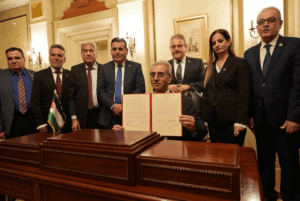
li Shaath, head of the new Palestinian technocratic committee for administering the Gaza Strip, sits at the inaugural meeting of the ‘National Committee for the Administration of Gaza’ (NCAG), in Cairo on 18 January 2026
There also remains significant uncertainty about the future cease-fire itself. While the Trump administration has reiterated its commitment to the demilitarization of Gaza, Hamas representatives have so far not assented to disarm nor given a clear indication that they will accept the new Palestinian administration’s monopoly on the use of force.
Prime Minister Benjamin Netanyahu, for his part, has threatened to resume the war in Gaza if Hamas refuses to do so, and the IDF has reportedly drawn up plans for a new offensive in Gaza City that could be launched as early as March.
In truth, neither Hamas nor the Netanyahu government seems to want the cease-fire arrangement to succeed, even if both have formally agreed to it. Pressure by the Gulf States on Hamas and by the United States on Israel has so far helped to keep the cease-fire together. But the next phase will test the cease-fire’s durability to an even greater degree.
The implementation of the second phase – in particular Hamas’s disarmament and Gaza’s demilitarization – threatens to strip the Islamist group of its raison d’être: armed resistance to Israel’s existence. For this reason, Hamas has not agreed to disarm, even as its leadership has agreed to give up day-to-day governance of Gaza.
For Netanyahu, President Trump’s 20-point plan – which gestures toward Palestinian statehood – was always a bitter bill to swallow. The Israeli prime minister would seemingly prefer to maintain the current situation on the ground into perpetuity: phase one of the cease-fire, in which Gaza is divided into two segments, with the larger portion under Israeli control.
Yet neither Hamas nor Netanyahu can afford to defy the Trump administration openly. The question, then, is how each might appear to comply with the cease-fire framework while negotiating around the provisions they oppose.
The implementation of the second phase – in particular Hamas’s disarmament and Gaza’s demilitarization – threatens to strip the Islamist group of its raison d’être: armed resistance to Israel’s existence. For Hamas, this may prove easier. Some Hamas officials have expressed willingness to relinquish the group’s “offensive weapons” – the missiles and rockets it still possesses – while maintaining its sizeable small-arms arsenal.
The implicit model here is Hezbollah. Hamas would agree to cede the day-to-day governance of Gaza to the technocratic Palestinian administration, and might even accept the eventual deployment of the international stabilization force in the Strip. Yet it would retain a fighting force of tens of thousands, exerting political influence through the continued existence of its paramilitary wing – a kind of veto power enforced by AK-47s.
Such a scenario – in which Hamas agrees to a performative version of disarmament, perhaps even making a public ceremony of decommissioning its remaining rockets – would put the Israeli government in an exceedingly difficult position. Netanyahu would almost certainly oppose such an outcome, which would leave him vulnerable to political backlash as Israel enters an election year. But it is far from obvious that the Trump administration would view things the same way.
Nor is it clear what Netanyahu could do about it. Trump is perhaps the only world leader who can effectively exert pressure on Netanyahu, which means that the Israeli prime minister arguably has fewer options. He can go along with the Trump plan, albeit begrudgingly. Or he can try to obstruct its progress wherever possible.
After the Trump administration’s named representatives of Turkey and Qatar to the Gaza Executive Board, which is slated to oversee the technocratic administration in Gaza, Netanyahu denounced the move as “contrary to [Israel’s] policy.” Earlier last week, he called the transition to phase two of the cease-fire merely “declarative.”
No more shrugs
Netanyahu is already looking for excuses to freeze the agreement since he cannot afford to torpedo it completely. And he may well find them. The body of Ran Gvili, the last deceased hostage in Gaza, has yet to be returned; as long as it remains missing, Netanyahu will likely try to argue that Hamas has not held up its part of the deal. He will also point to the periodic attacks by Hamas militants on Israeli soldiers along the Yellow Line” to make the same case.
From the moment he agreed to Trump’s plan, Netanyahu appears to have wagered that he would eventually find a way to avoid seeing it through to the end. That was, after all, how he dismissed the plan’s provisions concerning Palestinian statehood, saying that the necessary preconditions would never materialize anyway. Although his options are limited, Netanyahu will do everything he can to ensure the cease-fire’s failure is a fait accompli.
The cease-fire agreement in Gaza, consecrated by the bizarre spectacle in Sharm el-Sheikh, is far from perfect. It is vague precisely where it should have been surgically specific. It is something of a surprise the truce has held for as long as it has, given the routine violations by Israel and Hamas.
But if during the first phase these imperfections could be ignored, shrugged off to be dealt with later, they have now become unavoidable. The fate of the cease-fire’s second phase will determine the success of the deal as a whole.
The current obstacles are not necessarily unsurmountable. But their resolution will require a level of sustained focus from the Trump administration that seems increasingly implausible against the backdrop of the immense geopolitical chaos wrought by the American president.
Netanyahu, certainly, is betting that when it comes to the cease-fire in Gaza, the Trump administration’s frenetic incompetence will ultimately outstrip its ambition.
This article is reproduced in its entirety